4,068 posters, 219 videos, 101 topics, 69 sessions, 14,365 authors, 6,128 institutions
ePostersLive by SciGen Technologies S.A. All rights reserved.
Alzheimer's Association International Conference 2026
July 12-15, 2026 | London, United Kingdom, and Online

10549
Longitudinal Association Between Tricyclic Drug Exposure And Risk Of Alzheimer’S Disease And Related Dementia In Medicare Beneficiaries
Poster Presenter
Authors
Part of Topic
Background: Alzheimer’s Disease and Related Dementia (ADRD) is a major public health
challenge, with few disease-modifying therapies available. Drug repurposing targeting biological
mechanisms implicated in ADRD, including inflammation and proteotoxicity, is a promising
approach. In prior work, we identified tricyclics as a drug class with protective effects in ADRD
models. A subsequent cross-sectional pharmacoepidemiologic analysis of Medicare claims found
tricycic exposure associated with lower ADRD prevalence. To strengthen causal inference and
address temporality, we conducted a five year longitudinal study to evaluate the association
between tricyclic exposure and incident ADRD
Methods: We used a longitudinal cohort of 1,000,000 Medicare fee-for-service beneficiaries
aged 65-75 in 2012, randomly sampled and followed through 2016 or until death. Individuals
with ADRD at baseline were excluded. Tricyclic exposure was identified using Part D prescription
claims, with beneficiaries classified as exposed after receipt of at least one phenothiazine
prescription. The primary outcome was incident ADRD, identified using a modified Bynum
algorithm applied to inpatient and outpatient claims. We will estimate hazard ratios (HRs) and
95% confidence intervals (CIs) using Cox proportional hazards models, adjusting for age, sex,
race/ethnicity, ADRD comorbidities and risk factors. Sensitivity analyses will assess cumulative
exposure, confounding by indication
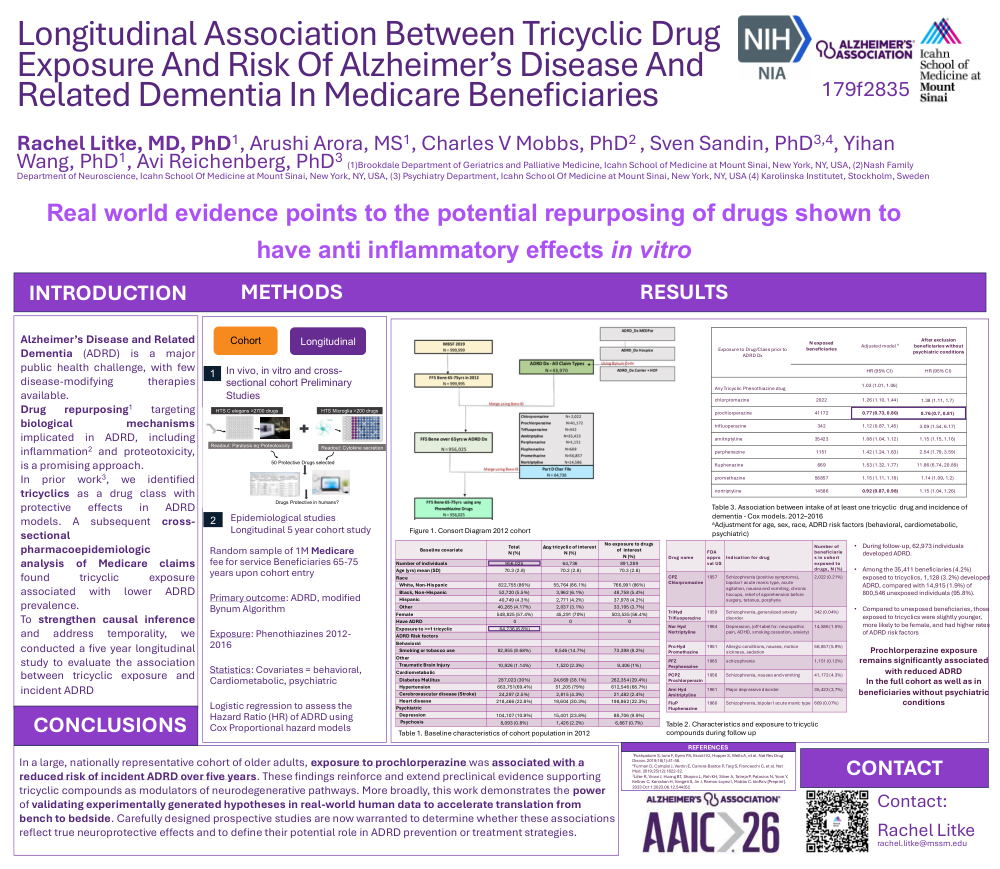
Results: The eligible study sample included 956,057 Medicare fee-for-service beneficiaries aged
65-75 in 2012 (M = 70.3, SD = 2.8). During follow-up, 62,973 individuals developed ADRD.
Among the 35,411 beneficiaries (4.2%) exposed to tricyclics, 1,128 (3.2%) developed ADRD,
compared with 14,915 (1.9%) of 800,546 unexposed individuals (95.8%). Compared to
unexposed beneficiaries, those exposed to tricyclics were slightly younger, more likely to be
female, and had higher rates of ADRD risk factors.
Prochlorperazine exposure remains significantly associated with reduced ADRD In the full cohort as well as in
beneficiaries without psychiatric conditions
Conclusion: In this large longitudinal analysis of Medicare beneficiaries, 4.2% were exposed to
tricyclics. We will evaluate whether phenothiazine exposure is associated with ADRD risk over
five years of follow-up. These findings extend prior cross-sectional results and assess
hypotheses related to ADRD pathophysiology in humans. Despite limitations inherent to claims
data and potential residual confounding, this study provides real-world evidence to inform
whether tricyclics warrant further investigation as repurposed agents for ADRD prevention or
delay
In a large, nationally representative cohort of older adults, exposure to prochlorperazine was associated with a
reduced risk of incident ADRD over five years. These findings reinforce and extend preclinical evidence supporting
tricyclic compounds as modulators of neurodegenerative pathways. More broadly, this work demonstrates the power
of validating experimentally generated hypotheses in real-world human data to accelerate translation from
bench to bedside. Carefully designed prospective studies are now warranted to determine whether these associations
reflect true neuroprotective effects and to define their potential role in ADRD prevention or treatment strategies.
In a large, nationally representative cohort of older adults, exposure to prochlorperazine was associated with a
reduced risk of incident ADRD over five years. These findings reinforce and extend preclinical evidence supporting
tricyclic compounds as modulators of neurodegenerative pathways. More broadly, this work demonstrates the power
of validating experimentally generated hypotheses in real-world human data to accelerate translation from
bench to bedside. Carefully designed prospective studies are now warranted to determine whether these associations
reflect true neuroprotective effects and to define their potential role in ADRD prevention or treatment strategies.
Comments
Email is required but is not shown publicly.
Loading comments...