4,068 posters, 219 videos, 101 topics, 69 sessions, 14,365 authors, 6,128 institutions
ePostersLive by SciGen Technologies S.A. All rights reserved.
Alzheimer's Association International Conference 2026
July 12-15, 2026 | London, United Kingdom, and Online

1044
LLM-powered Automated Metadata Extraction To Accelerate Dementia Cohort Exploration: A COSMIC Use Case
Part of Topic
Background
High-quality, standardised metadata are essential for making dementia cohort data Findable, Accessible, Interoperable and Reusable (FAIR), thereby accelerating discovery and maximising research impact. While major international initiatives curate extensive catalogues of ageing and dementia studies, these efforts rely heavily on manual extraction of study-level information. Current curation processes remain labour-intensive, inconsistently applied across platforms, and difficult to scale. Researchers conducting systematic reviews face similar challenges. There is an increasing need for scalable, reproducible tools that can automatically generate structured metadata from publicly available sources and support interoperability across research infrastructures.
Methods
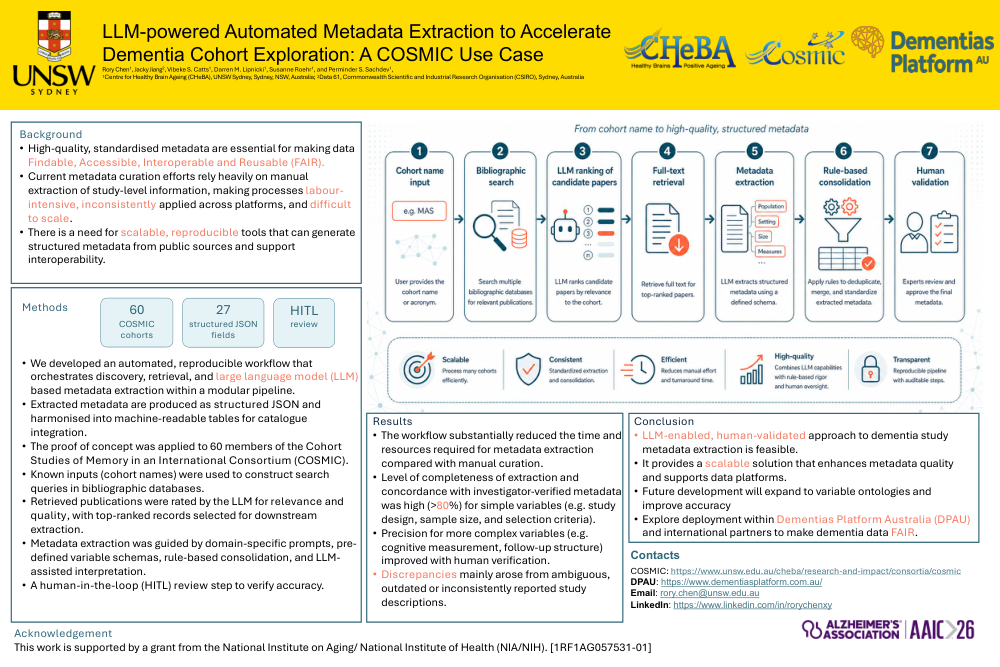
We developed an automated, reproducible workflow that orchestrates literature discovery, document retrieval, and large language model (LLM)–based metadata extraction within a modular pipeline. Extracted metadata are produced as structured JSON and harmonised into machine-readable tables for catalogue integration.
As a proof of concept, the workflow was applied to 60 members of the Cohort Studies of Memory in an International Consortium (COSMIC). For each cohort, known inputs (cohort names) were used to construct search queries in bibliographic databases (e.g., PubMed). Retrieved publications were rated by the LLM for relevance and quality, with top-ranked records selected for downstream extraction. Metadata extraction was guided by domain-specific prompts and pre-defined variable names. Rule-based consolidation, supported by LLM-assisted interpretation, addressed ambiguous or conflicting descriptions across sources. A human-in-the-loop (HITL) review step enabled internal validation and principal investigator review to verify accuracy.
Results
The workflow substantially reduced the time and resources required for metadata extraction compared with manual curation. Across COSMIC studies, the level of completeness of extraction achieved and the concordance with investigator-verified metadata was high (>80%) for simple variables, such as study design, sample size, and selection criteria. Precision for more complex variables such as cognitive measurement and follow‑up structure improved with human verification. Most discrepancies arose from ambiguous, outdated or inconsistently reported study descriptions.
Conclusion
This work demonstrates the feasibility and value of an LLM-enabled, human-validated approach to dementia study metadata extraction. Rather than replicating existing infrastructures, the workflow provides a scalable resource that enhances metadata quality and supports systematic reviewers and data platforms. Future development will expand variable ontologies, improve accuracy, and explore deployment within Dementias Platform Australia (DPAU) and international partners to strengthen global data FAIRness.
Comments
Email is required but is not shown publicly.
Loading comments...