Loading...

4,068 posters, 219 videos, 101 topics, 69 sessions, 14,365 authors, 6,128 institutions

ePostersLive by SciGen Technologies S.A. All rights reserved.

Alzheimer's Association International Conference 2026

July 12-15, 2026 | London, United Kingdom, and Online

Alzheimer's Association International Conference 2026 banner

4345

Long-term Exposure To Ultrafine Particulate Matter From Wildfires And Late-life Cognitive Decline In The Khandle And Star Cohorts
Part of Topic

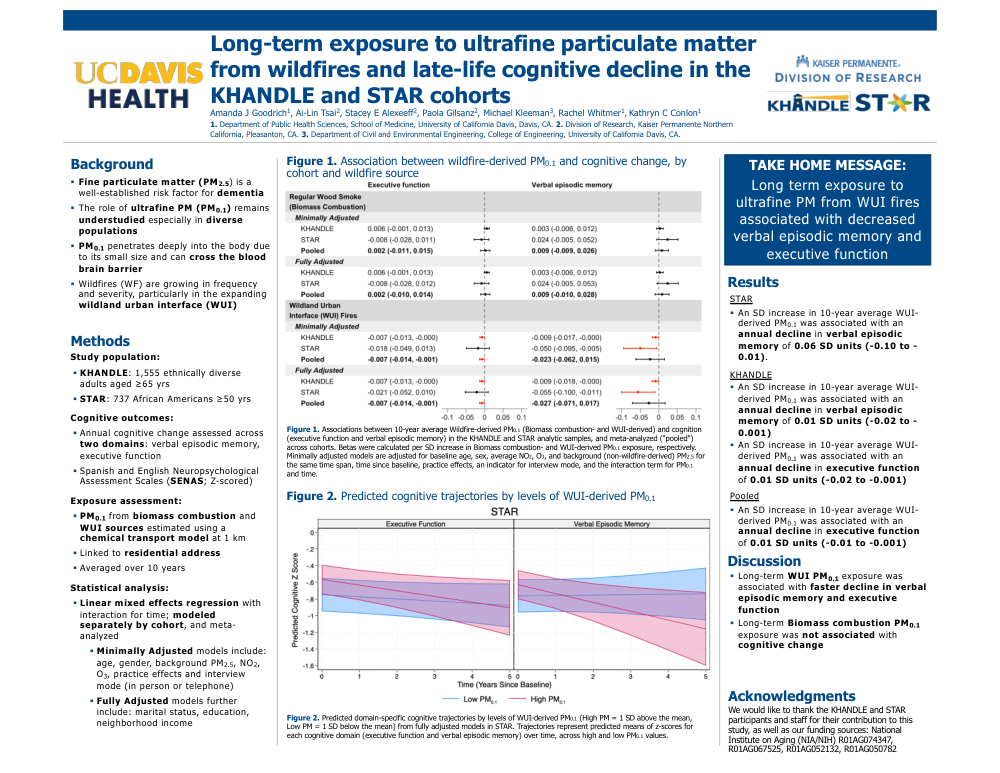
TAKE HOME MESSAGE: Long term exposure to ultrafine PM from WUI fires associated with decreased verbal episodic memory and executive function

Background

- Fine particulate matter (PM2.5) is a well-established risk factor for dementia
- The role of ultrafine PM (PM0.1) remainsunderstudied especially in diverse populations
- PM0.1 penetrates deeply into the body due to its small size and can cross the blood brain barrier 
- Wildfires (WF) are growing in frequency and severity, particularly in the expanding wildland urban interface (WUI)

Methods

Study population:

- KHANDLE: 1,555 ethnically diverse adults aged ≥65 yrs
- STAR: 737 African Americans ≥50 yrs 

Cognitive outcomes:

- Annual cognitive change assessed across two domains: verbal episodic memory, executive function
- Spanish and English Neuropsychological Assessment Scales (SENAS; Z-scored)

Exposure assessment:

- PM0.1 from biomass combustion and WUI sources estimated using a chemical transport model at 1 km
- Linked to residential address
- Averaged over 10 years

Statistical analysis:

- Linear mixed effects regression with interaction for time; modeled separately by cohort, and meta-analyzed 
- Minimally Adjusted models include:age, gender, background PM2.5, NO2, O3, practice effects and interview mode (in person or telephone)
- Fully Adjusted models further include:marital status, education, neighborhood income 

Results

STAR

- An SD increase in 10-year average WUI-derived PM0.1 was associated with an annual decline in verbal episodic memory of 0.06 SD units (-0.10 to -0.01).

KHANDLE

- An SD increase in 10-year average WUI-derived PM0.1 was associated with an annual decline in verbal episodic memory of 0.01 SD units (-0.02 to -0.001)
- An SD increase in 10-year average WUI-derived PM0.1 was associated with an annual decline in executive function of0.01 SD units (-0.02 to -0.001)

Pooled

- An SD increase in 10-year average WUI-derived PM0.1 was associated with an annual decline in executive function of0.01 SD units (-0.01 to -0.001)

Discussion

- Long-term WUI PM0.1 exposure was associated with faster decline in verbal episodic memory and executive function
- Long-term Biomass combustion PM0.1exposure was not associated with cognitive change

Comments

Email is required but is not shown publicly.

Loading comments...

aaic2026 banner
Copyright © 2015-2026, ePostersLive® SciGen is a registered trademark of SciGen Technologies S.A. Patent pending.

This website and third-party tools we use rely on cookies for the best user experience. By selecting "I agree", you agree to cookie usage as described in our Privacy Policy.