4,068 posters, 219 videos, 101 topics, 69 sessions, 14,365 authors, 6,128 institutions
ePostersLive by SciGen Technologies S.A. All rights reserved.
Alzheimer's Association International Conference 2026
July 12-15, 2026 | London, United Kingdom, and Online

720
Incidence And Risk Factors Of Dementia Among 85 Years Old Participants In The National Alzheimer’S Coordinating Center
Poster Presenter
Authors
Part of Topic
Incidence And Risk Factors Of Dementia Among 85 Years Old Participants In The National Alzheimer’S Coordinating Center
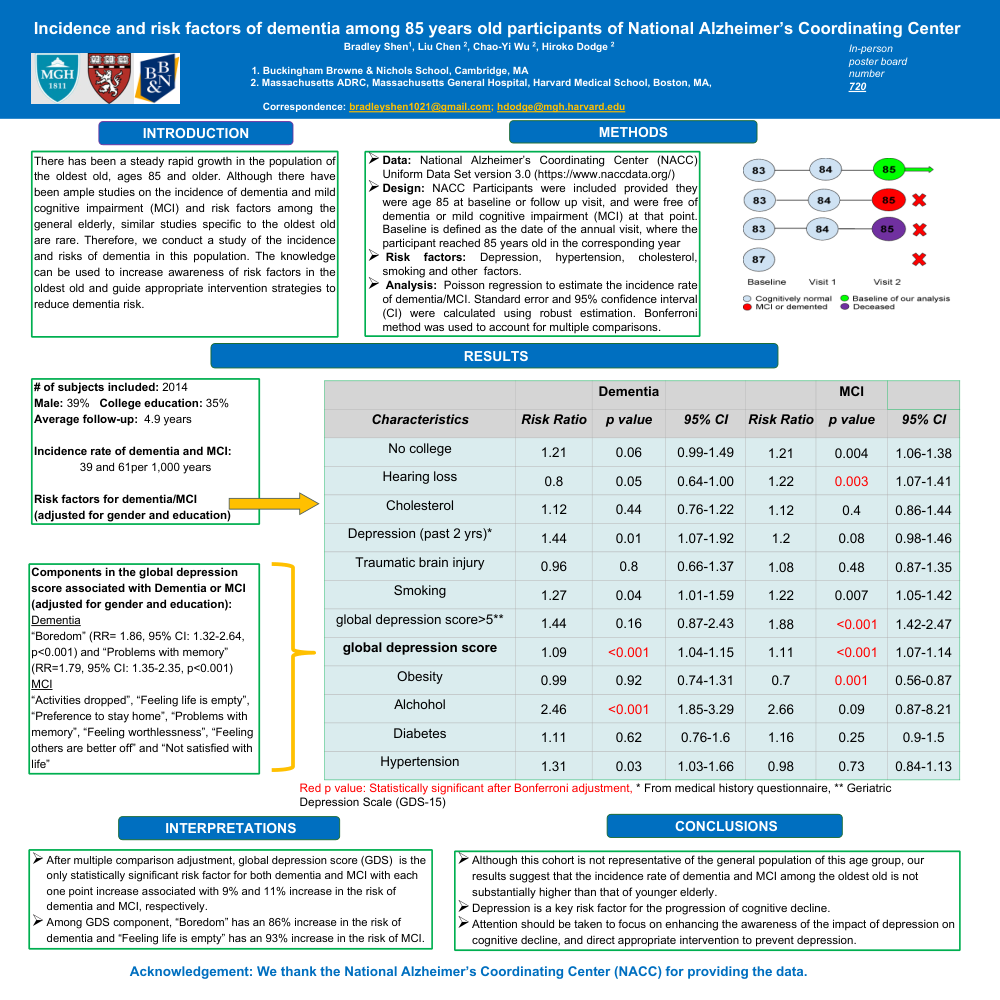
Background: The population of the oldest old—individuals aged 85 and older—is rapidly growing in the United States and other countries. Although many studies have examined dementia incidence and risk factors among older adults more broadly, research focused specifically on the oldest old remains limited. Therefore, we examined the incidence and risk factors for dementia in this population. Knowledge gained from this study may help guide dementia prevention strategies for the oldest old.
Methods: We used the National Alzheimer’s Coordinating Center (NACC) Uniform Data Set (V3). Participants were included if they were 85 years old at baseline or reached 85 during follow-up and were free of dementia or mild cognitive impairment (MCI) at that time. Baseline was defined as the annual visit at which the participant was 85 years old. We examined depression, hypertension, cholesterol, smoking, and other established risk factors. Poisson regression was used to estimate the incidence rate, and standard errors and 95% confidence intervals were calculated using robust estimation. The Bonferroni method was applied to adjust for multiple comparisons.
Results: We identified 2,014 subjects, among whom 38.5% were males and 35.0% did not have a college education. During an average follow-up of 4.9 years, the incidence rates of dementia and MCI are 30 and 61 per 1,000 person-years, respectively. After accounting for multiple comparisons, global depression score (GDS) was the only risk factor for dementia (rate ratio: 1.08 per point, p=0.0024). Hearing loss (rate ratio: 1.23, p = 0.003) and GDS (rate ratio: 1.09 per point, p < 0.001) were risk factors for incident MCI. Obesity (rate ratio: 0.67, p<0.001) is a protective for MCI. A post-hoc analysis of individual component of GDS shows that “boredom” and “not wonderful to be alive” were the strongest predictors of incident dementia.
Conclusion: Depression emerged as a key driver of cognitive decline. These findings highlight the need to increase awareness of the impact of depression on cognitive health and to implement appropriate interventions aimed at preventing depression.
Comments
Email is required but is not shown publicly.
Loading comments...