4,068 posters, 219 videos, 101 topics, 69 sessions, 14,365 authors, 6,128 institutions
ePostersLive by SciGen Technologies S.A. All rights reserved.
Alzheimer's Association International Conference 2026
July 12-15, 2026 | London, United Kingdom, and Online

6874
Association Between Number Of Languages Spoken And Late-life Cognition In Cognitively Unimpaired Older Adults
Poster Presenter
Authors
Anna Laura Toth, Marco Calabria, Gonzalo Sánchez-Benavides, Oriol Grau-Rivera, Miguel Santos-Santos, Laia Subirats, Lidon Marin-Marin
Affiliations
NeuroADAS Lab, Department of Health Sciences, Universitat Oberta de Catalunya, Barcelona, Spain, BarcelonaBeta Research Center, Barcelona, Spain; Hospital del Mar Research Institute, Barcelona, Spain, Sant Pau Memory Unit, Department of Neurology, Hospital de la Santa Creu i Sant Pau, Barcelona, Spain, Department of Developmental, Educational, Social and Methodology Psychology, University Jaume I, Castello de la Plana, Spain
Part of Topic
Background: Lifelong bilingualism has been linked to better late-life cognition. However, it is unclear whether speaking more than two languages provides additional benefits. This study examined whether a higher number of languages spoken is associated with better performance across multiple cognitive domains in a large sample of cognitively unimpaired older adults from Catalonia, Spain.
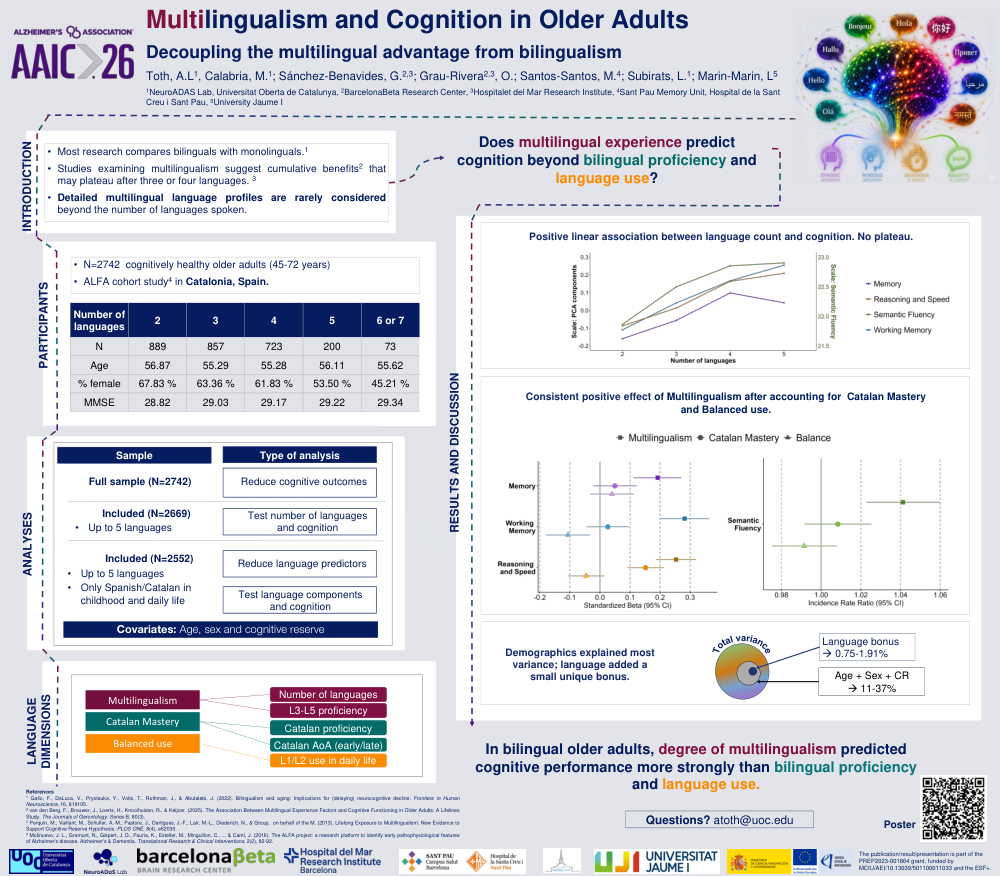
Methods: We studied the cognitive performance of 2665 cognitively unimpaired older adults (mean age=55.8, range 44 to 74 years, 63.72% female) from the ALFA cohort, of whom 888 reported speaking two, 856 three, 722 four, and 199 five languages. The cognitive assessment comprised: Memory Binding Test (MBT immediate, delayed, free, and paired recall), Digit Span (Forward, Backward, Sequence), WAIS-IV Coding, Visual Puzzle and Matrix Reasoning and Semantic fluency task. Principal component analysis identified four cognitive dimensions: Memory (all MBT subtests), Working memory (all Digit Span subtests), Processing speed/reasoning (all WAIS subtests), and Semantic fluency. Associations between the number of languages spoken and each cognitive dimension were examined using regression models, adjusting for age, sex, and cognitive reserve index.
Results: First, we found that across all four cognitive domains, there was a positive linear association between number of languages and performance. There was no evidence for a non-linear (quadratic or cubic) relationship. Second, group comparisons showed small-to-moderate standardized differences between language groups (Cohen’s d = 0.16-0.39), with a predominant tendency for speakers of four or five languages to outperform those speaking two or three languages, particularly on measures of memory, working memory, and processing speed/reasoning.
Conclusion: Our results suggest that speaking more than two languages is associated with incremental, domain-specific cognitive advantages in cognitively unimpaired older adults, rather than influencing a single general cognitive ability. These findings can help to clarify how and when multilingual cognitive advantages emerge and support policies promoting multilingualism as a contributor to cognitive reserve. Future research should test whether these dose-dependent effects of multilingualism extend to neuroimaging measures of brain structure and function as well.
Additional analyses: We performed further analyses after the submission of the abstract, which are also included on the poster.
We used principle component analysis to extract three language dimensions based on the variables measured:
1. Multilingualism, reflecting participants’ number of languages spoken and proficiency in their third to fifth language
2. Catalan mastery, aggregating Catalan AoA and proficiency
3. Balanced use, describing the proportion of Catalan and Spanish use across different contexts, with higher scores reflecting a more balanced usage pattern.
Then, we examined the association between these language components and cognitive performance. Multilingualism had a small but consistent positive association with all outcomes. Catalan mastery showed a positive relationship with Reasoning and Speed. Balanced use showed, somewhat surprisingly, a small negative association with Working memory, with more dominant use being associated with better performance. Overall we can say that multilingualism was a stronger and more consistent predictor of cognitive outcomes than the bilingualism components.
However, it is also important to contextualize the effects in relation to the effects of demographic variables, which were included as covariates in all analyses. While age, sex, and CR together explained between 11-37% of the variance in our data depending on the outcome, the language variables only contributed about 1%, going as high as 1.91% in the case of Working memory.
Take-home message: Our study showed that among older bilinguals, acquiring additional languages seems to be a stronger predictor of cognitive performance than perfecting the first two. This effect was consistent across outcomes but small and should be interpreted as only one piece of a larger cognitive profile shaped by linguistic as well as demographic factors.
Comments
Email is required but is not shown publicly.
Loading comments...