4,068 posters, 219 videos, 101 topics, 69 sessions, 14,365 authors, 6,128 institutions
ePostersLive by SciGen Technologies S.A. All rights reserved.
Alzheimer's Association International Conference 2026
July 12-15, 2026 | London, United Kingdom, and Online

1464
Segregation Of Functional Networks Confers Cognitive Reserve Against Amyloid-associated Cognitive Decline
Poster Presenter
Authors
Affiliations
Part of Topic
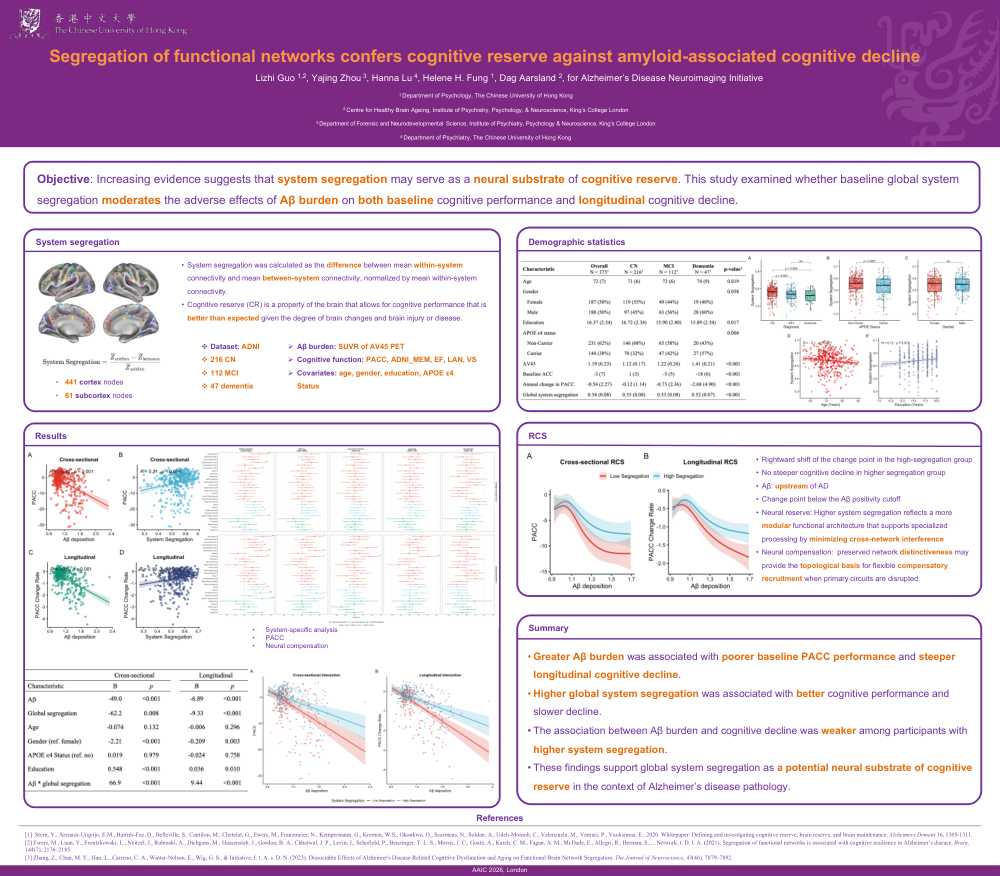
Background: functional network segregation, defined as the normalized difference between mean within-system connectivity and mean between-system connectivity, has been proposed as a potential neural substrate of cognitive reserve (CR). But its moderating role on the relationship between amyloid-β (Aβ) pathology and cognition remains unknown.
Methods: We analyzed 375 participants from the Alzheimer’s Disease Neuroimaging Initiative (ADNI). Global segregation was computed from resting-state fMRI using a 502-node parcellation. Aβ burden was measured by [¹⁸F]-florbetapir positron emission tomography (PET) composite standardized uptake value ratio (SUVR). Cognition was assessed by modified Preclinical Alzheimer Cognitive Composite (PACC). Multiple regression tested whether system segregation moderated the cross-sectional and longitudinal associations between Aβ burden and cognition, adjusting for age, sex, education, and apolipoprotein E (APOE) ε4 status. Restricted cubic spline (RCS) analyses were used to find potential nonlinear patterns in the moderation.
Results: Higher global system segregation was associated with better baseline cognition and slower subsequent cognitive decline (all p<0.001). System segregation significantly attenuated the adverse association between Aβ burden and PACC both cross-sectionally (B=66.9, p<0.001) and longitudinally (B=9.44, p<0.001). RCS analyses revealed a rightward shift of the change point in the high-segregation group, without evidence of steeper decline beyond this point.
Conclusions: These findings suggest that network segregation may confer resilience to amyloid pathology and highlight the need for longitudinal studies to guide early intervention and identify the protective window of CR.
Comments
Email is required but is not shown publicly.
Loading comments...