4,068 posters, 219 videos, 101 topics, 69 sessions, 14,365 authors, 6,128 institutions
ePostersLive by SciGen Technologies S.A. All rights reserved.
Alzheimer's Association International Conference 2026
July 12-15, 2026 | London, United Kingdom, and Online

5029
Sex Differences In Cognitive Reserve Proxies Among Stable And Worsening Participants In Preclinical And Prodromal Stages Of Dementia
Poster Presenter
Authors
Lucía Pérez-Blanco, Ingri Sandoval-García, Eduardo Picón, Lucía Peréz-Blanco, María Campos-Magdaleno, David Facal, Cristina Lojo-Seoane, Arturo X. Pereiro Rozas
Affiliations
1Applied Cognitive Neuroscience and Psychogerontology group, Health Research Institute of Santiago (IDIS), Spain 2Instituto de Psicoloxía (IPsiUS), Universidade de Santiago de Compostela, Spain, 3Methodology of Behavioral Sciences, Faculty of Psychology, Santiago de Compostela, Spain, 1Applied Cognitive Neuroscience and Psychogerontology group, Health Research Institute of Santiago (IDIS), Spain
Part of Topic
Sex Differences in Cognitive Reserve Proxies Among Stable and Worsening Participants in Preclinical and Prodromal Stages of Dementia
Sonali Arora¹,², Ingri Sandoval-García¹,², Eduardo Picón³, Lucía Perez-Blanco¹, María Campos-Magdaleno¹,², David Facal¹,², Cristina Lojo-Seoane¹,², Arturo X. Pereiro Rozas¹,²*
¹ Applied Cognitive Neuroscience and Psychogerontology Group, Health Research Institute of Santiago (IDIS), Spain
² Instituto de Psicoloxía (IPsiUS), Universidade de Santiago de Compostela, Spain
³ Methodology of Behavioral Sciences, Faculty of Psychology, Universidade de Santiago de Compostela, Spain
Contact: sonali.arora1@usc.es
Alzheimer’s Association International Conference | July 12–15, 2026 | London, UK
BACKGROUND
Cognitive Reserve (CR) reflects resilience against age-related cognitive decline, but sex differences in CR remain unclear (Arenaza et al., 2024).
Women may show lower traditional CR than men due to historical inequalities in education and occupation, yet may also exhibit advantages in cognitive efficiency and resilience (Emrani et al., 2025; Giacomucci et al., 2022).
AIM
Do sex differences in CR proxies differ between stable and worsening participants in preclinical (CU/SCD) and prodromal (MCI) dementia stages?
METHODS
CompAS Cohort
n = 240 participants aged ≥ 50 years
Women: 71.25%
Baseline diagnosis: CU/SCD/MCI
Follow-up assessments:
18–24 months and 48–70 months
Groups:
Stable: n = 176
Worsening: n = 64
Stable group:
Women: n = 128
Men: n = 48
Worsening group:
Women: n = 43
Men: n = 21
Participants with cognitive improvement were excluded.
Stable group: no change/minimal progression from CU to SCD.
Worsening group: progression from CU/SCD to MCI/dementia, or from MCI to multidomain MCI/dementia.
CR proxies, including school, work, and leisure, were assessed using the Cognitive Reserve Index Questionnaire (CRIq; Nucci et al., 2012).
A multivariate GLM was conducted with CRIq scores as dependent variables, and sex and group as between-subject factors.
RESULTS
Sample Descriptives
Age, M(SD):
Women Stable: 64.45 (8.46)
Men Stable: 66.94 (9.50)
Women Worsening: 68.53 (8.46)
Men Worsening: 71.52 (8.78)
CRIq Domains, M(SD):
CRIq-School
Women Stable: 107.19 (18.63)
Men Stable: 109.52 (18.47)
Women Worsening: 102.07 (17.97)
Men Worsening: 98.14 (13.76)
CRIq-Work
Women Stable: 97.80 (19.18)
Men Stable: 108.54 (16.76)
Women Worsening: 92.65 (16.69)
Men Worsening: 103.19 (20.68)
CRIq-Leisure
Women Stable: 109.73 (20.85)
Men Stable: 110.90 (20.99)
Women Worsening: 102.65 (19.55)
Men Worsening: 101.81 (18.91)
CRIq-Total
Women Stable: 106.51 (20.78)
Men Stable: 112.73 (20.01)
Women Worsening: 98.77 (18.28)
Men Worsening: 101.81 (18.29)
MAIN FINDINGS
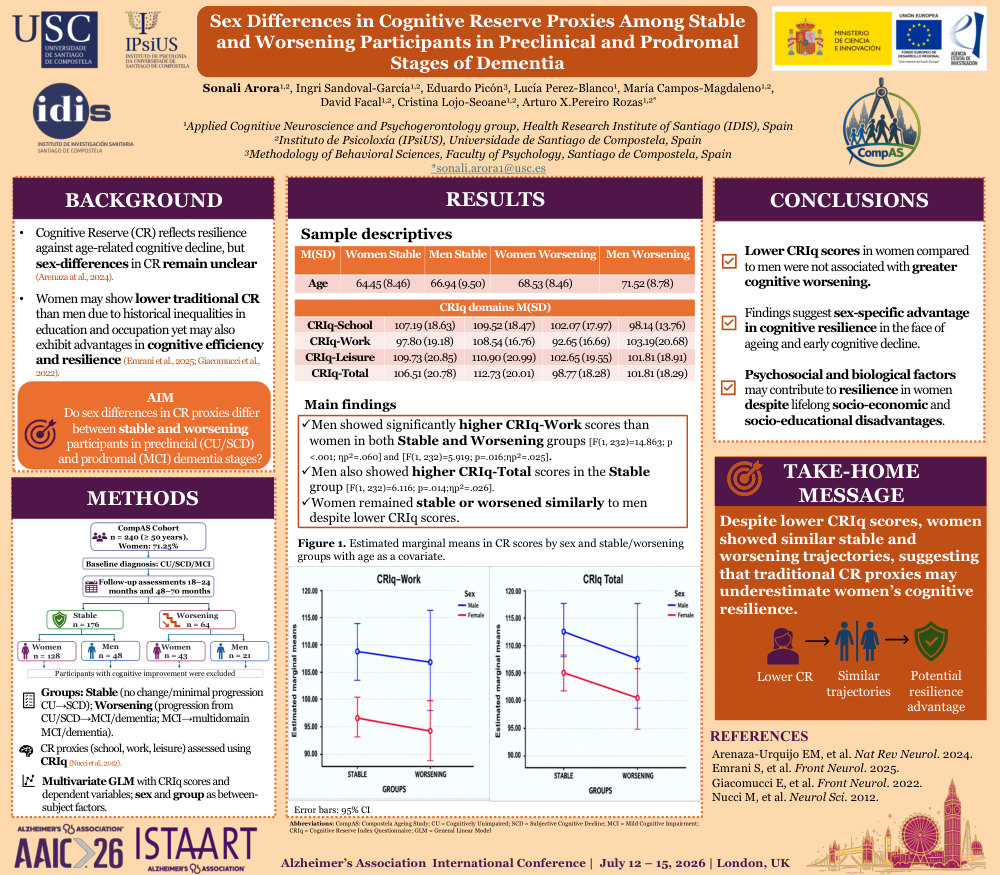
Men showed significantly higher CRIq-Work scores than women in both the Stable and Worsening groups:
Stable group: F(1, 232) = 14.863; p < .001; ηp² = .060
Worsening group: F(1, 232) = 5.919; p = .016; ηp² = .025
Men also showed higher CRIq-Total scores in the Stable group:
F(1, 232) = 6.116; p = .014; ηp² = .026
Women remained stable or worsened similarly to men despite lower CRIq scores.
FIGURE 1
Estimated marginal means in CR scores by sex and stable/worsening groups with age as a covariate.
Error bars: 95% CI.
CONCLUSIONS
Lower CRIq scores in women compared to men were not associated with greater cognitive worsening.
Findings suggest a sex-specific advantage in cognitive resilience in the face of ageing and early cognitive decline.
Psychosocial and biological factors may contribute to resilience in women despite lifelong socio-economic and socio-educational disadvantages.
TAKE-HOME MESSAGE
Despite lower CRIq scores, women showed similar stable and worsening trajectories, suggesting that traditional CR proxies may underestimate women’s cognitive resilience.
Main findings:
Lower CR
Similar trajectories
Potential resilience advantage
ABBREVIATIONS
CompAS = Compostela Ageing Study
CU = Cognitively Unimpaired
SCD = Subjective Cognitive Decline
MCI = Mild Cognitive Impairment
CRIq = Cognitive Reserve Index Questionnaire
GLM = General Linear Model
REFERENCES
Arenaza-Urquijo EM, et al. Nature Reviews Neurology. 2024.
Emrani S, et al. Frontiers in Neurology. 2025.
Giacomucci E, et al. Frontiers in Neurology. 2022.
Nucci M, et al. Neurological Sciences. 2012.
Comments
Email is required but is not shown publicly.
Loading comments...