4,068 posters, 219 videos, 101 topics, 69 sessions, 14,365 authors, 6,128 institutions
ePostersLive by SciGen Technologies S.A. All rights reserved.
Alzheimer's Association International Conference 2026
July 12-15, 2026 | London, United Kingdom, and Online

9352
Mediation Of Age-related Cognitive Outcomes By Stroke And Vascular Risk Factors In The Canadian Longitudinal Study On Aging (clsa)
Poster Presenter
Authors
Part of Topic
Mediation of Age-related Cognitive Outcomes by Stroke and Vascular Risk Factors in the Canadian Longitudinal Study on Aging (CLSA)
Anjana J. Menon, Bogna A. Drozdowska, Ryan T. Muir, Michael D. Hill, Philip A. Barber, Eric E. Smith, and Aravind Ganesh
Introduction
Cognition changes with age. Stroke and vascular risk factors can affect brain aging, and many vascular risk factors are modifiable. The objective of this study was to examine whether stroke and vascular risk factors mediate the association between chronological age and cognitive outcomes.
Methods
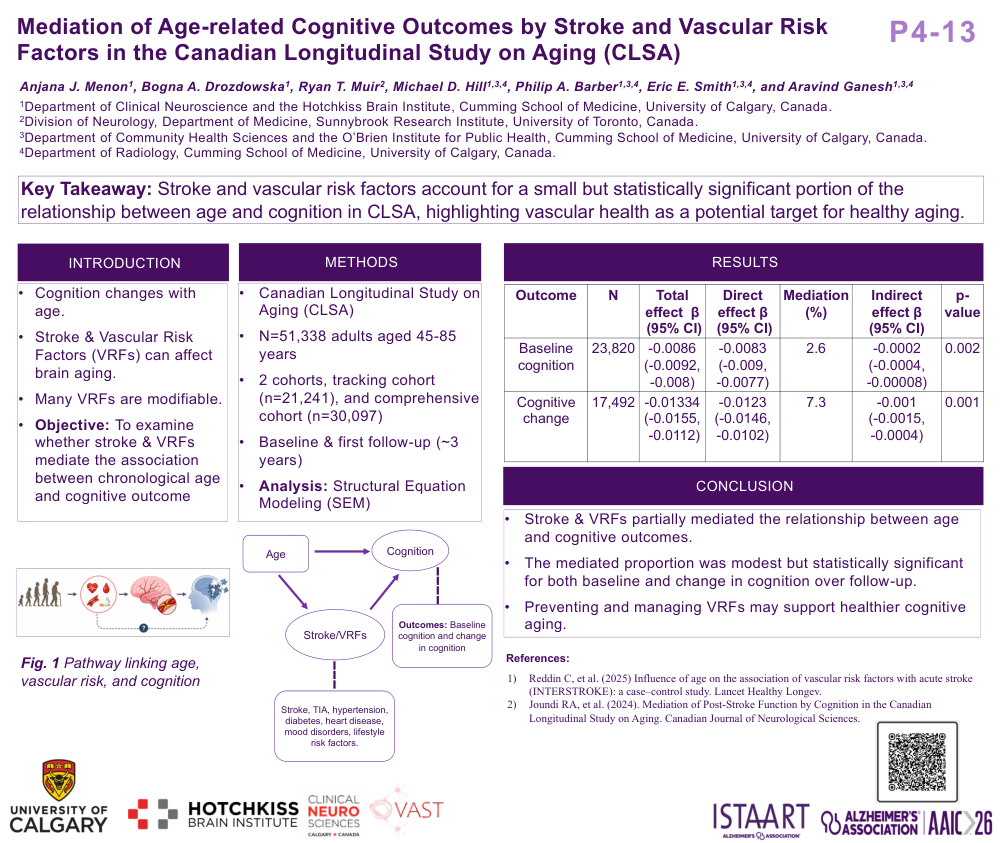
We used data from the Canadian Longitudinal Study on Aging (CLSA), including 51,338 adults aged 45 to 85 years. The study included two cohorts: the tracking cohort (n = 21,241) and the comprehensive cohort (n = 30,097). Baseline and first follow-up data, approximately three years apart, were analyzed using structural equation modeling. Stroke and vascular risk factors included stroke, TIA, hypertension, diabetes, heart disease, mood disorders, and lifestyle risk factors. Outcomes included baseline cognition and change in cognition.
Results
Stroke and vascular risk factors partially mediated the relationship between age and cognitive outcomes. For baseline cognition, the total effect beta was -0.0086, the direct effect beta was -0.0083, and the indirect effect beta was -0.0002, corresponding to 2.6% mediation. For cognitive change, the total effect beta was -0.01334, the direct effect beta was -0.0123, and the indirect effect beta was -0.001, corresponding to 7.3% mediation.
Conclusion
Stroke and vascular risk factors partially mediated the relationship between age and cognitive outcomes. The mediated proportion was modest but statistically significant for both baseline cognition and change in cognition over follow-up. Preventing and managing vascular risk factors may support healthier cognitive aging.
Key Takeaway
Stroke and vascular risk factors account for a small but statistically significant portion of the relationship between age and cognition in CLSA, highlighting vascular health as a potential target for healthy aging.
Comments
Email is required but is not shown publicly.
Loading comments...