4,068 posters, 219 videos, 101 topics, 69 sessions, 14,365 authors, 6,128 institutions
ePostersLive by SciGen Technologies S.A. All rights reserved.
Alzheimer's Association International Conference 2026
July 12-15, 2026 | London, United Kingdom, and Online

6185
Nacc Data: Who Is Represented Over Time And Across Centers, And Implications For Generalizability
Part of Topic
Chan KCG, Xia F, Kukull WA. (2025) NACC data: Who is represented over time and across centers, and implications for generalizability. Alzheimer’s & Dementia; 21(9):e70657. https://doi.org/10.1002/alz.70657
INTRODUCTION
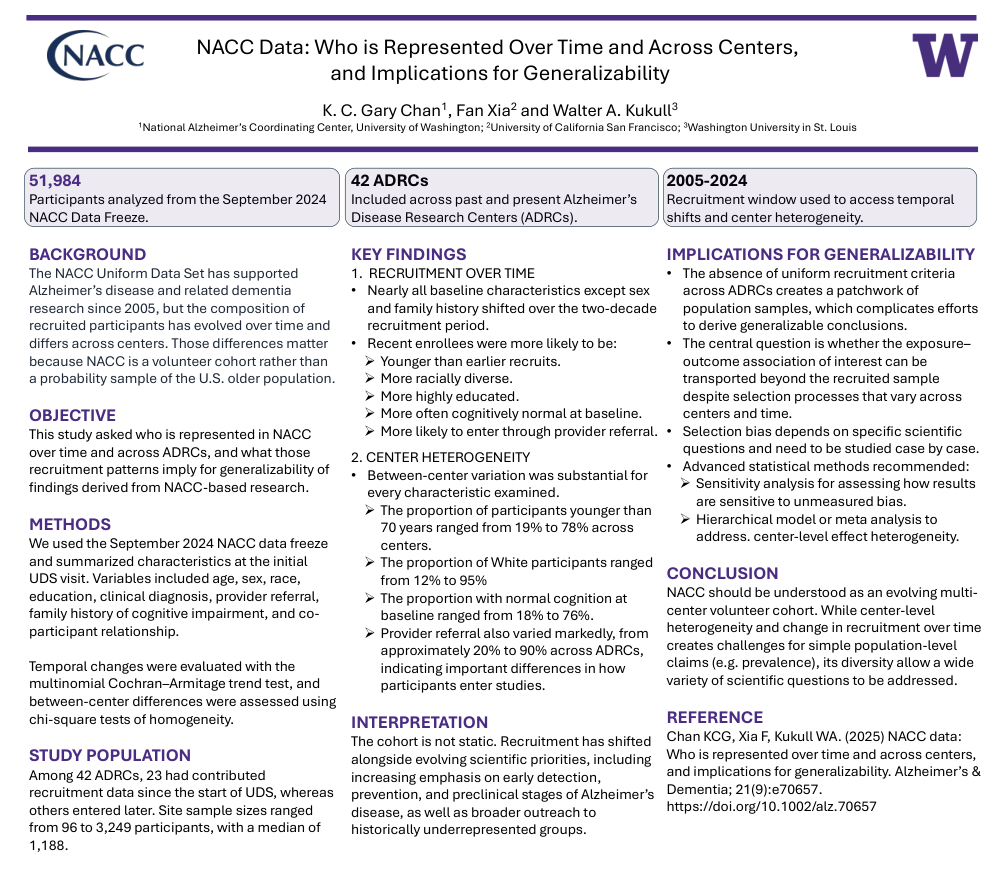
Since 2005, the Alzheimer's Disease Research Centers (ADRCs) have recruited participants into the Uniform Data Set (UDS), but enrollment trends and center-level differences remain underexplored. This study investigates temporal patterns and heterogeneity in recruitment across ADRCs, with implications for generalizability.
METHODS
Using data from the National Alzheimer's Coordinating Center (NACC), we assessed trends and between-center variation in baseline characteristics, including age, sex, race, education, clinical diagnosis, referral source, family history, and co-participant relationship.
RESULTS
All characteristics except sex and family history showed directional shifts over time. Substantial between-center heterogeneity was observed in all variables examined.
DISCUSSION
Temporal changes and site-level variability in participant profiles highlight challenges and opportunities for generalizing findings from UDS data. Although not nationally representative, statements about generalization could often be made using UDS data, with strengthened inferences and enhanced transparency through analytic approaches such as sensitivity analysis or meta-analytic techniques treating centers as separate studies.
Highlights
- The National Alzheimer's Coordinating Center (NACC) Uniform Data Set has enrolled participants for 20 years across more than 40 centers.
- We identified temporal trends and site-level variation in participant characteristics in the initial visit.
- Despite being a volunteer sample, modern epidemiologic and biostatistical approaches can help assess and enhance the generalizability of scientific findings derived from NACC data.
Comments
Email is required but is not shown publicly.
Loading comments...