4,068 posters, 219 videos, 101 topics, 69 sessions, 14,365 authors, 6,128 institutions
ePostersLive by SciGen Technologies S.A. All rights reserved.
Alzheimer's Association International Conference 2026
July 12-15, 2026 | London, United Kingdom, and Online

3306
Pregnancy And Breastfeeding Are Associated With Less Later-life Cognitive Decline In A Longitudinal, Prospective Cohort
Poster Presenter
Authors
Molly Fox, Jennifer Bramen, Dayoon Kwon, Mark Espeland, Yijia Sun, Li Zhang, Aladdin Shadyab, Ramon Casanova, JoAnn Manson, Marcus Chang, Verna Porter, Leslie Farland, Qian Xiao, Robert Wild, Prabha Siddarth, Carolyn Crandall
Affiliations
Department of Anthropology, University of California, Los Angeles, Los Angeles, CA 90095, USA, Pacific Neuroscience Institute and Foundation, Providence Saint John's Health Center, Santa Monica, CA, 90404, USA, Department of Epidemiology, University of California, Los Angeles, Los Angeles, CA 90095, Department of Internal Medicine, Wake Forest University School of Medicine, One Medical Center Drive, Winston-Salem, North Carolina 27159, USA, Department of Biostatistics, UCLA Fielding School of Public Health, University of California, Los Angeles, Los Angeles, CA, 90095, USA, Herbert Wertheim School of Public Health and Human Longevity Science, Department of Medicine, University of California San Diego, La Jolla, CA, 92093, USA, Department of Biostatistics and Data Science, Wake Forest University School of Medicine, Winston Salem, Wake Forest University School of Medicine, Winston Salem, NC, 27157, USA, Department of Medicine, Brigham and Women’s Hospital, Harvard Medical School, Boston, MA, 02115, USA, Department of Epidemiology and Biostatistics, Mel and Enid Zuckerman College of Public Health, University of Arizona, Tucson, AZ 85724 USA, Department of Epidemiology, School of Public Health, University of Texas Health Science Center at Houston, Houston, TX 77030, USA, Department of Obstetrics and Gynecology, University of Oklahoma College of Medicine, 800 SL Young Blvd, Oklahoma City, OK 73104, USA, Department of Psychiatry & Biobehavioral Sciences, Semel Institute for Neuroscience and Human Behavior, University of California, Los Angeles, Los Angeles, CA 90095, USA, Division of General Internal Medicine and Health Services Research, David Geffen School of Medicine at University of California, Los Angeles, 1100 Glendon Ave. Suite 850 - Room 858 Los Angeles, CA 90024, USA
Part of Topic
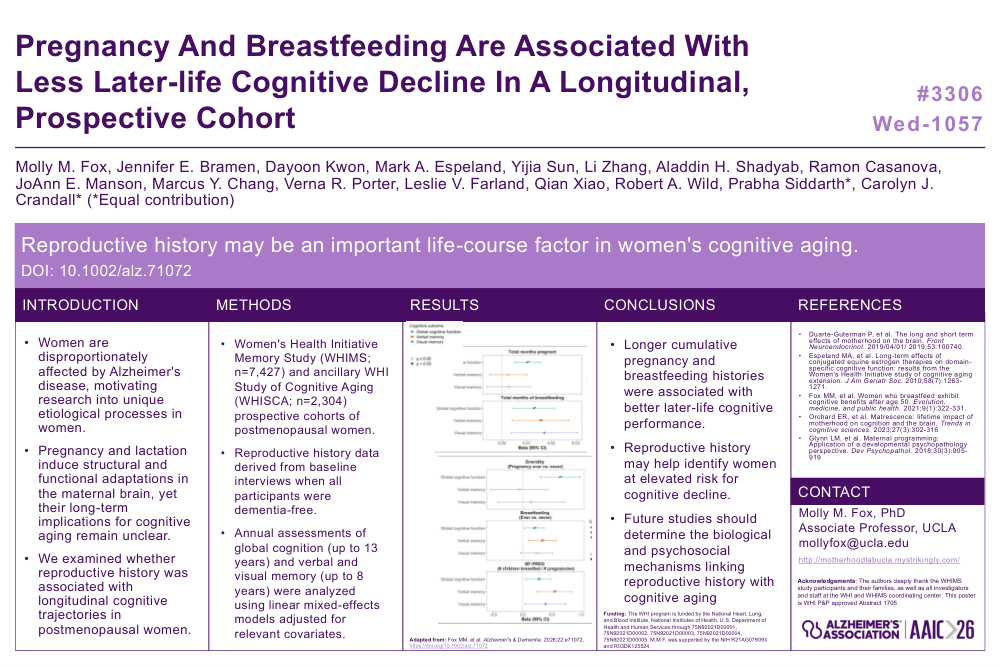
Pregnancy And Breastfeeding Are Associated With Less Later-life Cognitive Decline In A Longitudinal, Prospective Cohort. Molly M. Fox, Jennifer E. Bramen, Dayoon Kwon, Mark A. Espeland, Yijia Sun, Li Zhang, Aladdin H. Shadyab, Ramon Casanova, JoAnn E. Manson, Marcus Y. Chang, Verna R. Porter, Leslie V. Farland, Qian Xiao, Robert A. Wild, Prabha Siddarth*, Carolyn J. Crandall* (*Equal contribution). Reproductive history may be an important life-course factor in women's cognitive aging.
DOI: 10.1002/alz.71072
INTRODUCTION
Women are disproportionately affected by Alzheimer's disease, motivating research into unique etiological processes in women.
Pregnancy and lactation induce structural and functional adaptations in the maternal brain, yet their long-term implications for cognitive aging remain unclear.
We examined whether reproductive history was associated with longitudinal cognitive trajectories in postmenopausal women.
METHODS
Women's Health Initiative Memory Study (WHIMS; n=7,427) and ancillary WHI Study of Cognitive Aging (WHISCA; n=2,304) prospective cohorts of postmenopausal women.
Reproductive history data derived from baseline interviews when all participants were dementia-free.
Annual assessments of global cognition (up to 13 years) and verbal and visual memory (up to 8 years) were analyzed using linear mixed-effects models adjusted for relevant covariates.
RESULTS
<figures>
CONCLUSIONS
Longer cumulative pregnancy and breastfeeding histories were associated with better later-life cognitive performance.
Reproductive history may help identify women at elevated risk for cognitive decline.
Future studies should determine the biological and psychosocial mechanisms linking reproductive history with cognitive aging
REFERENCES
Duarte-Guterman P, et al. The long and short term effects of motherhood on the brain. Front Neuroendocrinol. 2019/04/01/ 2019;53:100740.
Espeland MA, et al. Long-term effects of conjugated equine estrogen therapies on domain-specific cognitive function: results from the Women's Health Initiative study of cognitive aging extension. J Am Geriatr Soc. 2010;58(7):1263-1271.
Fox MM, et al. Women who breastfeed exhibit cognitive benefits after age 50. Evolution, medicine, and public health. 2021;9(1):322-331.
Orchard ER, et al. Matrescence: lifetime impact of motherhood on cognition and the brain. Trends in cognitive sciences. 2023;27(3):302-316
Glynn LM, et al. Maternal programming: Application of a developmental psychopathology perspective. Dev Psychopathol. 2018;30(3):905-919
Funding: The WHI program is funded by the National Heart, Lung, and Blood Institute, National Institutes of Health, U.S. Department of Health and Human Services through 75N92021D00001, 75N92021D00002, 75N92021D00003, 75N92021D00004, 75N92021D00005. M.M.F. was supported by the NIH R21AG079093 and R03DK125524.
Acknowledgements: The authors deeply thank the WHIMS study participants and their families, as well as all investigators and staff at the WHI and WHIMS coordinating center. This poster is WHI P&P approved Abstract 1705
CONTACT
Molly M. Fox, PhD
Associate Professor, UCLA
mollyfox@ucla.edu
http://motherhoodlabucla.mystrikingly.com/
Comments
Email is required but is not shown publicly.
Loading comments...