4,068 posters, 219 videos, 101 topics, 69 sessions, 14,365 authors, 6,128 institutions
ePostersLive by SciGen Technologies S.A. All rights reserved.
Alzheimer's Association International Conference 2026
July 12-15, 2026 | London, United Kingdom, and Online

6289
Intensive Systolic Blood Pressure Control Reduces Cerebral Small Vessel Disease Burden: Randomized MRI Evidence From SPRINT
Poster Presenter
Authors
Sokratis Charisis, Nicholas M. Pajewski, Larry R. Price, Ngoc Huynh Ho, Tanweer Rashid, David Wang, Yuheng Zeng, Niyas Shamsudeen Kutty, R. Nick Bryan, Bradford C. Dickerson, Sudha Seshadri, Ilya Nasrallah, Lenore Launer, Christos Davatzikos, Jeff D. Williamson, Mohamad Habes
Affiliations
Harvard Medical School, University of Texas Health Science Center San Antonio, San Antonio, Texas, Wake Forest University School of Medicine, Winston-Salem, North Carolina, University of Pennsylvania, Philadelphia, Pennsylvania, National Institute on Aging, Bethesda, Maryland
Part of Topic
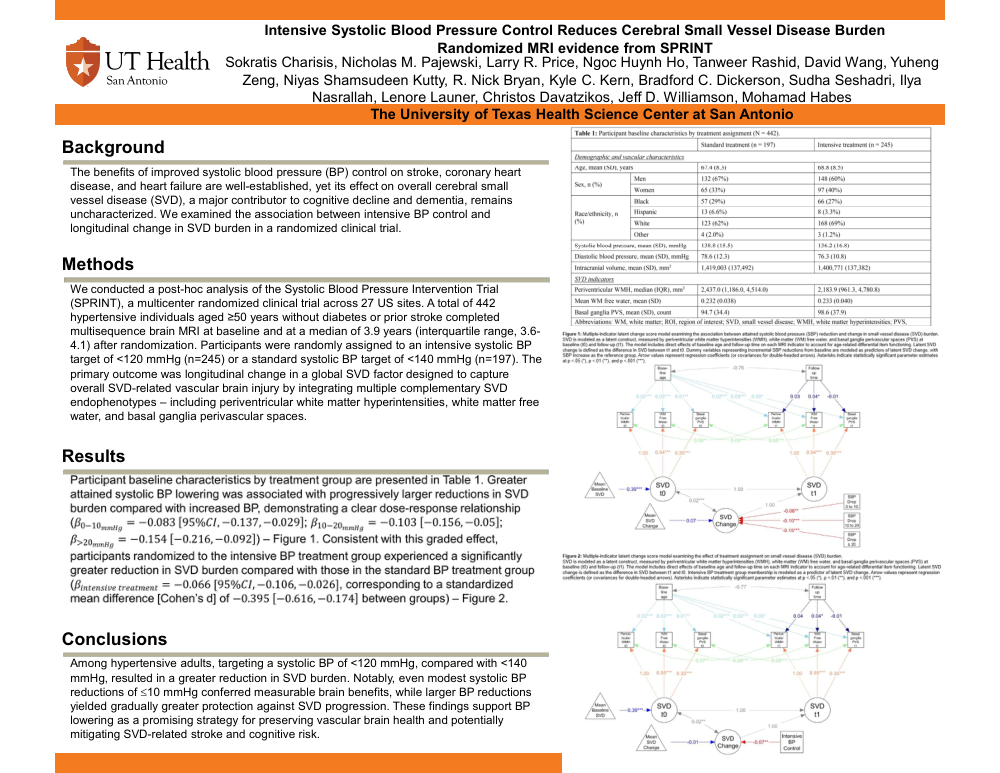
Background: The benefits of improved systolic blood pressure (BP) control on stroke, coronary heart disease, and heart failure are well-established, yet its effect on overall cerebral small vessel disease (SVD), a major contributor to cognitive decline and dementia, remains uncharacterized. We examined the association between intensive BP control and longitudinal change in SVD burden in a randomized clinical trial.
Methods: We conducted a post-hoc analysis of the Systolic Blood Pressure Intervention Trial (SPRINT), a multicenter randomized clinical trial across 27 US sites. A total of 442 hypertensive individuals aged ≥50 years without diabetes or prior stroke completed multisequence brain MRI at baseline and at a median of 3.9 years (interquartile range, 3.6-4.1) after randomization. Participants were randomly assigned to an intensive systolic BP target of <120 mmHg (n=245) or a standard systolic BP target of <140 mmHg (n=197). The primary outcome was longitudinal change in a global SVD factor designed to capture overall SVD-related vascular brain injury by integrating multiple complementary SVD endophenotypes – including periventricular white matter hyperintensities, white matter free water, and basal ganglia perivascular spaces.
Results: Participant baseline characteristics by treatment group are presented in Table 1. Greater attained systolic BP lowering was associated with progressively larger reductions in SVD burden compared with increased BP, demonstrating a clear dose-response relationship (β_{0-10mmHg} = -0.083 [95%CI, -0.137, -0.029]; β_{10-20mmHg} = -0.103 [-0.156, -0.05]; β_{>20mmHg} = -0.154 [-0.216,-0.092]) – Figure 1. Consistent with this graded effect, participants randomized to the intensive BP treatment group experienced a significantly greater reduction in SVD burden compared with those in the standard BP treatment group (β_{intensive treatment} = -0.066 [95%CI,-0.106,-0.026], corresponding to a standardized mean difference [Cohen’s d] of -0.395 [-0.616, -0.174] between groups) – Figure 2.
Conclusions: Among hypertensive adults, targeting a systolic BP of <120 mmHg, compared with <140 mmHg, resulted in a greater reduction in SVD burden. Notably, even modest systolic BP reductions of ≤10 mmHg conferred measurable brain benefits, while larger BP reductions yielded gradually greater protection against SVD progression. These findings support BP lowering as a promising strategy for preserving vascular brain health and potentially mitigating SVD-related stroke and cognitive risk.
Comments
Email is required but is not shown publicly.
Loading comments...