4,068 posters, 219 videos, 101 topics, 69 sessions, 14,365 authors, 6,128 institutions
ePostersLive by SciGen Technologies S.A. All rights reserved.
Alzheimer's Association International Conference 2026
July 12-15, 2026 | London, United Kingdom, and Online

9475
Moving Beyond The Prevalent Exposure Design For Causal Inference In Dementia Research
Poster Presenter
Authors
Lachlan Cribb, Margarita Moreno-Betancur, Zimu Wu, Rory Wolfe, Matthew Pase, Joanne Ryan
Affiliations
null,
Part of Topic
Moving beyond prevalent exposure designs for causal inference in dementia research.
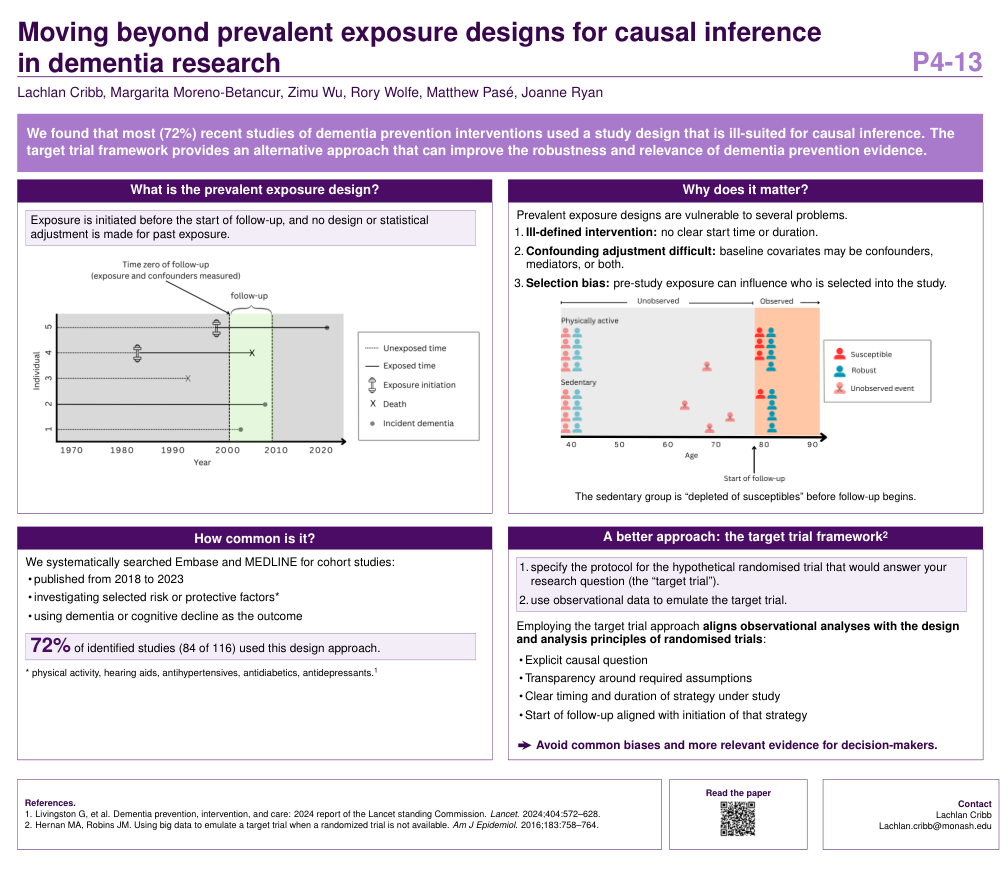
We found that most (72\%) recent studies of dementia prevention interventions used a study design that is ill-suited for causal inference. The target trial framework provides an alternative approach that can improve the robustness and relevance of dementia prevention evidence.
What is the prevalent exposure design?
Exposure is initiated before the start of follow-up, and no design or statistical adjustment is made for past exposure.
How common is it?
We systematically searched Embase and MEDLINE for cohort studies:
published from 2018 to 2023
investigating selected risk or protective factors (physical activity, hearing aids, antihypertensives, antidiabetics, antidepressants)
using dementia or cognitive decline as the outcome
72% of identified studies (84 of 116) used this design approach.
Why does it matter?
Prevalent exposure designs are vulnerable to several problems.
Ill-defined intervention: no clear start time or duration.
Confounding adjustment difficult: baseline covariates may be confounders, mediators, or both.
Selection bias: pre-study exposure can influence who is selected into the study.
The sedentary group is ``depleted of susceptibles'' before follow-up begins.
A better approach: the target trial framework
specify the protocol for the hypothetical randomised trial that would answer your research question (the ``target trial'').
use observational data to emulate the target trial.
Employing the target trial approach aligns observational analyses with the design and analysis principles of randomised trials:
Explicit causal question
Transparency around required assumptions
Clear timing and duration of strategy under study
Start of follow-up aligned with initiation of that strategy
Avoid common biases and more relevant evidence for decision-makers.
Comments
Email is required but is not shown publicly.
Loading comments...