4,068 posters, 219 videos, 101 topics, 69 sessions, 14,365 authors, 6,128 institutions
ePostersLive by SciGen Technologies S.A. All rights reserved.
Alzheimer's Association International Conference 2026
July 12-15, 2026 | London, United Kingdom, and Online

4297
The Mediating Role Of Oral Health-related Quality Of Life (ohrqol) In The Association Between Exercise Patterns And Life Satisfaction.
Poster Presenter
Authors
Jooman Yun, Namhee Kim, Woochol Joseph Choi, Sarah Kim, Eunjee Park, Chanyoung Park, Hokyung Lee, Hyelim Hong, Ickpyo Hong
Affiliations
Department of Occupational Therapy, Graduate School, Yonsei university, Wonju-si, Korea, Republic of., Department of Occupational Therapy, Yonsei university, Wonju-si, Korea, Republic of., Department of Dental Hygiene, Yonsei university, Wonju-si, Korea, Republic of., Department of Physical Therapy, Yonsei university, Wonju-si, Korea, Republic of., Department of Dental Hygiene, Graduate School, Yonsei university, Wonju-si, Korea, Republic of.
Part of Topic
The Mediating Role Of Oral Health-related Quality Of Life (ohrqol) In The Association Between Exercise Patterns And Life Satisfaction.:
1Department of Occupational Therapy, Graduate School, Yonsei university, Wonju-si, Korea, Republic of, 2Department of Dental Hygiene, Yonsei university, Wonju-si, Korea, Republic of, 3Department of Physical Therapy, Yonsei university, Wonju-si, Korea, Republic of, 4Department of Dental Hygiene, Graduate School, Yonsei university, Wonju-si, Korea, Republic of, 5Department of Occupational Therapy, Graduate School, Yonsei University, Wonju-si, Korea, Republic of, 6Department of Occupational Therapy, Yonsei university, Wonju-si, Korea, Republic of.
Abstract:
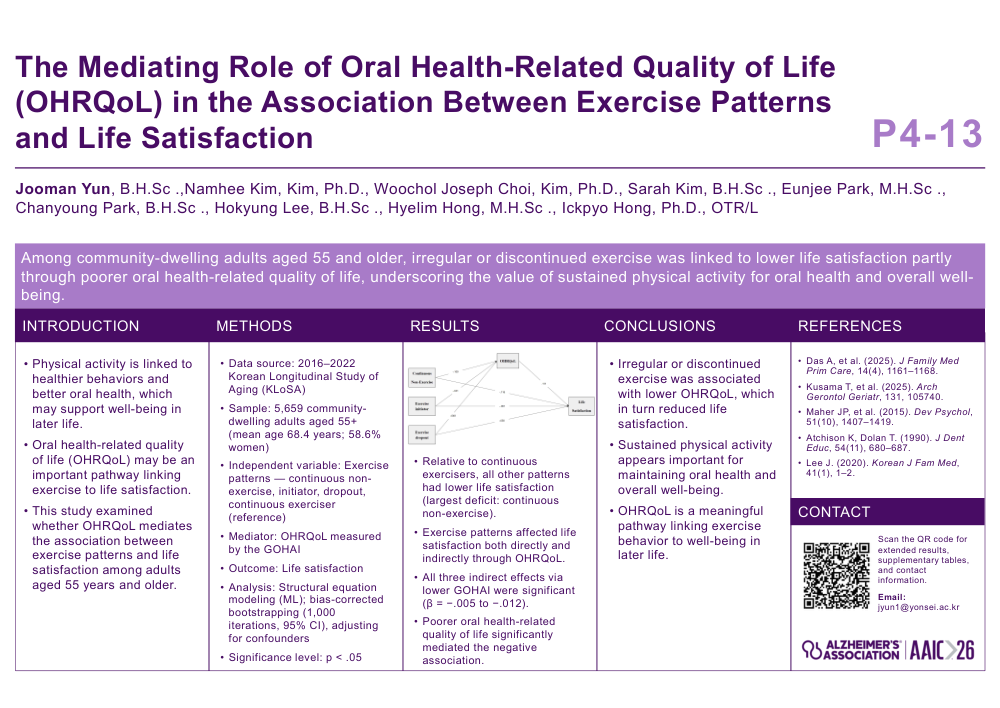
Background: This study aimed to explore the association between exercise patterns and life satisfaction among community-dwelling adults aged ≥55 years. We examined whether this association could be partly explained by the influence of physical activity on oral health, given its link to healthier behavior and better oral health. We also examined the mediating role of oral health-related quality of life (OHRQoL).
Methods: This study used longitudinal data from the 2016-2022 Korean Longitudinal Study of Aging (KLoSA). The final analytic sample included 5,659 community-dwelling adults aged ≥ 55 years. Exercise patterns (the independent variable) were classified into four groups based on exercise regularity in 2016 and 2018: “continuous non-exercise,” “exercise initiator,” “exercise dropout,” and “continuous exerciser.” Oral Health-Related Quality of Life (OHRQoL), measured using the GOHAI, was examined as a mediator, with life satisfaction as the primary outcome. Structural equation modeling (SEM) using ML estimation was conducted, adjusting for confounders, including age, sex, and socioeconomic status. Indirect effects were tested using bias-corrected bootstrapping with 1,000 iterations to derive 95% confidence intervals (CI).
Results: A total of 5,659 participants, the mean age of 68.36 years (SD = 9.18), and 58.6% of them were female. Compared with the "continuous exerciser" group, the "continuous non-exercise" group (β = -.116) had the lowest life satisfaction scores, followed by the "exercise initiator" group (β = -.061) and the "exercise dropout" group (β = -.050). Exercise patterns demonstrated both direct and indirect effects on life satisfaction through the GOHAI. The continuous non-exercise group showed a significant negative indirect effect on life satisfaction, mediated by lower GOHAI scores (β = -0.012, 95% CI [-0.017, -0.007]). Negative indirect effects were also observed in the exercise dropout (β = -0.005, 95% CI [-0.009, -0.002]) and exercise initiator groups (β = -0.005, 95% CI [-0.008, -0.001]).
Conclusion: This study revealed a significant pathway in which irregular exercise habits or discontinuation of exercise led to a decline in oral health-related quality of life, ultimately reducing life satisfaction. These findings suggest that promoting persistent physical activity is crucial for maintaining oral health and overall well-being in older adults.
Keywards: Exercise patterns; Oral health-related quality of life; Life satisfaction; Older adults; Korean Longitudinal Study of Aging
Comments
Email is required but is not shown publicly.
Loading comments...