4,068 posters, 219 videos, 101 topics, 69 sessions, 14,365 authors, 6,128 institutions
ePostersLive by SciGen Technologies S.A. All rights reserved.
Alzheimer's Association International Conference 2026
July 12-15, 2026 | London, United Kingdom, and Online

10356
Applicability And Sensitivity Of The Clinical Dementia Rating (cdr) In Patients With Low Educational Levels: A Cross-sectional Study
Poster Presenter
Authors
Rafael Tavares, Igor Oliveira, Cintia Hatasa, Thiago Ibiapino, Luiza Oliveira, Caio Cobucci, Antonio Neto
Affiliations
null,
Part of Topic
Background:
The Clinical Dementia Rating (CDR), which classifies the severity of dementia, has highsensitivity and specificity for identifying mild cognitive impairment (MCI) and dementia, even inindividuals with low educational levels.
Methods:
A cross-sectional study was conducted with 62 patients from a cognitive neurology center.Data were collected from medical records, including variables such as age, sex, comorbidities,education, dementia level (CDR), duration of symptoms, and diagnosis. Statistical analysis wasperformed using one-way ANOVA, Bonferroni post-test, and chi-square tests (p < 0.05).
Results:
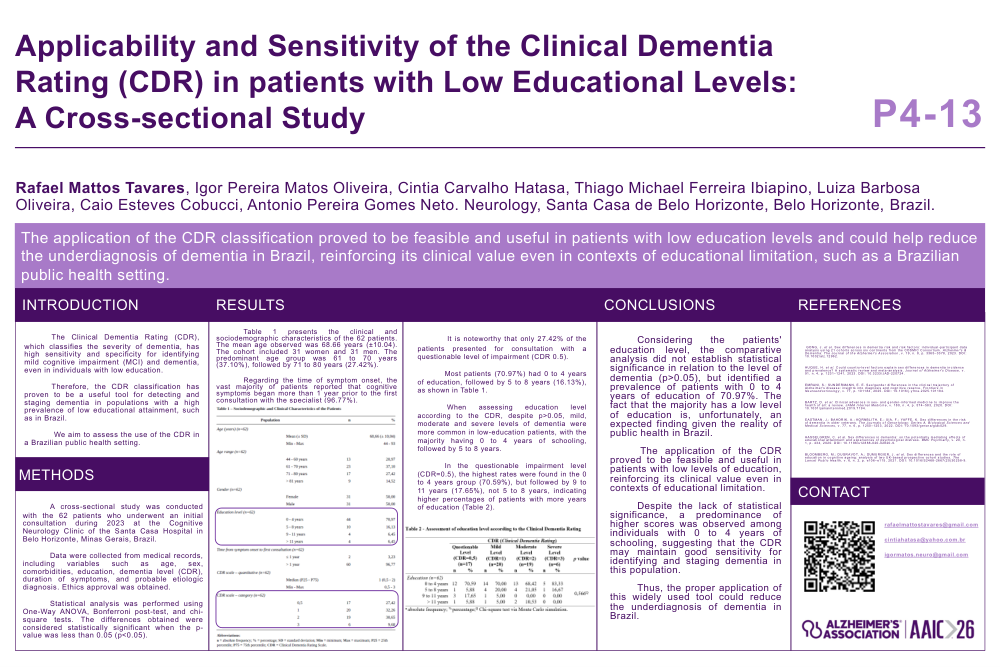
Most patients (70.97%) had 0-4 years of education, followed by 5-8 years (16.13%). Despite p>0.05, mild to severe levels of dementia were more common in low-education patients. In CDR 0.5, 70.59% had 0 to 4 years of education, followed by 17.65% with 9 to 11 years.
Conclusion:
Considering the patients' education, the comparative analysis did not identify statistical significance in relation to the level of dementia (p>0.05), but identified a prevalence of patients with 0 to 4 years of education of 70.97%. The CDR proved to be feasible and sensitive in patients with low education.
Comments
Email is required but is not shown publicly.
Loading comments...