4,068 posters, 219 videos, 101 topics, 69 sessions, 14,365 authors, 6,128 institutions
ePostersLive by SciGen Technologies S.A. All rights reserved.
Alzheimer's Association International Conference 2026
July 12-15, 2026 | London, United Kingdom, and Online

1063
Sex-specific reproductive and environmental risk factors for Lewy body dementia
Poster Presenter
Part of Topic
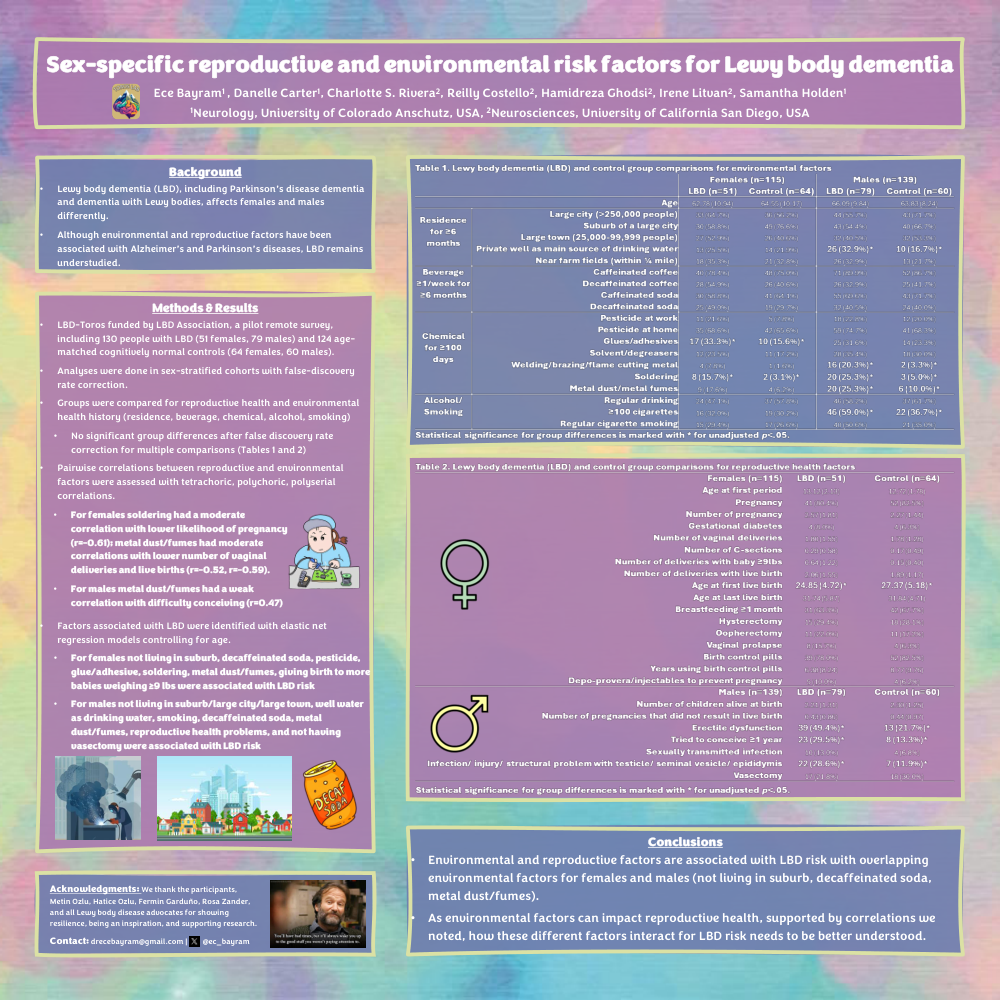
Background: Lewy body dementia (LBD), an umbrella term for Parkinson’s disease dementia and dementia with Lewy bodies, affects females and males differently. Although environmental and reproductive factors have been associated with Alzheimer’s and Parkinson’s diseases, suggesting a role in LBD, risk factors in LBD remain understudied. As sex differences in LBD prevalence can change with age, and vary across regions (North America, Europe, Asia), reproductive and environmental factors likely play a role in LBD pathogenesis.
Methods: Data were from the LBD-Toros, a pilot remote survey study, including 130 people with LBD (51 females, 79 males) and 124 age-matched cognitively normal controls (64 females, 60 males). Groups were compared for reproductive health history and environmental history including residential history, beverage consumption, chemical exposure, smoking, alcohol. Pairwise correlations between reproductive and environmental factors were assessed with tetrachoric, polychoric, polyserial correlations. Factors associated with LBD were identified with elastic net regression models controlling for age. Analyses were done in sex-stratified cohorts with false-discovery rate correction.
Results: For females, soldering had a moderate correlation with lower likelihood of pregnancy (r=-0.61); metal dust/fumes had moderate correlations with lower number of vaginal deliveries and live births (r=-0.52, r=-0.59). Not living in a suburb, decaffeinated soda, pesticide, glue/adhesive, soldering, metal dust/fumes, giving birth to more babies weighing ≥9 lbs were associated with LBD risk for females. For males, metal dust/fumes had a weak correlation with difficulty conceiving (r=0.47). Not living in a suburb/large city/large town, well water as drinking water, smoking, decaffeinated soda, metal dust/fumes, reproductive health problems, and not having vasectomy were associated with LBD risk for males.
Conclusions: Environmental and reproductive factors are associated with LBD risk with overlapping factors for females and males (not living in a suburb, decaffeinated soda, metal dust/fumes) as well as sex-specific reproductive factors. These factors can be modifiable risk factors for LBD, a common and burdensome neurodegenerative dementia lacking effective treatment options. As environmental factors can impact reproductive health, as supported by correlations noted in this pilot study, how these different factors interact for LBD risk needs to be better understood.
Comments
Email is required but is not shown publicly.
Loading comments...