4,068 posters, 219 videos, 101 topics, 69 sessions, 14,365 authors, 6,128 institutions
ePostersLive by SciGen Technologies S.A. All rights reserved.
Alzheimer's Association International Conference 2026
July 12-15, 2026 | London, United Kingdom, and Online

4612
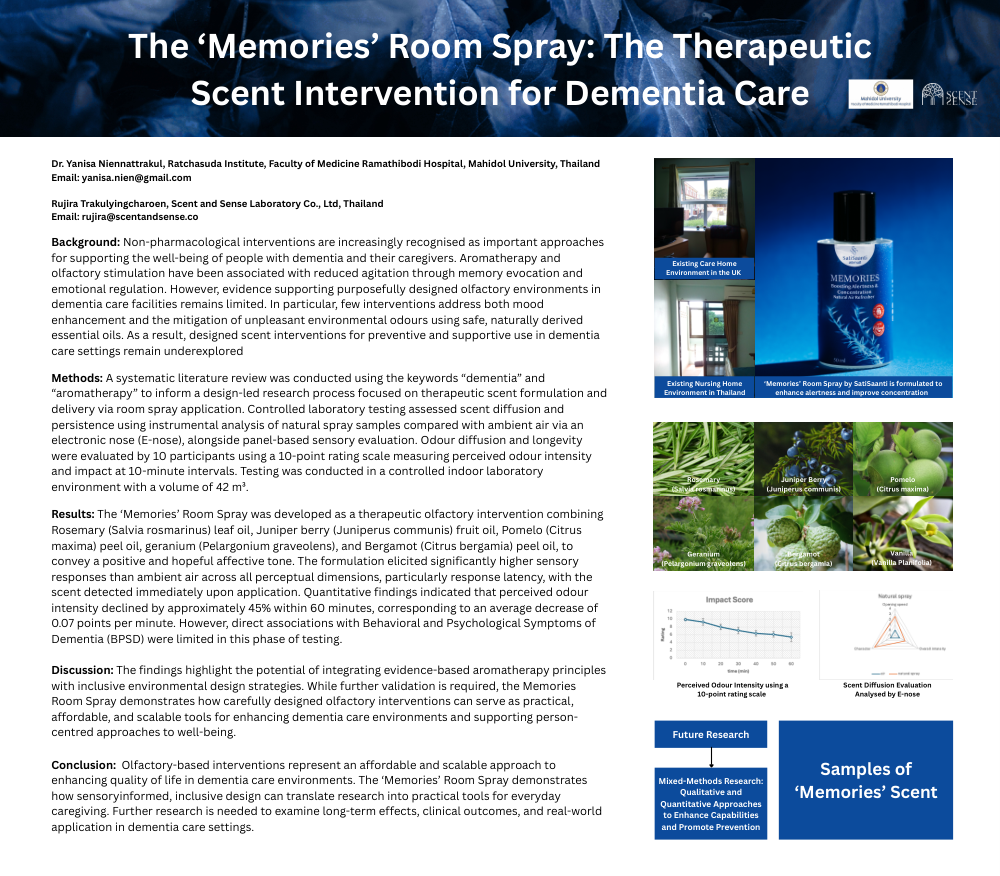
The 'Memories'Room Spray: A Therapeutic Scent Intervention For Dementia Care
Part of Topic
Background: Non-pharmacological interventions are increasingly recognised as important approaches for supporting the well-being of people with dementia and their caregivers. Aromatherapy and olfactory stimulation have been associated with reduced agitation through memory evocation and emotional regulation. However, evidence supporting purposefully designed olfactory environments in dementia care facilities remains limited. In particular, few interventions address both mood enhancement and the mitigation of unpleasant environmental odours using safe, naturally derived essential oils. As a result, designed scent interventions for preventive and supportive use in dementia care settings remain underexplored
Methods: A systematic literature review was conducted using the keywords “dementia” and “aromatherapy” to inform a design-led research process focused on therapeutic scent formulation and delivery via room spray application. Controlled laboratory testing assessed scent diffusion and persistence using instrumental analysis of natural spray samples compared with ambient air via an electronic nose (E-nose), alongside panel-based sensory evaluation. Odour diffusion and longevity were evaluated by 10 participants using a 10-point rating scale measuring perceived odour intensity and impact at 10-minute intervals. Testing was conducted in a controlled indoor laboratory environment with a volume of 42 m³.
Results: The ‘Memories’ Room Spray was developed as a therapeutic olfactory intervention combining Rosemary (Salvia rosmarinus) leaf oil, Juniper berry (Juniperus communis) fruit oil, Pomelo (Citrus maxima) peel oil, geranium (Pelargonium graveolens), and Bergamot (Citrus bergamia) peel oil, to convey a positive and hopeful affective tone. The formulation elicited significantly higher sensory responses than ambient air across all perceptual dimensions, particularly response latency, with the scent detected immediately upon application. Quantitative findings indicated that perceived odour intensity declined by approximately 45% within 60 minutes, corresponding to an average decrease of 0.07 points per minute. However, direct associations with Behavioral and Psychological Symptoms of Dementia (BPSD) were limited in this phase of testing.
Discussion: The findings highlight the potential of integrating evidence-based aromatherapy principles with inclusive environmental design strategies. While further validation is required, the Memories Room Spray demonstrates how carefully designed olfactory interventions can serve as practical, affordable, and scalable tools for enhancing dementia care environments and supporting person-centred approaches to well-being.
Conclusion:Olfactory-based interventions represent an affordable and scalable approach to enhancing quality of life in dementia care environments. The ‘Memories’ Room Spray demonstrates how sensoryinformed, inclusive design can translate research into practical tools for everyday caregiving. Further research is needed to examine long-term effects, clinical outcomes, and real-world application in dementia care settings.
Comments
Email is required but is not shown publicly.
Loading comments...