4,068 posters, 219 videos, 101 topics, 69 sessions, 14,365 authors, 6,128 institutions
ePostersLive by SciGen Technologies S.A. All rights reserved.
Alzheimer's Association International Conference 2026
July 12-15, 2026 | London, United Kingdom, and Online

1840
Royal Victoria Hospital Meeting Centre: Community Support In A Hospital Setting
Poster Presenter
Authors
Part of Topic
Shirley Barbara Evans1, Graham Galloway2, Howard Gordon3, Fiona Barrett4, Suzanne Gray5.
1Association for Dementia Studies, University of Worcester, Worcester, United Kingdom, 2Meeting Centres Scotland, Kirriemuir, United Kingdom, 3Meeting Centres England, Sheffield, United Kingdom, 4Meeting Centres Scotland, Dundee, United Kingdom, 5Ninewells Hospital, NHS Tayside, Dundee, United Kingdom.
Abstract:
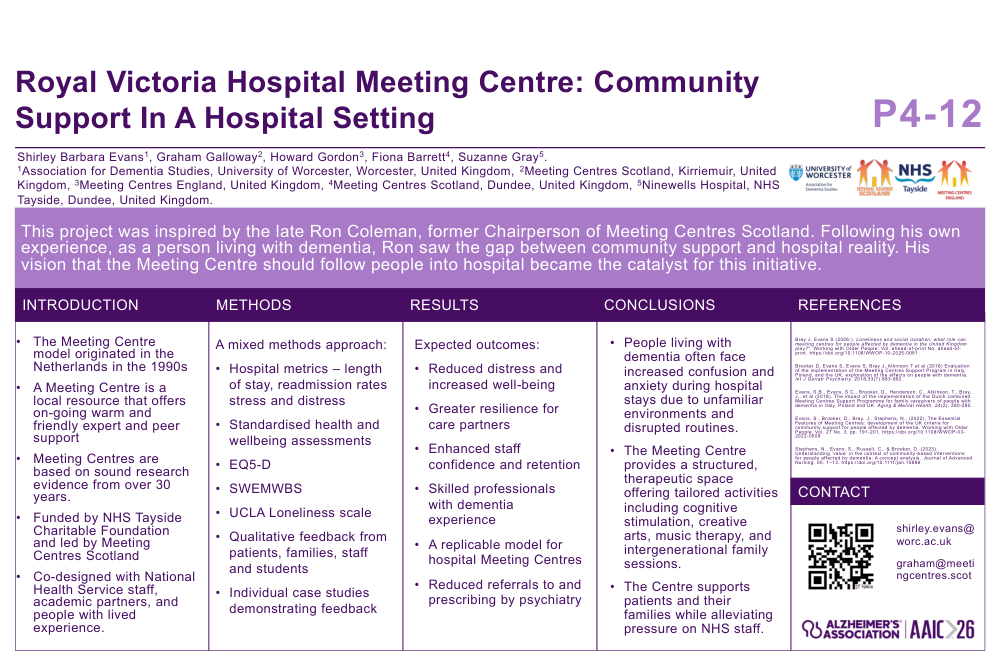
Background: The Royal Victoria Hospital Meeting Centre is a hospital-based adaptation of the dementia Meeting Centre model which originated in the Netherlands in the 1990s (www.meetingdem.eu). A Meeting Centre is a local resource, operating out of ordinary community buildings, that offers on-going warm and friendly expert and peer support to people with mild to moderate dementia and their families. Meeting Centres are based on sound research evidence of what helps people to cope well in adjusting to living with the symptoms and changes that dementia brings. Funded by NHS Tayside Charitable Foundation and led by Meeting Centres Scotland, the hospital Meeting Centre was co-designed with National Health Service (NHS) staff, academic partners, and people with lived experience. The primary outcome of the research (April 2025 to March 2027) is to assess the impact of attending the Meeting Centre on people living with dementia.
Methods: A mixed methods approach has been applied incorporating:-1. Administration of The EuroQol Health-related Quality of Life Questionnaire (EQ-5D)], the Shorter Warwick-Edinburgh Mental Wellbeing Scale (SWEMWBS) to measure well-being and changes in mood.2. Analysis of records to assess the reach of the Meeting Centre i.e. the number of people supported.3. Analysis of data relating to changes in hospital stay duration and readmission rates to measure the impact of the Meeting Centre on clinical outcomes.4. Case studies, focus groups and interviews to assess the benefits of the Meeting Centre for people with dementia, family members/visitors, staff and the wider patient group/hospital.
Results: Data collection had only just started at the time of abstract submission. Early results are promising. Observation and anecdotal evidence are showing that patients and staff are benefitting from the Meeting Centre. Nine months of findings will be presented covering the outcomes as indicated above.
Conclusion: People living with dementia often face increased confusion and anxiety during hospital stays due to unfamiliar environments and disrupted routines. The Meeting Centre provides a structured, therapeutic space offering tailored activities including cognitive stimulation, creative arts, music therapy, and intergenerational family sessions. The Centre supports patients and their families while alleviating pressure on NHS staff.
Comments
Email is required but is not shown publicly.
Loading comments...