4,068 posters, 219 videos, 101 topics, 69 sessions, 14,365 authors, 6,128 institutions
ePostersLive by SciGen Technologies S.A. All rights reserved.
Alzheimer's Association International Conference 2026
July 12-15, 2026 | London, United Kingdom, and Online

8645
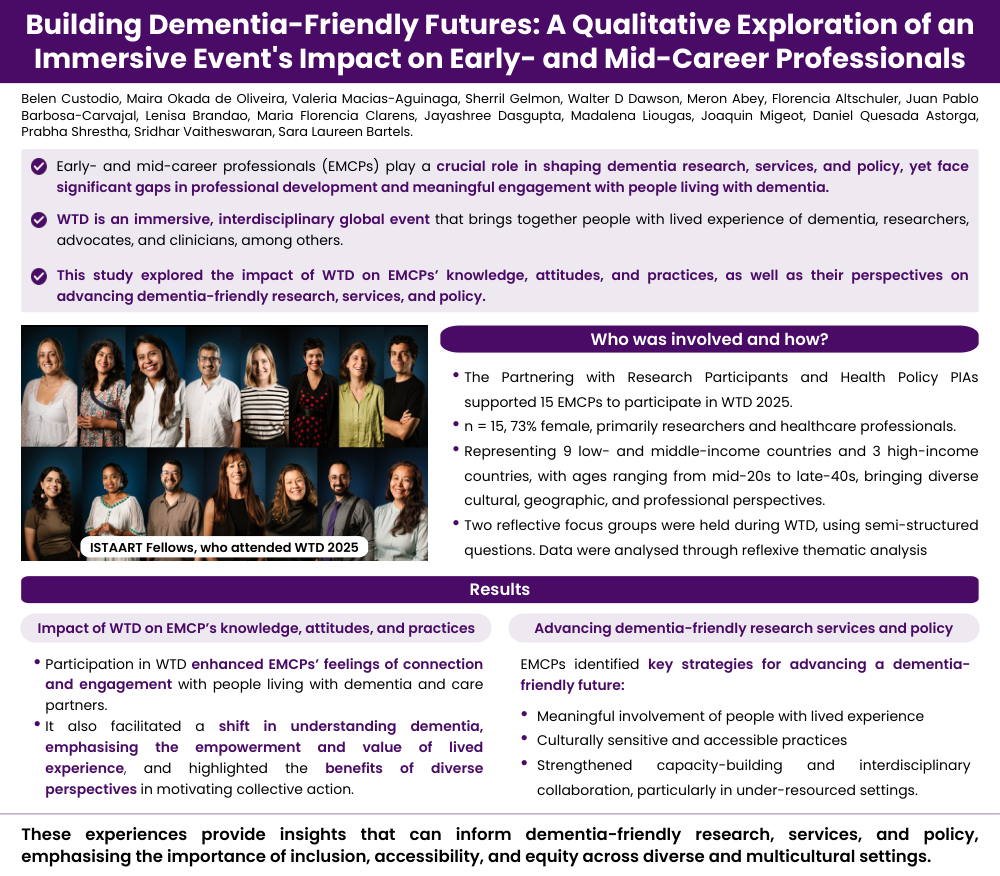
Building Dementia-Friendly Futures: A Qualitative Exploration Of An Immersive Event's Impact On Early- And Mid-career Professionals
Poster Presenter
Authors
Belen Custodio, Maira Okada de Oliveira, Valeria Macias Aguinaga, Sherril Gelmon, Walter Dawson, Meroy Abey, Florencia Altschuler, Juan Pablo Barbosa, Lenisa Brandao, Maria Florencia Clarens, Jayashree Dasgupta, Madalena Liougas, Joaquin Migeot, Daniel Quesada, Prabha Shrestha, Sridhar Vaitheswaran, Sara Bartels
Affiliations
Part of Topic
Early- and mid-career professionals (EMCPs) play a crucial role in shaping dementia research, services, and policy, yet face significant gaps in professional development and meaningful engagement with people living with dementia.
WTD is an immersive, interdisciplinary global event that brings together people with lived experience of dementia, researchers, advocates, and clinicians, among others.
This study explored the impact of WTD on EMCPs’ knowledge, attitudes, and practices, as well as their perspectives on advancing dementia-friendly research, services, and policy.
Who was involved and how?
• The Partnering with Research Participants and Health Policy PIAs supported 15 EMCPs to participate in WTD 2025.
• n = 15, 73% female, primarily researchers and healthcare professionals.
• Representing 9 low- and middle-income countries and 3 high-income countries, with ages ranging from mid-20s to late-40s, bringing diverse cultural, geographic, and professional perspectives.
• Two reflective focus groups were held during WTD, using semi-structured questions. Data were analysed through reflexive thematic analysis
Results
Impact of WTD on EMCP’s knowledge, attitudes, and practices
• Participation in WTD enhanced EMCPs’ feelings of connection and engagement with people living with dementia and care partners.
• It also facilitated a shift in understanding dementia, emphasising the empowerment and value of lived experience, and highlighted the benefits of diverse perspectives in motivating collective action.
Advancing dementia-friendly research services and policy
EMCPs identified key strategies for advancing a dementia- friendly future:
• Meaningful involvement of people with lived experience
• Culturally sensitive and accessible practices
• Strengthened capacity-building and interdisciplinary collaboration, particularly in under-resourced settings.
These experiences provide insights that can inform dementia-friendly research, services, and policy, emphasising the importance of inclusion, accessibility, and equity across diverse and multicultural settings.
Comments
Email is required but is not shown publicly.
Loading comments...