4,068 posters, 219 videos, 101 topics, 69 sessions, 14,365 authors, 6,128 institutions
ePostersLive by SciGen Technologies S.A. All rights reserved.
Alzheimer's Association International Conference 2026
July 12-15, 2026 | London, United Kingdom, and Online

8941
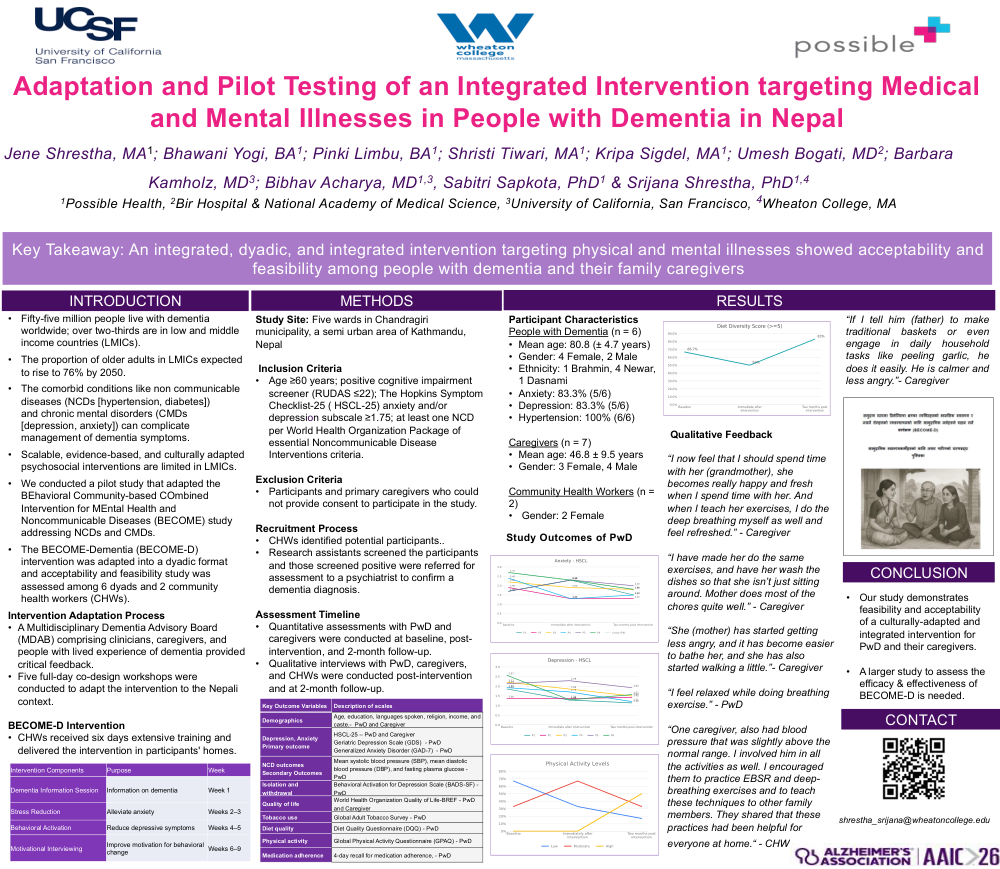
Adaption And Pilot Testing Of An Integrated Intervention Targeting Medical And Mental Illnesses For People With Dementia In Nepal
Poster Presenter
Authors
Jene Shrestha, Bhawani Yogi, Pinki Limbu, Shristi Tiwari, Kripa Sigdel, Umesh Bogati, Barbara Kamholz, Bibhav Acharya, Sabitri Sapkota, Srijana Shrestha
Affiliations
University of California, San Francisco, Wheaton College, MA, Possible Health, Nepal, Bir Hospital & National Academy of Medical Sciences
Part of Topic
Background: Worldwide, there are 55 million people living with Alzheimer’s Disease and Related Dementias (ADRD), more than 2/3rd of whom live in low- and middle-income countries (LMICs). Psychosocial interventions have positive impact on people with dementia and their caregivers. However, access to such interventions is severely limited in LMICs, creating an urgent need to develop, build evidence for, and implement interventions that are culturally-informed, responsive to local needs, integrated to existing systems of care, and with potential to scale-up. Our study developed and tested the acceptability and feasibility of a psychosocial intervention targeting medical (hypertension or diabetes) and mental illnesses (depression or anxiety) among people living with dementia (PwD) or mild cognitive impairment (MCI) and tested the acceptability and feasibility of the intervention in a pilot study.
Methods: A multidisciplinary dementia advisory board, comprising of clinicians, community advocates, caregivers, and individuals with lived experience of dementia guided the development of a 9-session BECOME-D (BEhavioral Community-based COmbined Intervention for MEntal Health and Noncommunicable Diseases for Dementia) intervention.We pilot tested the acceptability and feasibility of the BECOME-D intervention delivered by community health workers (CHW), who are embedded in a government-run clinics in a semi-urban municipality in Nepal.
Results: Six older adults (aged 76–89 years; mean ≈81) with dementia completed the intervention along with a caregiver, primarily family members. All recommended sessions; dementia education, strategies to reduce anxiety or depression, and motivational interviewing to improve hypertension or diabetes were completed by all participants. Quantitative data demonstrated positive outcomes for anxiety and depression for PwD, and improved quality of life among PwD and the caregivers. Qualitative data showed high acceptability among PwD, caregivers and CHWs; all reporting how the participant-centered, interactive intervention enhanced engagement. Caregivers also reported BECOME-D increasing and improving the quality time they spent with PwD. The CHWs provided feedback for more dementia-focused information during training. An active involvement of family members, not just one caregiver, emerged as a key learning.
Conclusion: The pilot study demonstrates feasibility and acceptability for culturally-adapted and integrated interventions among PwD and their caregivers. A larger study to assess the efficacy/effectiveness of BECOME-D is the next step.
Comments
Email is required but is not shown publicly.
Loading comments...