4,068 posters, 219 videos, 101 topics, 69 sessions, 14,365 authors, 6,128 institutions
ePostersLive by SciGen Technologies S.A. All rights reserved.
Alzheimer's Association International Conference 2026
July 12-15, 2026 | London, United Kingdom, and Online

3031
Wearable Technology-facilitated Dementia Care In Rural Taiwan- Preliminary Results From A Dyadic Feasibility Study
Part of Topic
Introduction:
In Taiwan, the transition to a super-aged society intensifies the societal and economic burdens brought by the increasing population of people living with Alzheimer’s disease (AD) who experience behavioral and psychological symptoms of dementia (BPSD), including depression, agitation, apathy, and sleep disturbances, which significantly increase caregiver stress, particularly in rural areas where care resources are limited. Current assessments rely on caregiver-reported tools, which may be less reliable due to caregivers’ own age-related cognitive decline.
Wearable technologies offer a promising alternative by enabling objective, continuous tracking of sleep and activity. Devices like Geneactiv provide validated longitudinal measures, while metrics such as the sleep regularity index are associated with health outcomes. Non-pharmacological interventions, particularly light-based therapies, are increasingly recommended. The Re-Timer, a wearable light-emitting device, may help regulate circadian rhythms and improve symptoms.
Materials and methods:
This study uses an eight-week, mixed-methods approach combining Geneactiv monitoring and Re-Timer intervention in dementia caregiver-patient dyads in rural Taiwan. It primarily evaluates feasibility and acceptability, while also exploring potential impacts on circadian rhythms, BPSD, and caregiver burden.
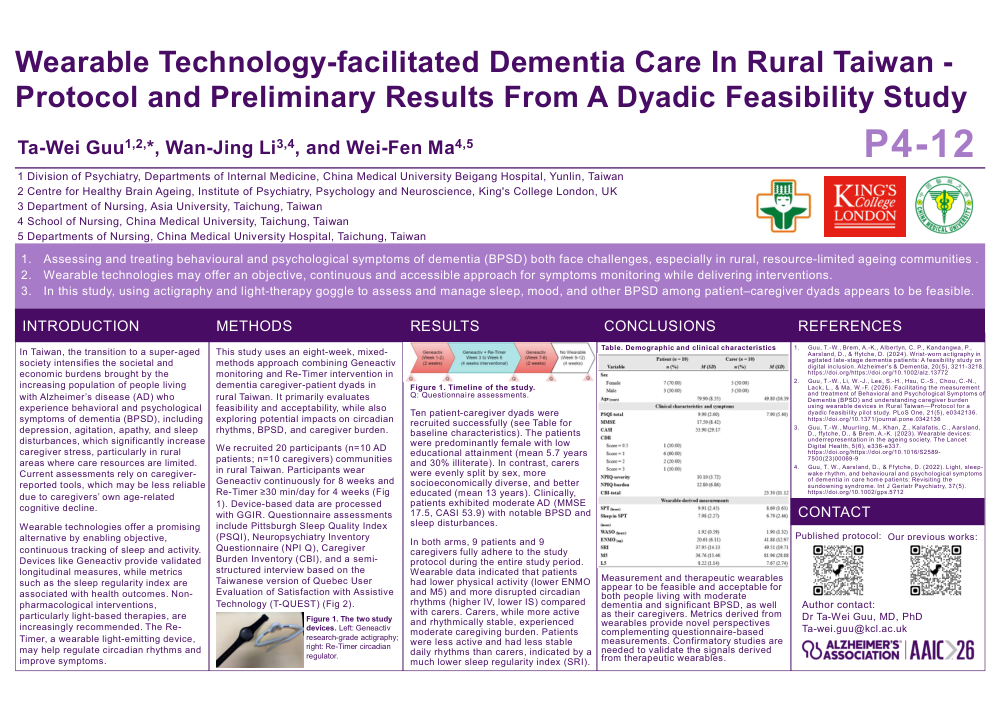
We recruited 20 participants (n=10 AD patients; n=10 caregivers) communities in rural Taiwan. Participants wear Geneactiv continuously for 8 weeks and Re-Timer ≥30 min/day for 4 weeks (Fig 1). Device-based data are processed with GGIR. Questionnaire assessments include Pittsburgh Sleep Quality Index (PSQI), Neuropsychiatry Inventory Questionnaire (NPI Q), Caregiver Burden Inventory (CBI), and a semi-structured interview based on the Taiwanese version of Quebec User Evaluation of Satisfaction with Assistive Technology (T-QUEST) (Fig 2).
Results:
Ten patient-caregiver dyads were recruited successfully (see Table for baseline characteristics). The patients were predominantly female with low educational attainment (mean 5.7 years and 30% illiterate). In contrast, carers were evenly split by sex, more socioeconomically diverse, and better educated (mean 13 years). Clinically, patients exhibited moderate AD (MMSE 17.5, CASI 53.9) with notable BPSD and sleep disturbances.
In both arms, 9 patients and 9 caregivers fully adhere to the study protocol during the entire study period. Wearable data indicated that patients had lower physical activity (lower ENMO and M5) and more disrupted circadian rhythms (higher IV, lower IS) compared with carers. Carers, while more active and rhythmically stable, experienced moderate caregiving burden. Patients were less active and had less stable daily rhythms than carers, indicated by a much lower sleep regularity index (SRI).
Conclusion:
Measurement and therapeutic wearables appear to be feasible and acceptable for both people living with moderate dementia and significant BPSD, as well as their caregivers. Metrics derived from wearables provide novel perspectives complementing questionnaire-based measurements. Confirmatory studies are needed to validate the signals derived from therapeutic wearables.
References:
Author contact:Dr Ta-Wei Guu, MD, PhD
Ta-wei.guu@kcl.ac.uk
Comments
Email is required but is not shown publicly.
Loading comments...