4,068 posters, 219 videos, 101 topics, 69 sessions, 14,365 authors, 6,128 institutions
ePostersLive by SciGen Technologies S.A. All rights reserved.
Alzheimer's Association International Conference 2026
July 12-15, 2026 | London, United Kingdom, and Online

1418
Momentary Triggers, Lasting Impact: Environmental Dynamics And Agitation In Dementia
Poster Presenter
Authors
Chunhong Xiao, Cary Springer, Rita A Jablonski, Frank Puga, Arie Nakhmani, Azziza Bankole, Roberto Fernandez-Romero
Affiliations
University of Tennessee at Knoxville , the United States, University of Alabama at Birmingham, the United States, The University of South Carolina, the United States, Virginia Tech, the United States, The Pat Summitt Clinic, The University of Tennessee Medical Center, Brain and Spine Institute. Knoxville, TN, the United States
Part of Topic
Title: Momentary triggers, lasting impact: Environmental dynamics and agitation in dementia
BACKGROUND: Evidence on how environmental triggers in home settings lead to momentary agitation remains limited.
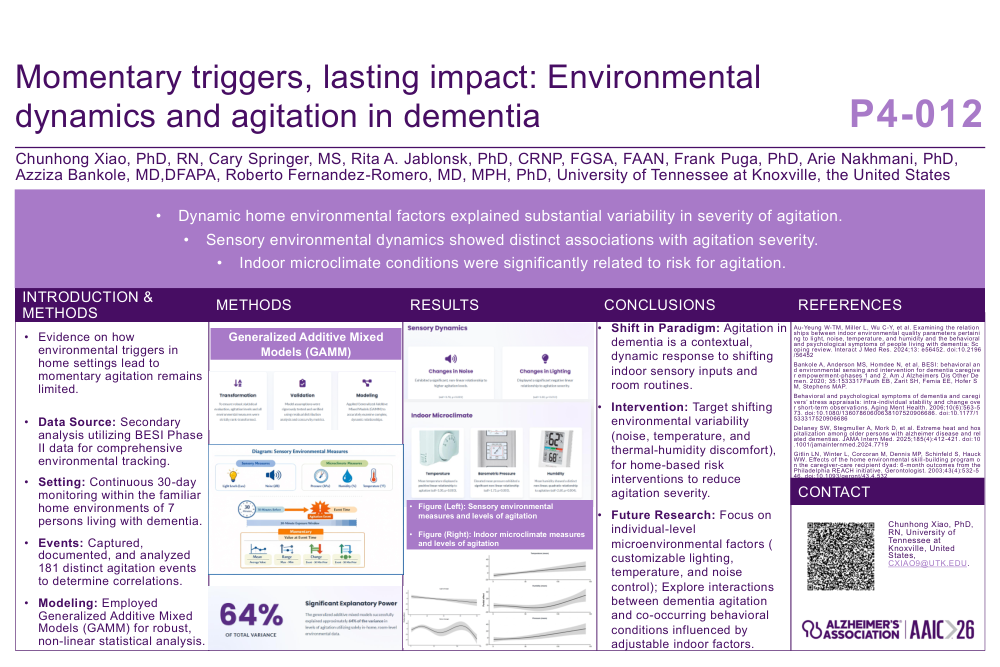
METHODS: This secondary analysis used BESI Phase II data and applied GAMM to examine relationships between levels of agitation and home environments through 181 agitation events from seven persons with dementia monitored for 30 days. Agitation and environmental measures were rank-transformed, and model assumptions were tested using residual distribution and concurvity.
RESULTS: Changes in noise showed a significant, non-linear relationship to agitation (edf=3.78, p<0.001). Changes in lighting displayed a negative linear relationship to agitation (edf=1.00, p=0.011). Mean temperature displayed a positive linear relationship to agitation (edf=1.00, p=0.003). Mean barometric pressure exhibited a significant non-linear relationship with agitation (edf=1.73, p=0.003). Mean humidity showed a non-linear, quadratic relationship to agitation (edf=2.60, p=0.004).
DISCUSSION: Agitation levels were shaped by moment‑to‑moment sensory variability, indoor microclimate conditions, and room‑level context, reflecting the dynamic and context‑responsive nature of environmental influence.
Comments
Email is required but is not shown publicly.
Loading comments...