4,068 posters, 219 videos, 101 topics, 69 sessions, 14,365 authors, 6,128 institutions
ePostersLive by SciGen Technologies S.A. All rights reserved.
Alzheimer's Association International Conference 2026
July 12-15, 2026 | London, United Kingdom, and Online

949
From Pilot To Implementation: Advancing Dementia Literacy In Brazilian Public Schools To Reduce Stigma
Poster Presenter
Authors
Karen Pulgatti, Lea Veras, Giulianna Bueno Denari, Ari Alex Ramos, Lucas Pelegrini Nogueira de Carvalho, Marcia Regina Cominetti
Affiliations
Department of Gerontology, University Federal of São Carlos, Department of Gerontology, University Federal of São Carlos and Global Brain Health Institute, Trinity College Dublin, Dublin, Ireland
Part of Topic
From Pilot To Implementation: Advancing Dementia Literacy In Brazilian Public Schools To Reduce Stigma
Author:Karen Leticia Pulgatti1, Lea Veras1, Giulianna Bueno Denari1, Ari Alex Ramos1, Lucas Pelegrini Nogueira de Carvalho1, Marcia Regina Cominetti, PhD1,2.
1Department of Gerontology, University Federal of São Carlos, São Carlos, Brazil,
2Gerontology, UFSCar, São Carlos, Brazil.
Abstract:
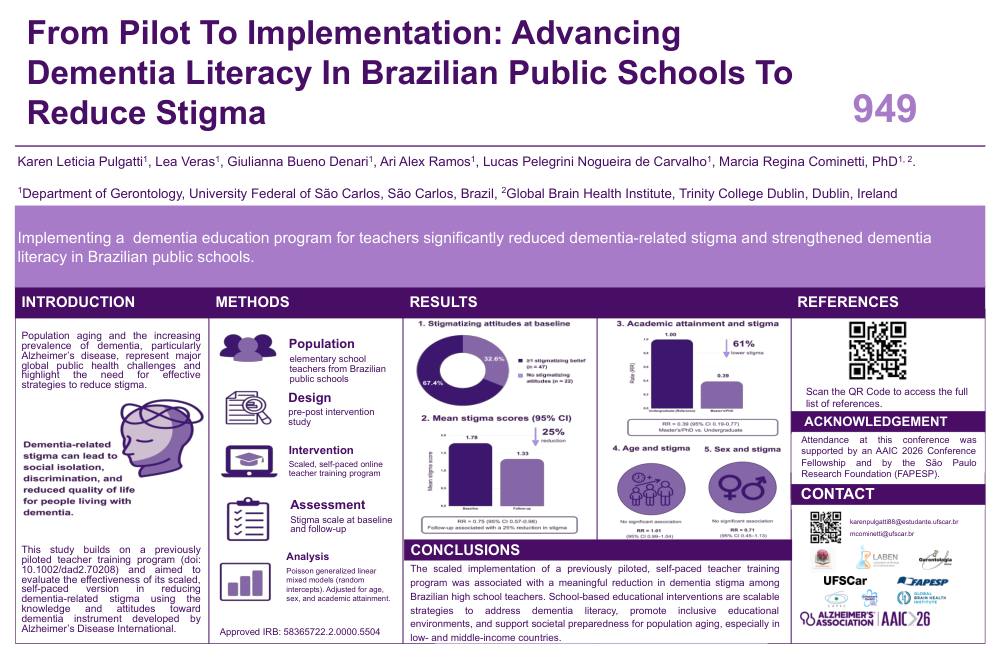
Background: Population aging and the increasing prevalence of dementia, particularly Alzheimer’s disease, represent major global public health challenges and highlight the need for effective strategies to reduce stigma. Schools are strategic settings for dementia literacy, as teachers play a central role in shaping students’ and families’ knowledge, attitudes, and dialogue. This study builds on a previously piloted teacher training program (doi: 10.1002/dad2.70208) and aimed to evaluate the effectiveness of its scaled, self-paced version in reducing dementia-related stigma using the knowledge and attitudes toward dementia instrument developed by Alzheimer’s Disease International.
Methods: This pre-post intervention study recruited 69 elementary school teachers (65% female; mean age 47.8 years, SD = 9.4) from Brazilian public schools. Participants completed the stigma scale at baseline and at follow-up after completing the training program. Poisson generalized linear mixed models with random intercepts were used to account for within-participant repeated measures. Models were adjusted for age, sex, and academic attainment to examine factors associated with stigma levels and changes over time.
Results: At baseline, 32.6% of teachers reported no stigmatizing attitudes, whereas 67.4% endorsed at least one stigmatizing belief. Mean stigma scores declined from baseline (M = 1.78; 95% CI, 1.35-2.22) to follow-up (M = 1.33; 95% CI, 0.98-1.69). In adjusted Poisson mixed-effects models, follow-up assessments were associated with a 25% reduction in stigma scores compared with baseline (rate ratio [RR] = 0.75; 95% CI, 0.57-0.98). Teachers holding a Master’s and/or Doctoral degree showed a 61% lower rate of stigma relative to those with undergraduate education (RR = 0.39; 95% CI, 0.19-0.77). No statistically significant associations were observed for age (RR = 1.01; 95% CI, 0.99-1.04) or sex (RR = 0.71; 95% CI, 0.45-1.13).
Conclusion: The scaled implementation of a previously piloted, self-paced teacher training program was associated with a meaningful reduction in dementia-related stigma among elementary and high school teachers in Brazil. These findings reinforce the value of school-based educational interventions as scalable strategies to advance dementia literacy, promote inclusive educational environments, and support broader societal preparedness for population aging, particularly in low- and middle-income country contexts.
Comments
Email is required but is not shown publicly.
Loading comments...