4,068 posters, 219 videos, 101 topics, 69 sessions, 14,365 authors, 6,128 institutions
ePostersLive by SciGen Technologies S.A. All rights reserved.
Alzheimer's Association International Conference 2026
July 12-15, 2026 | London, United Kingdom, and Online

2051
Improving Communication And Outcomes For Latinos With Alzheimer’S Disease Through A Culturally Tailored Interactive Visualization Tool
Poster Presenter
Authors
Rafael Samper-Ternent, Carl Haacke, Paige Padgett Wermuth, Delma Montoya, Elsa Rodarte, Alejandra Mera, Mei Robson
Affiliations
Part of Topic
Background
Latinos with Alzheimer’s disease and related dementias (ADRD) experience significant obstacles in diagnosis and treatment. Communication barriers driven by language discordance, low health literacy, limited educational attainment, and cognitive impairment contribute to delayed care, poor adherence to care plans, unmet needs, and reduced quality of life. These challenges are frequent in primary care, where time constraints and reliance on detailed explanations limit patient and care partner understanding and retention. Addressing communication barriers through culturally appropriate, person-centered innovations is a priority.
Methods
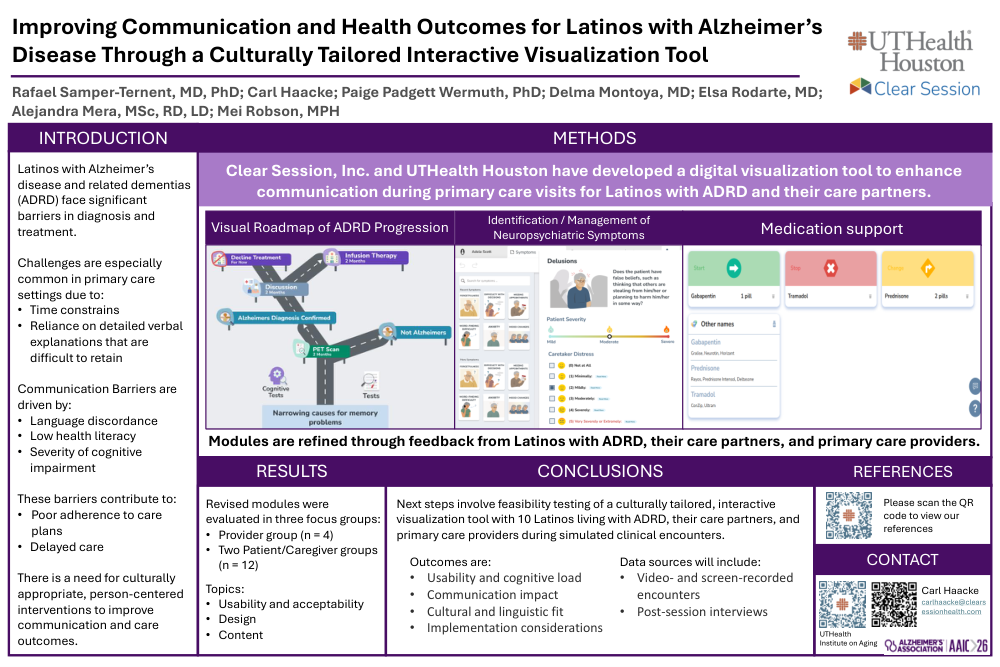
Clear Session, Inc. and UTHealth Houston are developing a culturally tailored, interactive digital visualization tool to enhance real-time communication during primary care visits for Latinos with ADRD and their care partners. The tool presents personalized images on an office computer or tablet to support clinical conversations and improve comprehension. Content is delivered in Spanish or English, designed for low-literacy audiences, and allows visual interactions to be saved as animations for later review.
An iterative, user-centered design process guided by a panel with expertise in ADRD care, Latino health, communication science, and clinical innovation is guiding development of the tool. Three prototype modules have been designed: (1) a visual roadmap of ADRD progression, (2) identification and management of neuropsychiatric symptoms, and (3) medication support. Modules are refined through iterative feedback from Latinos with ADRD, care partners, and primary care providers.
Results
Project results are ongoing. Expert panel feedback informed simplification and refinement of the symptom and medication modules. These modified modules were presented to two focus groups (provider group, n=4, and patient group, n=6). Participant discussions centered on visual representation of symptoms and medications, module navigation, display format, and color-coded messaging.
Conclusions
Next steps involve feasibility testing with 20 Latinos with ADRD, their care partners, and primary care providers using recorded simulated clinical encounters. Usability, acceptability, and workflow will be assessed through analysis of these encounters, qualitative feedback, and validated quantitative measures. By integrating a culturally tailored, interactive tool into clinical encounters, we tackle communication gaps that contribute to disparities in ADRD care. This equity-focused, scalable approach will advance person-centered dementia care for Latino families affected by ADRD.
Comments
Email is required but is not shown publicly.
Loading comments...