4,068 posters, 219 videos, 101 topics, 69 sessions, 14,365 authors, 6,128 institutions
ePostersLive by SciGen Technologies S.A. All rights reserved.
Alzheimer's Association International Conference 2026
July 12-15, 2026 | London, United Kingdom, and Online

5221
Safety, Clinical Outcomes, And Biomarker Changes Of Lecanemab In A Chinese Real-world Cohort: A Single-center Prospective Study
Poster Presenter
Part of Topic
Background:
Lecanemab has revolutionized the treatment of Alzheimer’s disease (AD) as the first fully approved anti-amyloid-beta therapy. However, its safety and efficacy in routine clinical practice, particularly within East Asian populations, require further validation through real-world evidence.
Methods:
This single-center, prospective cohort study enrolled 165 patients at the First Affiliated Hospital, Zhejiang University School of Medicine, between July 2024 and December 2025. The cohort comprised individuals with mild cognitive impairment (MCI), mild AD dementia, and a subset of patients with moderate AD dementia who underwent rigorous risk assessment and provided informed consent. All participants completed baseline evaluations and received at least one lecanemab infusion. Longitudinal follow-ups were conducted at 3, 6, 12, and 18 months, encompassing plasma biomarker collection, brain MRI, and comprehensive neuropsychological assessments. Amyloid PET scans were performed at 6, 12, and/or 18 months to monitor amyloid-β dynamics.
Results:
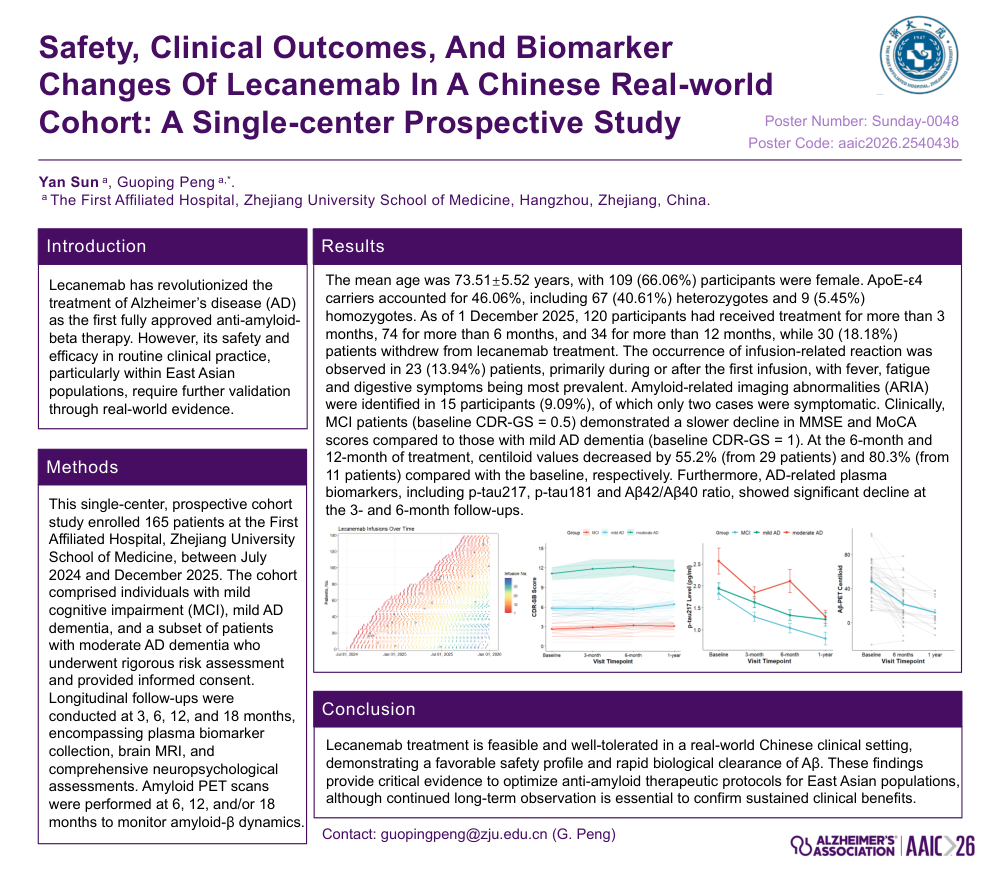
The mean age was 73.51±5.52 years, with 109 (66.06%) participants were female. ApoE-ε4 carriers accounted for 46.06%, including 67 (40.61%) heterozygotes and 9 (5.45%) homozygotes. As of 1 December 2025, 120 participants had received treatment for more than 3 months, 74 for more than 6 months, and 34 for more than 12 months, while 30 (18.18%) patients withdrew from lecanemab treatment. The occurrence of infusion-related reaction was observed in 23 (13.94%) patients, primarily during or after the first infusion, with fever, fatigue and digestive symptoms being most prevalent. Amyloid-related imaging abnormalities (ARIA) were identified in 15 participants (9.09%), of which only two cases were symptomatic. Clinically, MCI patients (baseline CDR-GS = 0.5) demonstrated a slower decline in MMSE and MoCA scores compared to those with mild AD dementia (baseline CDR-GS = 1). At the 6-month and 12-month of treatment, centiloid values decreased by 55.2% (from 29 patients) and 80.3% (from 11 patients) compared with the baseline, respectively. Furthermore, AD-related plasma biomarkers, including p-tau217, p-tau181 and Aβ42/Aβ40 ratio, showed significant decline at the 3- and 6-month follow-ups.
Conclusion:
Lecanemab treatment is feasible and well-tolerated in a real-world Chinese clinical setting, demonstrating a favorable safety profile and rapid biological clearance of amyloid-β. These findings provide critical evidence to optimize anti-amyloid therapeutic protocols for East Asian populations, although continued long-term observation is essential to confirm sustained clinical benefits.
Comments
Email is required but is not shown publicly.
Loading comments...