4,068 posters, 219 videos, 101 topics, 69 sessions, 14,365 authors, 6,128 institutions
ePostersLive by SciGen Technologies S.A. All rights reserved.
Alzheimer's Association International Conference 2026
July 12-15, 2026 | London, United Kingdom, and Online

4141
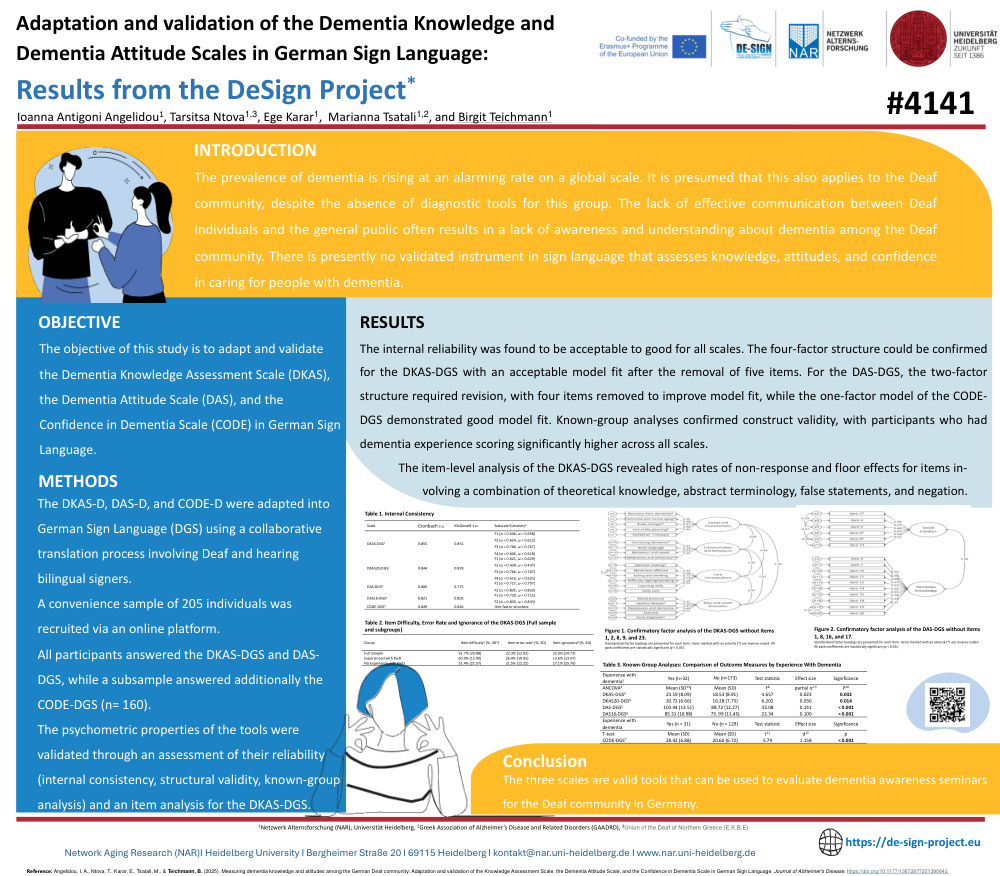
Adaptation And Validation Of Dementia Knowledge And Dementia Attitude Scales In German Sign Language
Poster Presenter
Authors
Birgit Teichmann, Ioanna Antigoni Angelidou, Tarsitsa Ntova, Ege Karar, Marianna Tsatali
Affiliations
Netzwerk Alternsforschung (NAR), Universität Heidelberg, Network Aging Research (NAR), Heidelberg University, Network Aging Research (NAR), Heidelberg University; Union of the Deaf of Northern Greece (E.K.B.E), Greek Association of Alzheimer’s Disease and Related Disorders (GAADRD), Network Aging Research (NAR), Heidelberg University
Part of Topic
INTRODUCTION
The prevalence of dementia is rising at an alarming rate on a global scale. It is presumed that this also applies to the Deaf community, despite the absence of diagnostic tools for this group. The lack of effective communication between Deaf individuals and the general public often results in a lack of awareness and understanding about dementia among the Deaf community. There is presently no validated instrument in sign language that assesses knowledge, attitudes, and confidence in caring for people with dementia.
OBJECTIVE
The objective of this study is to adapt and validate the Dementia Knowledge Assessment Scale (DKAS), the Dementia Attitude Scale (DAS), and the Confidence in Dementia Scale (CODE) in German Sign Language.
METHODS
The DKAS-D, DAS-D, and CODE-D were adapted into German Sign Language (DGS) using a collaborative translation process involving Deaf and hearing bilingual signers.
A convenience sample of 205 individuals was recruited via an online platform.
All participants answered the DKAS-DGS and DAS-DGS, while a subsample answered additionally the CODE-DGS (n= 160).
The psychometric properties of the tools were validated through an assessment of their reliability (internal consistency, structural validity, known-group analysis) and an item analysis for the DKAS-DGS.
CONCLUSION
The three scales are valid tools that can be used to evaluate dementia awareness seminars for the Deaf community in Germany.
Comments
Email is required but is not shown publicly.
Loading comments...