4,068 posters, 219 videos, 101 topics, 69 sessions, 14,365 authors, 6,128 institutions
ePostersLive by SciGen Technologies S.A. All rights reserved.
Alzheimer's Association International Conference 2026
July 12-15, 2026 | London, United Kingdom, and Online

5158
Associations Between Psychological Wellbeing And Ambulatory Cognitive Assessment: The Role Of Amyloid Pathology
Poster Presenter
Authors
Part of Topic
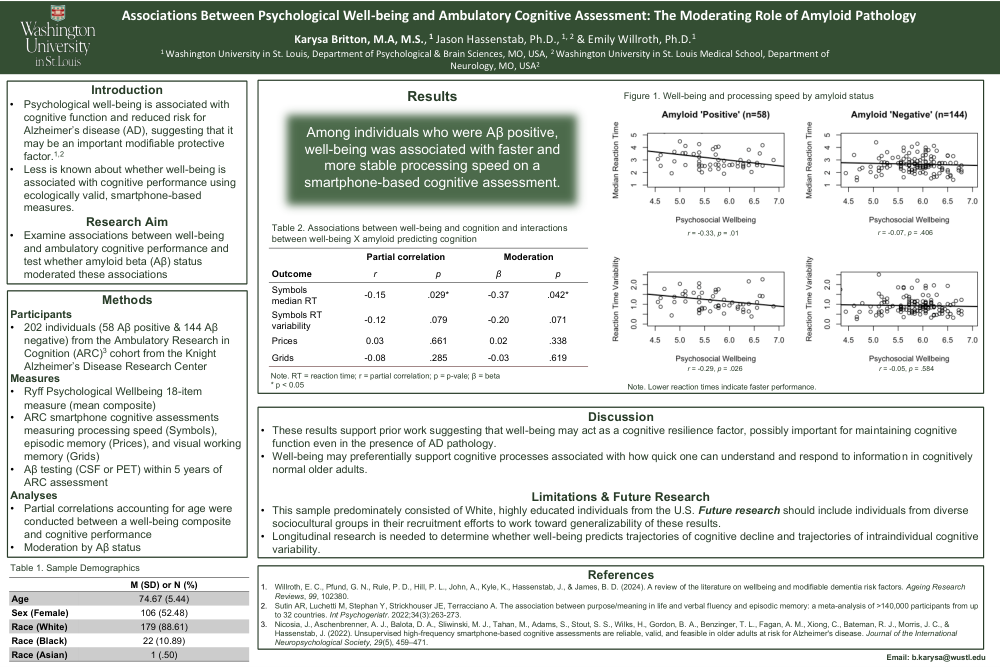
Background: Psychological wellbeing has been consistently associated with cognitive function and reduced risk for Alzheimer’s disease (AD), suggesting that it may be an important modifiable protective factor. However, less is known about whether wellbeing is associated with cognitive performance using ecologically valid, smartphone-based measures. This study examined associations between wellbeing and ambulatory cognitive performance and tested whether amyloid beta (Aβ) status moderated these associations.
Methods: Participants were 202 individuals (58 Aβ positive and 144 Aβ negative) from the Ambulatory Research in Cognition (ARC) cohort from the Knight Alzheimer’s Disease Research Center. Participants had previously undergone Aβ testing (CSF or PET) and completed the Ryff Psychological Wellbeing 18-item measure and cognitive assessments using the ARC smartphone application. Processing speed (Symbols), visual working memory (Grids), and associative memory (Prices) were assessed. Partial correlations accounting for age were conducted between a wellbeing composite and cognitive performance. Moderation by Aβ status was assessed.
Results: Higher levels of wellbeing were associated with faster reaction time (r=-0.15, p=.029) on the processing speed test but were not significantly associated with performance on associative memory or visual working memory tests (ps>.05). This pattern replicated for reaction time variability on the processing speed test but was marginally significant (r=-0.12, p=.079). Aβ significantly moderated the association between wellbeing and processing speed (b=-.37, p=.042). Among participants who were Aβ positive, the association between wellbeing and faster reaction times was strong and statistically significant (r=-0.33, p=.01). Among participants who were Aβ negative, the association was weak and statistically non-significant (r=-0.07, p=.406). This pattern replicated for reaction time variability but was only marginally significant (b=-.19, p=.071). No significant interactions were observed for associative memory or visual working memory tests (ps>.05).
Conclusions: Among individuals who were Aβ positive, wellbeing was associated with faster and more stable processing speed measured using a valid and reliable smartphone-based cognitive assessment. These results support prior work suggesting that wellbeing may act as a cognitive resilience factor, possibly important for maintaining cognitive function even in the presence of AD pathology. Future longitudinal research is needed to determine whether wellbeing is associated with intraindividual cognitive variability, a potential early indicator of AD risk.
Comments
Email is required but is not shown publicly.
Loading comments...