4,068 posters, 219 videos, 101 topics, 69 sessions, 14,365 authors, 6,128 institutions
ePostersLive by SciGen Technologies S.A. All rights reserved.
Alzheimer's Association International Conference 2026
July 12-15, 2026 | London, United Kingdom, and Online

8747
Fluency Tests In Yoruba Speakers: Do Letters Or Meaning Reveal True Cognitive Performance? Insights From The Ibadan Arm Of The Readd-adsp
Poster Presenter
Authors
Part of Topic
Title: Fluency Tests in Yoruba Speakers: Do Letters or Meaning Reveal True Cognitive Performance? Insights from the Ibadan Arm of the READD–ADSP
Abstract
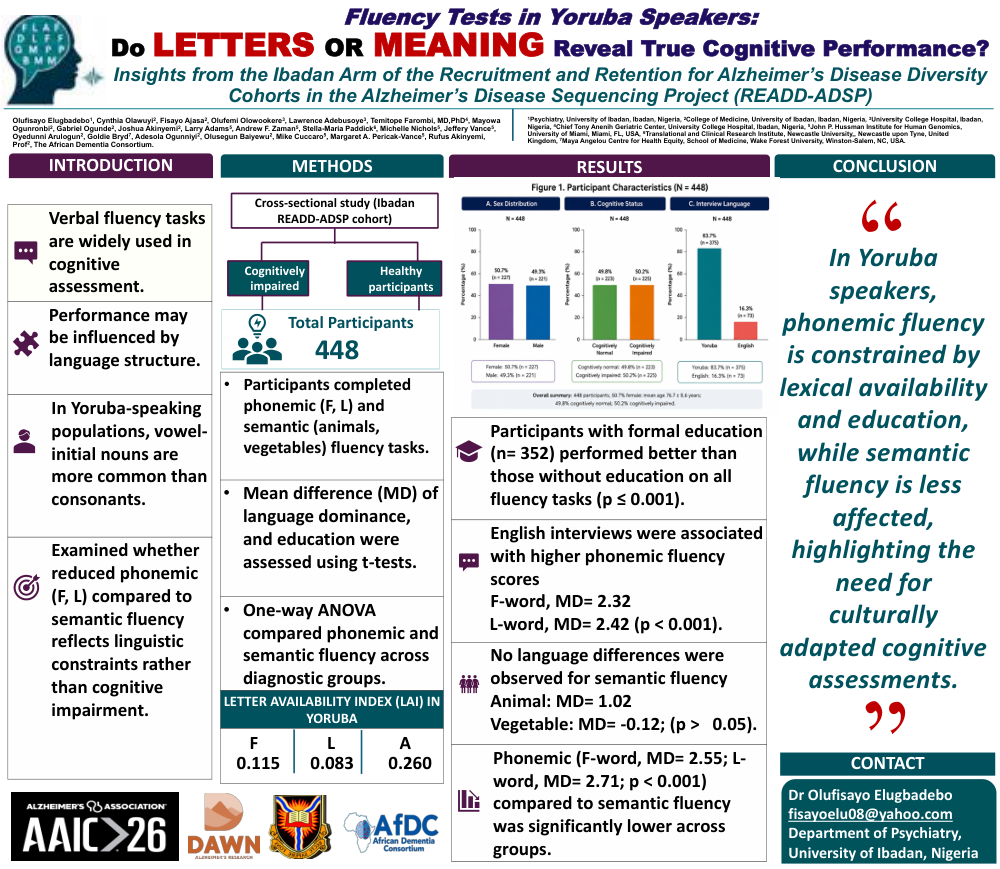
Background: Verbal fluency tasks are widely used in cognitive assessment, but performance may be influenced by language structure. In Yoruba-speaking populations, phonemic fluency using certain letters may be disadvantaged due to language-specific lexical characteristics, as vowel-initial nouns are more common than consonants. This study examined whether lower performance on phonemic fluency using letters F and L, compared with semantic fluency, reflects linguistic constraints rather than cognitive impairment among Yoruba speakers.
Methods: A cross-sectional study of individuals with cognitive impairment and healthy controls from the Ibadan arm, Recruitment and Retention for Alzheimer’s Disease Diversity Cohorts in the Alzheimer’s Disease Sequencing Project (READD-ADSP), a predominantly Yoruba-speaking community. Participants completed phonemic (F, L) and semantic (animals, vegetables) fluency tasks. To account for language specific lexical availability, Letter Availability Index (LAI) was derived from common Yoruba nouns (F = 0.115, L = 0.083, A = 0.26). Language dominance (Yoruba vs English), and education (<1year vs ≥1year) were assessed using t-tests to determine their mean difference (MD). One-way ANOVA examined differences between phonemic and semantic fluency performance between diagnostic groups. Games-Howell post-hoc tests were used when group variances were not equal.
Results: A total of 448 participants (50.7% female; mean age 76.7 ± 8.6 years) were included; 49.8% were cognitively normal and 50.2% impaired. Phonemic (F-word, MD = 2.55; L-word, MD = 2.71; p < 0.001) compared to semantic fluency was significantly lower across groups. Participants with formal education (≥1 year; n = 352) performed better than those without education on all fluency tasks (F-word, MD = -3.83; L-word, MD = -3.68; animal MD = -1.81; vegetable MD = -1.24; p ≤ 0.001). Most interview were conducted in Yoruba (83.7%); however, English interviews were associated with higher phonemic fluency scores (F-word, MD = 2.32; L-word, MD = 2.42; p < 0.001). No language differences were observed for semantic fluency (animal, MD = 1.02; vegetable, MD = -0.12; p > 0.05).
Conclusion: Letter-based phonemic fluency in Yoruba is constrained by language-specific lexical availability and influenced by education. Semantic fluency is less affected by language, underscoring the need for culturally-adapted cognitive assessments in African populations.
Comments
Email is required but is not shown publicly.
Loading comments...