4,068 posters, 219 videos, 101 topics, 69 sessions, 14,365 authors, 6,128 institutions
ePostersLive by SciGen Technologies S.A. All rights reserved.
Alzheimer's Association International Conference 2026
July 12-15, 2026 | London, United Kingdom, and Online

2129
Comparison between patients' self-perception and caregivers' reports on sensory changes
Part of Topic
Comparison between patients' self-perception and caregivers' reports on sensory changes
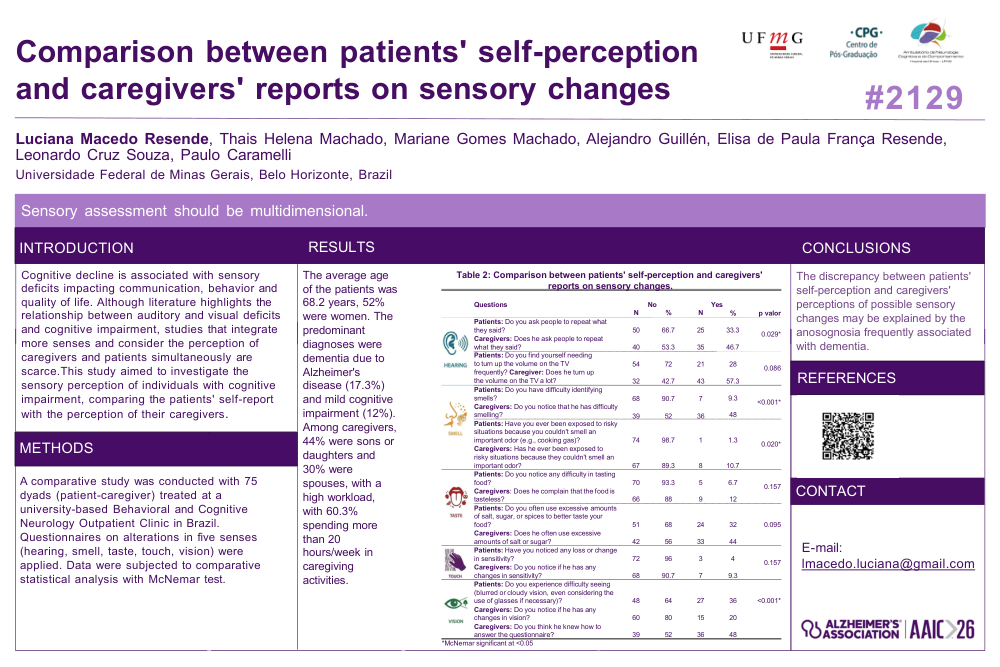
Introduction: Cognitive decline is associated with sensory deficits impacting communication, behavior and quality of life. Although literature highlights the relationship between auditory and visual deficits and cognitive impairment, studies that integrate more senses and consider the perception of caregivers and patients simultaneously are scarce. Objective: To investigate the sensory perception of individuals with cognitive impairment, comparing the patients' self-report with the perception of their caregivers. Methods: A comparative study was conducted with 75 dyads (patient-caregiver) treated at a university-based Behavioral and Cognitive Neurology Outpatient Clinic in Brazil. Questionnaires on alterations in five senses (hearing, smell, taste, touch, vision) were applied. Data were subjected to comparative statistical analysis with McNemar test. Results: The average age of the patients was 68.2 years, 52% were women. The predominant diagnoses were dementia due to Alzheimer's disease (17.3%) and mild cognitive impairment (12%). Among caregivers, 44% were sons or daughters and 30% were spouses, with a high workload, with 60.3% spending more than 20 hours/week in caregiving activities. Regarding hearing, when asked if patients usually ask for things to be repeated, this difficulty was significantly more perceived among caregivers (46.7%) than among patients (33.3%), p-value 0.029. Caregivers (48%) also showed a significantly higher perception of olfactory deficits compared to patients (9.3%), p-value <0.001. Regarding vision, patients (36%) reported alterations more frequently than their caregivers (20%), p-value <0.001. Only 6.7% of patients and 12% of caregivers reported perceiving difficulties related to taste perception; however, when asked if they perceived excessive use of spices, 32% of patients and 44% of caregivers perceived excessive use of salt, sugar, or other spices, with no statistically significant difference between the two groups. Regarding the sense of touch, there was also little perceived alteration, with 4% of patients and 9.3% of caregivers perceiving deficits in tactile sensitivity. Most caregivers (52%) doubted patients' ability to fully comprehend the questionnaire. Conclusions: The divergence of perceptions underscores the need for a multidimensional sensory assessment, integrating patient self-perception, clinical observation, and caregiver input to ensure comprehensive care and improved quality of life.
Comments
Email is required but is not shown publicly.
Loading comments...