4,068 posters, 219 videos, 101 topics, 69 sessions, 14,365 authors, 6,128 institutions
ePostersLive by SciGen Technologies S.A. All rights reserved.
Alzheimer's Association International Conference 2026
July 12-15, 2026 | London, United Kingdom, and Online

269
Adapting And Validating The Dementia Knowledge Assessment Scale (DKAS) Thai
Poster Presenter
Authors
Kanthee Anantapong, Aimorn Jiraphan, Pornjira Pariwatcharakul, Napakkawat Buathong, Suwanna Setthawatcharawanich, Warut Aunjitsakul, Pongsatorn Paholpak, Sirinapa Aphisitphinyo, Pakawat Wiwattanaworaset, Pattharee Paholpak, Nopdanai Sirimaharaj, Kritta Supanimitamorn, Chatchawan Rattanabannakit, Kitikan Thana-udom, Tinakon Wongpakaran, Nahathai Wongpakaran
Affiliations
Department of Psychiatry, Faculty of Medicine, Prince of Songkla University, Hat Yai, Thailand, Department of Psychiatry, Faculty of Medicine, Chiang Mai University, Chiang Mai, Thailand, Department of Psychiatry, Faculty of Medicine, Khon Kaen University, Khon Kaen, Thailand, Neurology Division, Internal Medicine Faculty of Medicine, Chiang Mai University, Chiang Mai, Thailand, Department of Family and Preventive Medicine, Faculty of Medicine, Prince of Songkla University, Hat Yai, Thailand, Department of Psychiatry, Faculty of Medicine, Siriraj Hospital, Mahidol University, Bangkok, Thailand, Division of Neurology, Department of Internal Medicine, Faculty of Medicine, Prince of Songkla University, Thailand, Division of Neurology, Department of Medicine, Faculty of Medicine Siriraj Hospital, Mahidol University, Bangkok, Thailand
Part of Topic
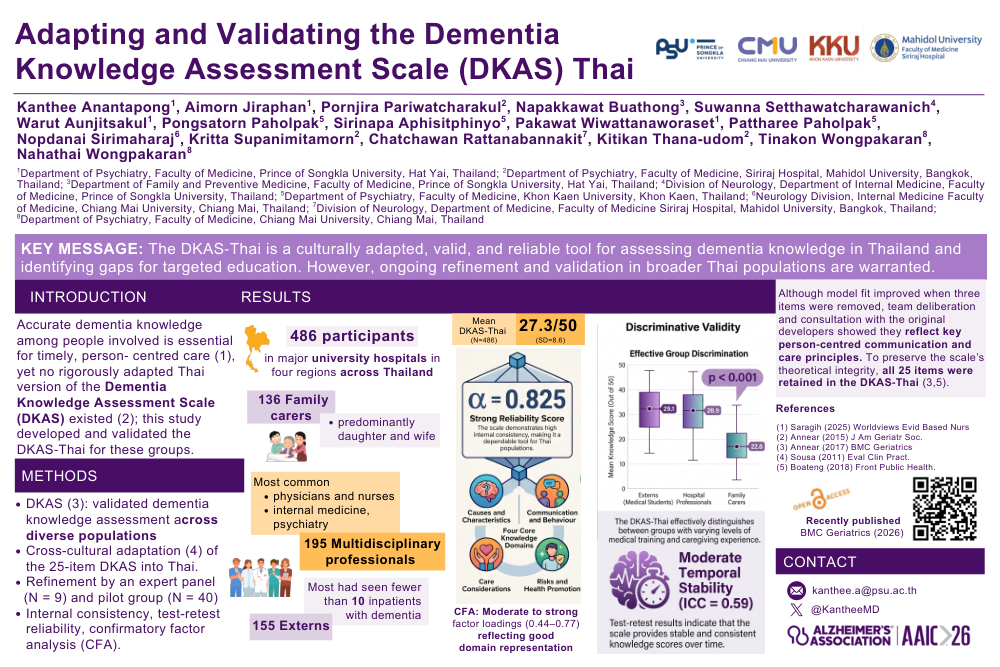
Background: Dementia constitutes a major public health challenge globally, with increasing prevalence linked to ageing populations. Enhancing dementia knowledge among healthcare professionals and lay carers is vital for improving quality of care, reducing stigma, and guiding targeted educational interventions. Accurate assessment of dementia literacy enables identification of knowledge gaps and evaluation of educational outcomes; however, validated tools for use in the Thai context are lacking.
Methods: The Dementia Knowledge Assessment Scale (DKAS) was translated into Thai using standard cross-cultural adaptation procedures involving expert review and pilot testing. The DKAS-Thai was then administered to 486 participants, including hospital professionals, family carers, and externs in four major university hospitals across four regions in Thailand. Psychometric properties were assessed by internal consistency (Cronbach’s alpha), test-retest reliability (intraclass correlation coefficients), and confirmatory factor analysis (CFA).
Results: The DKAS-Thai achieved good overall internal consistency (α = 0.825). Three subscales had reliability close to the 0.70 threshold (α = 0.621–0.750), while the Communication and Behaviour subscale remained low (α = 0.327). CFA supported the original four-factor structure with fit indices approaching acceptable levels (RMSEA = 0.083, CFI = 0.897, TLI = 0.884, SRMR = 0.109). Removal of poorly performing items did not meaningfully improve reliability. Test-retest reliability indicated moderate stability. Discriminative validity was established, with DKAS-Thai significantly differentiating dementia knowledge across professionals, externs, and family carers (p < 0.001).
Conclusions: The DKAS-Thai is a reliable and culturally adapted instrument for measuring dementia knowledge among Thai healthcare professionals and carers. Its application can support identification of knowledge gaps and inform development of targeted educational strategies. Further refinement and validation in wider Thai populations are recommended to enhance scale utility as dementia care continues to advance nationally.
Comments
Email is required but is not shown publicly.
Loading comments...