4,068 posters, 219 videos, 101 topics, 69 sessions, 14,365 authors, 6,128 institutions
ePostersLive by SciGen Technologies S.A. All rights reserved.
Alzheimer's Association International Conference 2026
July 12-15, 2026 | London, United Kingdom, and Online

2688
HIC and LMIC National Public Health Systems: reaping apprentices, sowing ideas
Poster Presenter
Authors
Paula Carnevale Vianna, Matheus Ghossain Barbosa, Lucas Martins Teixeira, Carolina Godoy, Fabiana A F da Mata, Marcelo Diniz, Ana Ágata Keinert, Fernanda Menezes de Faria, Thais Suarez, Andrew Miguel, Pedro Pinho, Rosa Camila Lucchetta, Cleusa Ferri
Affiliations
Research Unit, Hospital Alemao Oswaldo Cruz, Sao Paulo, Brazil, Research Unit, Hospital Alemao Oswaldo Cruz, Sao Paulo, Brazil; Psychiatry, Universidade Federal de São Paulo, São Paulo, Brazil, Psychiatry, Universidade Federal de São Paulo, São Paulo, Brazil, Research Unit, Hospital Alemao Oswaldo Cruz, Sao Paulo, Brazil;, Research Unit, Hospital Alemao Oswaldo Cruz, Sao Paulo, Brazil;Psychiatry, Universidade Federal de São Paulo, São Paulo, Brazil
Part of Topic
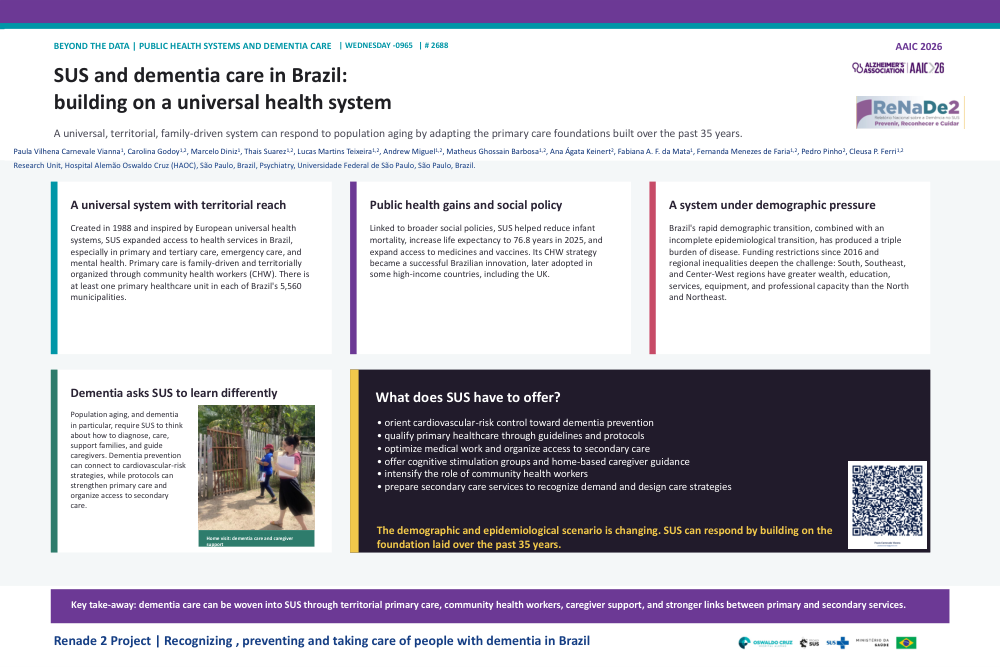
SUS, the Brazilian public health system, was established in 1988, inspired by European universal health systems. SUS improved access to health services, especially in primary and tertiary care, emergency, and mental health services. Primary care is family-driven and territorially organized, based on the work of community health workers (CHW), a successful strategy that has been adopted in some HICs, such as UK. There is at least one primary healthcare unit in each of the 5,560 Brazilian municipalities. Linked to social policies, SUS contributed to bring down infant mortality rate, to increase life expectancy (76.8 years in 2025), and to expand access to medicines and vaccines. The rapid demographic transition, coupled with an incomplete epidemiological transition, has led to a triple burden of disease. Funding, restricted since 2016 under a constitutional amendment, is another challenge, as are regional inequalities: the South, Southeast, and Center-West regions are richer, with better levels of education and installed capacity regarding equipment, services, and professionals, as compared to the North and Northeast regions. Population aging in general, and dementia in particular, add to such challenges—the system should learn to think about dementia, how to diagnose, care, and give support to people with dementia and caregivers. What does SUS have to offer? In primary care, strategies already implemented to control cardiovascular diseases could be oriented to dementia prevention; guidelines and protocols could qualify primary healthcare and optimize medical work, as well as organize access to secondary care; non-pharmacological strategies could be offered in groups (cognitive stimulation) and at home (guidance for caregivers), intensifying the CHW's role; secondary care services ought to recognize the demand and design care strategies. The demographic and epidemiological scenario is changing, and SUS can respond to this transition by building on the foundation laid over the past 35 years.
Comments
Email is required but is not shown publicly.
Loading comments...