4,068 posters, 219 videos, 101 topics, 69 sessions, 14,365 authors, 6,128 institutions
ePostersLive by SciGen Technologies S.A. All rights reserved.
Alzheimer's Association International Conference 2026
July 12-15, 2026 | London, United Kingdom, and Online

10391
Association Of Visual Mri Atrophy Scales And Cognitive Performance In The Cog-aging Cohort
Poster Presenter
Authors
Affiliations
Part of Topic
Video
Background: In low- and middle-income countries, where biological biomarkers are limited, magnetic resonance imaging (MRI) remains widely used for dementia diagnosis through visual atrophy scales (VAS). However, their association with cognitive performance still needs further investigation.
Objective: Evaluate the association between VAS and neuropsychological tests.
Methods: This cross-sectional study used data from the Cog-Aging cohort (2019–2024). Participants (n = 46) who underwent neuropsychological assessment within 6 months of MRI were included. Cognitive performance was assessed using Frontal Assessment Battery (FAB), Mattis Dementia Rating Scale (MDRS), and Rey Auditory Verbal Learning Test (RAVLT). MRI scans were rated using the medial temporal lobe atrophy (MTA), entorhinal cortex atrophy (ERICA), and posterior cortical atrophy (Koedam) scales. Associations between VAS and cognitive performance were assessed using partial Spearman’s correlations adjusted for age and education. Kruskal–Wallis tests with Dunn’s post hoc comparisons were applied to outcomes showing trend-level correlations (p = 0.05–0.10) to explore non-linear effects.
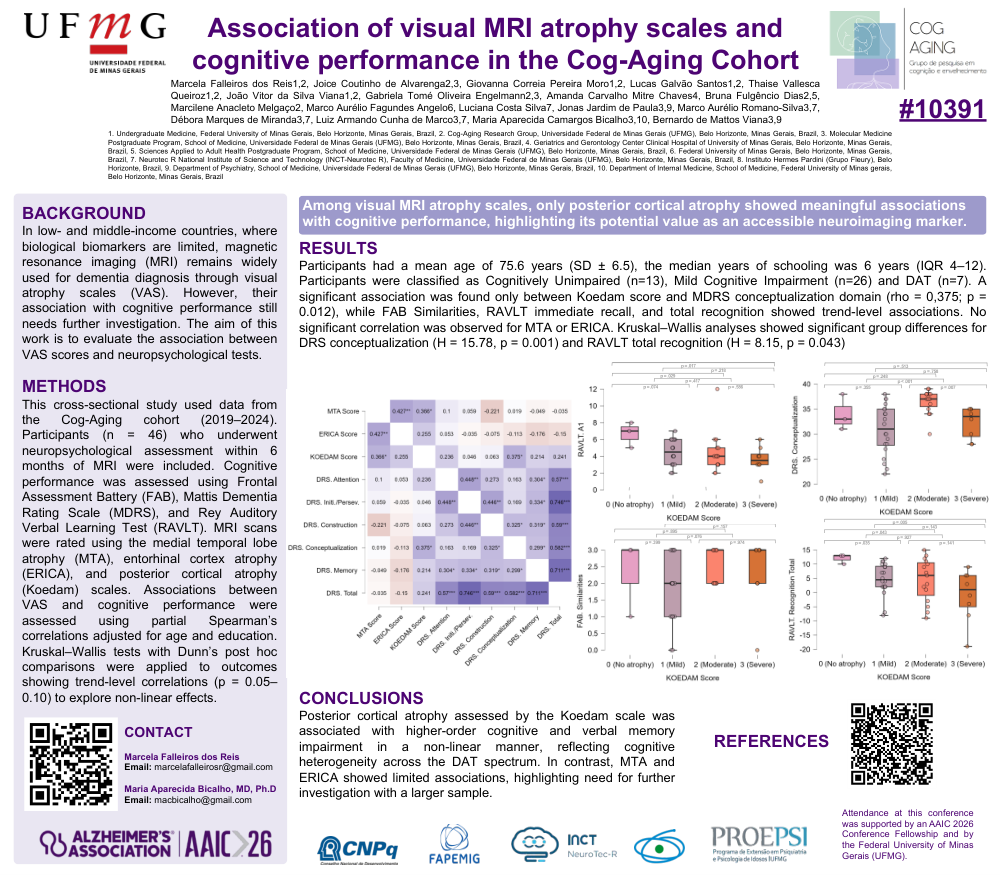
Results: Participants had a mean age of 75.6 years (SD ± 6.5), the median years of schooling was 6 years (IQR 4–12). Participants were classified as Cognitively Unimpaired (n=13), Mild Cognitive Impairment (n=26) and DAT (n=7) (Table 1). A significant association was found only between Koedam score and MDRS conceptualization domain (rho = 0,375; p = 0.012) (Figure 1), while FAB Similarities, RAVLT immediate recall (A1), and total recognition showed trend-level associations. No significant correlation was observed for MTA or ERICA. Kruskal–Wallis analyses showed significant group differences for DRS conceptualization (H = 15.78, p = 0.001) and RAVLT total recognition (H = 8.15, p = 0.043) (Figure 2). Post hoc analyses indicated a non-linear pattern for DRS conceptualization, with higher scores at intermediate levels (p < 0.05), and lower recognition performance in individuals with severe atrophy (p = 0.027).
Conclusion: Posterior cortical atrophy assessed by the Koedam scale was associated with higher-order cognitive and verbal memory impairment in a non-linear manner, reflecting cognitive heterogeneity across the DAT spectrum. In contrast, MTA and ERICA showed limited associations, highlighting need for further investigation with a larger sample.
Comments
Email is required but is not shown publicly.
Loading comments...