4,068 posters, 219 videos, 101 topics, 69 sessions, 14,365 authors, 6,128 institutions
ePostersLive by SciGen Technologies S.A. All rights reserved.
Alzheimer's Association International Conference 2026
July 12-15, 2026 | London, United Kingdom, and Online

10673
Academic Discipline And Willingness To Donate Brains For Research Among Nigerian University Students: A Cross-Sectional Study
Poster Presenter
Authors
Henry Oyoyo, Tobi Olajide, Ajibola Moshood, Chukwuma Igwe, David Akoki, Ayomide Falola, Chijioke Mgbeobukwa, Timileyin Olanrewaju, David Akinjare, Samuel Omojola, Olu-Pereao Orinayo, Chisom Obah, Sarah Olaoye, Tobi Akingbulugbe, Sodiq Lawal, David Babalola, Mayowa Owolabi, Rufus Akinyemi
Affiliations
College Research and Innovation Hub, Ibadan, Nigeria,, Neuroscience and Ageing Research Unit, Institute for Advanced Medical Research and Training, College of Medicine University of Ibadan, Ibadan, Nigeria, College of Health Sciences, Obafemi Awolowo University, Ile-Ife, Nigeria.
Part of Topic
Faculty and Departmental Differences in Inclination to Donate Brains for Research Among University of Ibadan Students: Implications for Awareness and Sensitization Programs
Authors : Henry Oyoyo1,2, Tobi Olajide1,2, Sodiq Lawal3,4, David Babalola2, Fuhad Moshood1,2, David Akoki1,2, Timileyin Olanrewaju1,2, Ayomide Fatola1,2, Samuel Omojola1,2, Barnabas Igwe1,2, Olu-Pereao Orinayoe1,2, Chijioke Mgbeobukwa1,2, David Akinjare1,2, Obah Chisom1,2, Olaoye Sarah1,2 , Akingbulugbe Tobi1,2, Mayowa Owolabi3, Rufus Akinyemi3
Affiliations: (1) College Research and Innovation Hub, Ibadan, Nigeria, (2) College of Medicine University of Ibadan, Ibadan, Nigeria, (3) Neuroscience and Ageing Research Unit, Institute for Advanced Medical Research and Training, College of Medicine University of Ibadan, Ibadan, Nigeria (4) College of Health Sciences, Obafemi Awolowo University, Ile-Ife, Nigeria.
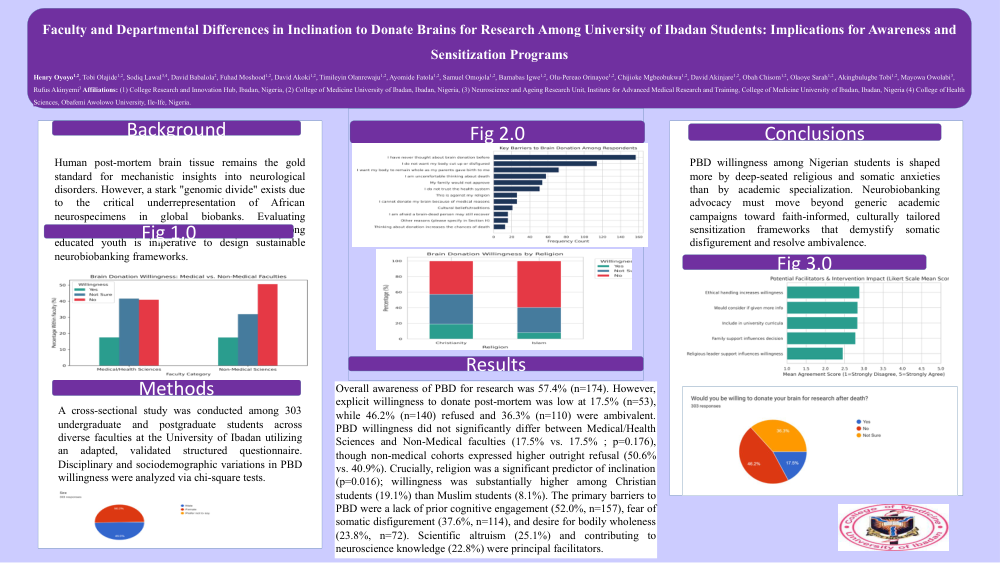
Background: Human post-mortem brain tissue remains the gold standard for mechanistic insights into neurological disorders. However, a stark "genomic divide" exists due to the critical underrepresentation of African neurospecimens in global biobanks. Evaluating posthumous brain donation (PBD) inclination among educated youth is imperative to design sustainable neurobiobanking frameworks.
Methods: A cross-sectional study was conducted among 303 undergraduate and postgraduate students across diverse faculties at the University of Ibadan utilizing an adapted, validated structured questionnaire. Disciplinary and sociodemographic variations in PBD willingness were analyzed via chi-square tests.
Results: Overall awareness of PBD for research was 57.4% (n=174). However, explicit willingness to donate post-mortem was low at 17.5% (n=53), while 46.2% (n=140) refused and 36.3% (n=110) were ambivalent. PBD willingness did not significantly differ between Medical/Health Sciences and Non-Medical faculties (17.5% vs. 17.5% ; p=0.176), though non-medical cohorts expressed higher outright refusal (50.6% vs. 40.9%). Crucially, religion was a significant predictor of inclination (p=0.016); willingness was substantially higher among Christian students (19.1%) than Muslim students (8.1%). The primary barriers to PBD were a lack of prior cognitive engagement (52.0%, n=157), fear of somatic disfigurement (37.6%, n=114), and desire for bodily wholeness (23.8%, n=72). Scientific altruism (25.1%) and contributing to neuroscience knowledge (22.8%) were principal facilitators.
Conclusion: PBD willingness among Nigerian students is shaped more by deep-seated religious and somatic anxieties than by academic specialization. Neurobiobanking advocacy must move beyond generic academic campaigns toward faith-informed, culturally tailored sensitization frameworks that demystify somatic disfigurement and resolve ambivalence.
Comments
Email is required but is not shown publicly.
Loading comments...