4,068 posters, 219 videos, 101 topics, 69 sessions, 14,365 authors, 6,128 institutions
ePostersLive by SciGen Technologies S.A. All rights reserved.
Alzheimer's Association International Conference 2026
July 12-15, 2026 | London, United Kingdom, and Online

10852
Preferred Language And Delirium In Hospitalized Older Adults With Dementia: An EHR-based Cohort Study
Poster Presenter
Authors
Affiliations
Part of Topic
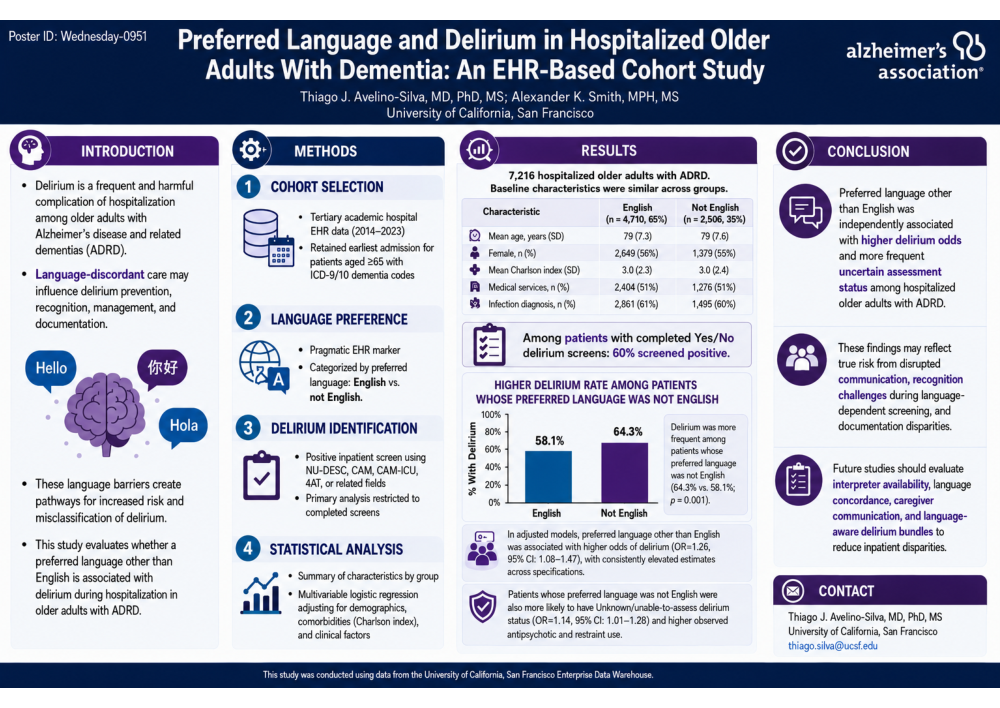
Background: Delirium is a frequent and harmful complication of hospitalization among older adults with Alzheimer’s disease and related dementias (ADRD). Language-discordant care may influence delirium prevention, recognition, management, and documentation, creating pathways for both increased risk and misclassification. We evaluated whether preferred language other than English is associated with delirium during hospitalization in older adults with ADRD.
Methods: We conducted a cohort study using de-identified EHR data from a tertiary academic hospital (2014-2023). We identified admissions for adults aged ≥65 years with ICD-9/ICD-10 dementia codes and retained each patient’s earliest qualifying admission. Preferred language was categorized as English vs. Not English, a pragmatic EHR marker of language-access. Delirium was defined as any positive inpatient screen using NU-DESC, CAM, CAM-ICU, 4AT, or related flowsheet fields; primary analyses were restricted to admissions with completed Yes/No screens. We summarized characteristics by language group and delirium status and used multivariable logistic regression adjusted for demographics, Charlson index, acute illness proxies, vitals, labs, service, and year.
Results: We included 7,216 hospitalized older adults with ADRD. Baseline characteristics were similar across language groups: mean age was 79 years, 55% were female, mean Charlson index was 3, 51% were admitted to medical services, and 60% had an infection diagnosis. Not English preferred language was reported by 2,506 (35%). Among admissions with completed Yes/No delirium screens, 60% screened positive. Delirium was more frequent among patients with Not English preferred language than English-preferring patients (64.3% vs. 58.1%; p=0.001). In adjusted models, Not English preferred language was associated with higher delirium odds (OR=1.26, 95%CI=1.08-1.47), with consistently elevated estimates across specifications. Patients with Not English preferred language were also more likely to have Unknown/unable-to-assess delirium status (OR=1.14, 95%CI=1.01-1.28) and higher observed antipsychotic and restraint use.
Conclusion: Preferred language other than English was independently associated with higher delirium odds and more frequent uncertain assessment status among hospitalized older adults with ADRD. These findings may reflect true risk from disrupted communication, recognition challenges during language-dependent screening, and documentation disparities. Future studies should evaluate interpreter availability, language concordance, caregiver communication, and language-aware delirium bundles to reduce inpatient disparities.
Comments
Email is required but is not shown publicly.
Loading comments...