4,068 posters, 219 videos, 101 topics, 69 sessions, 14,365 authors, 6,128 institutions
ePostersLive by SciGen Technologies S.A. All rights reserved.
Alzheimer's Association International Conference 2026
July 12-15, 2026 | London, United Kingdom, and Online

5159
Care Service Use, Care Home Residency, And Hospitalisation At The End Of Life Among People With Dementia In England And Wales
Poster Presenter
Authors
Part of Topic
Abstract:
Background: Unplanned hospitalisations are common among people with dementia towards the end of life, often contrary to the preferences of patients and families. Little is known about care service use among people with dementia near the end of life, how this differs by care setting, and the association with hospitalisation. This study examines primary and community care service use and hospitalisation in the last three months of life among people with dementia living at home or in care homes.
Methods: Secondary analysis of a nationally representative post-bereavement survey conducted in 2023 in England and Wales. We describe care service use for decedents with dementia according to overnight hospitalisation in their last three months of life. Our analysis was restricted to those with outcome (hospitalisation) data and stratified by place of residence.
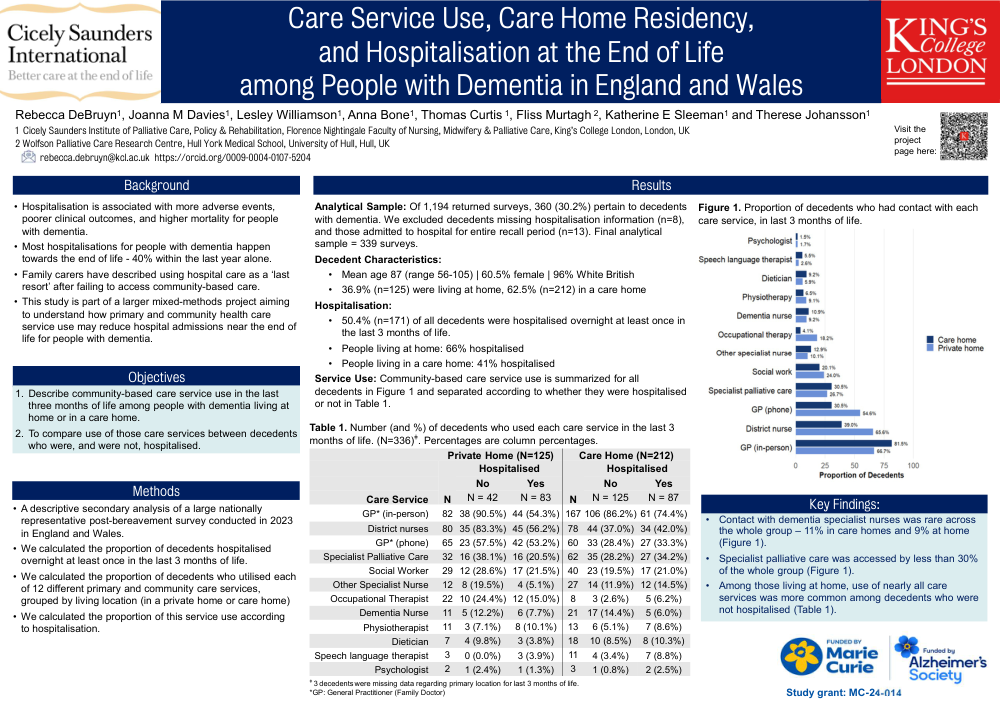
Results: 1,194 surveys were received, of which 360 regarded decedents with dementia. Of the analytic sample (n=339), 131 (39%) were male, mean age was 87 (range 56-105), and 324 (96%) were White British. Prior to death or final hospital admission, 212 (63%) were living in a care home, and 125 (37%) in a private home. Overall, 50% of decedents were hospitalised overnight at least once: hospitalisation was more common among those living at home 82 (66%) compared to care home residents 87 (41%). Among those living at home, non-hospitalised individuals had higher use of nearly all care services (Table 1). Among care home residents, hospitalisation was less common for those who received care from dementia nurses, GPs (in-person), and healthcare assistants, whereas hospitalisation was more common if individuals had telephone contact with a GP, or received care from district/community nurses, specialist palliative care teams, occupational therapists, physiotherapists, dieticians, psychologists or counsellors, and speech-language therapists.
Conclusion: Primary and community care service use was more common among decedents living at home who were not hospitalised in their final three months of life, aligning with existing evidence that timely access to community care services mitigates avoidable hospitalisations. Our findings highlight variation in service use by care setting (private vs. care home) and hospitalisation status, suggesting care home residence may moderate these relationships.
Comments
Email is required but is not shown publicly.
Loading comments...