4,068 posters, 219 videos, 101 topics, 69 sessions, 14,365 authors, 6,128 institutions
ePostersLive by SciGen Technologies S.A. All rights reserved.
Alzheimer's Association International Conference 2026
July 12-15, 2026 | London, United Kingdom, and Online

8659
The Availability And Uptake Of Non-pharmacological Dementia Interventions In The UK And Barriers To Their Access: A Systematic Review
Poster Presenter
Authors
Iain Hartnell, Cliodhna Mallon, Lou Crathorne, Freya Luling Feilding, Hayley Hogan
Affiliations
Part of Topic
The Availability And Uptake Of Non-pharmacological Dementia
Interventions In The UK And Barriers To Their Access: A Systematic Review
Dr Iain Hartnell, Cliodhna Mallon, Lou Crathorne, Freya Luling Feilding, Hayley Hogan
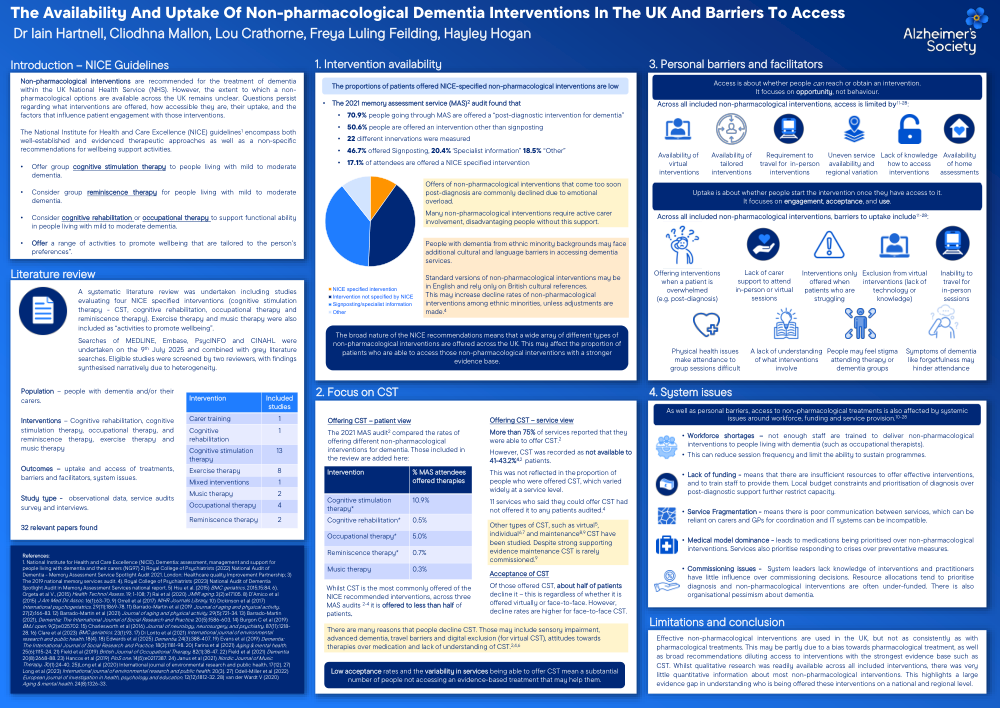
Introduction – NICE Guidelines
NICE guidance for dementia care in the UK recommends several non‑drug approaches. These include well‑established therapies with strong evidence, as well as broader wellbeing‑focused activities. The guidelines advise offering:
-
Group cognitive stimulation therapy (CST) for people with mild to moderate dementia
-
Group reminiscence therapy for the same population
-
Cognitive rehabilitation or occupational therapy to support functional ability
-
A personalised range of activities that promote wellbeing
Quoted line from the poster: “Offer group cognitive stimulation therapy to people living with mild to moderate dementia.”
Despite these recommendations, it is unclear how consistently such interventions are available across the UK, how accessible they are, and what influences whether people engage with them.
Literature Review
A systematic review was conducted, covering CST, cognitive rehabilitation, occupational therapy, reminiscence therapy, exercise therapy, and music therapy. Searches were run on MEDLINE, Embase, PsycINFO, and CINAHL (9 July 2025), supplemented with grey literature.
Eligibility criteria included:
-
Population: people with dementia and/or their carers
-
Interventions: the NICE‑specified therapies plus exercise and music therapy
-
Outcomes: access, uptake, barriers, facilitators, and system‑level issues
-
Study types: observational studies, audits, surveys, interviews
A total of 32 studies were included.
Breakdown:
-
CST: 13
-
Exercise therapy: 8
-
Occupational therapy: 4
-
Music therapy: 2
-
Reminiscence therapy: 2
-
Cognitive rehabilitation: 1
-
Carer training: 1
-
Mixed interventions: 1
1. Intervention Availability
Findings from the 2021 Memory Assessment Service (MAS) audit show:
-
70.9% of people undergoing MAS receive some form of post‑diagnostic intervention
-
50.6% receive something beyond simple signposting
-
22 different interventions were recorded
-
Signposting was offered to 46.7%
-
Specialist information to 20.4%
-
“Other” interventions to 18.5%
-
Only 17.1% were offered a NICE‑specified intervention
People often decline interventions offered immediately after diagnosis because they feel emotionally overwhelmed. Many interventions require active carer involvement, which disadvantages people without such support.
People from ethnic minority backgrounds may face additional barriers, including language and cultural mismatch. Standard versions of interventions often rely on English and British cultural references, which can reduce uptake unless adapted.
Because NICE recommendations are broad, services offer a wide variety of interventions, which may dilute access to those with the strongest evidence base.
3. Personal Barriers and Facilitators
Access Barriers (Opportunity)
Across all interventions, access is limited by:
-
Limited availability of virtual formats
-
Lack of tailored or personalised versions
-
Need to travel for in‑person sessions
-
Regional variation in service provision
-
Limited knowledge of how to access services
-
Restricted availability of home‑based assessments
Uptake Barriers (Engagement)
Once people have access, uptake is hindered by:
-
Interventions offered when people feel overwhelmed (e.g., immediately post‑diagnosis)
-
Lack of carer support for attending sessions
-
Interventions only offered when people are already struggling
-
Digital exclusion for virtual formats
-
Travel difficulties
-
Physical health issues that make group attendance challenging
-
Stigma associated with therapy or dementia groups
-
Dementia symptoms such as forgetfulness affecting attendance
-
Limited understanding of what the interventions involve
2. Focus on Cognitive Stimulation Therapy (CST)
Offering CST – Patient View
MAS audit data shows the proportion of attendees offered each therapy:
-
CST: 10.9%
-
Cognitive rehabilitation: 0.5%
-
Occupational therapy: 5.0%
-
Reminiscence therapy: 0.7%
-
Music therapy: 0.3%
Across multiple audits, CST is offered to less than half of patients.
Offering CST – Service View
More than 75% of services report that they can provide CST. However:
-
CST was recorded as not available to 41–43.2% of patients
-
Some services that claim to offer CST did not offer it to any audited patients
-
There is wide variation between services
Alternative CST formats exist (virtual, individual, maintenance). Maintenance CST has strong evidence but is rarely commissioned.
Acceptance of CST
Around half of people offered CST decline it, whether virtual or in‑person. Decline rates are higher for face‑to‑face CST.
Reasons include:
-
Sensory impairments
-
Advanced dementia
-
Travel barriers
-
Digital exclusion
-
Preference for medication over therapy
-
Limited understanding of CST
Low acceptance and inconsistent offering mean many people miss out on an evidence‑based intervention.
4. System Issues
System‑level barriers also restrict access:
Workforce Shortages
-
Not enough trained staff (e.g., occupational therapists)
-
Reduced session frequency
-
Difficulty sustaining programmes
Funding Constraints
-
Insufficient resources to deliver interventions
-
Limited funding for staff training
-
Local budgets prioritise diagnosis over post‑diagnostic support
Service Fragmentation
-
Poor communication between services—
Comments
Email is required but is not shown publicly.
Loading comments...