4,068 posters, 219 videos, 101 topics, 69 sessions, 14,365 authors, 6,128 institutions
ePostersLive by SciGen Technologies S.A. All rights reserved.
Alzheimer's Association International Conference 2026
July 12-15, 2026 | London, United Kingdom, and Online

4683
The Participatory Advisory Board For Dementia Research Rostock: Evaluation Of Members’ Motivation, Challenges, Facilitators, And Impact
Poster Presenter
Authors
Part of Topic
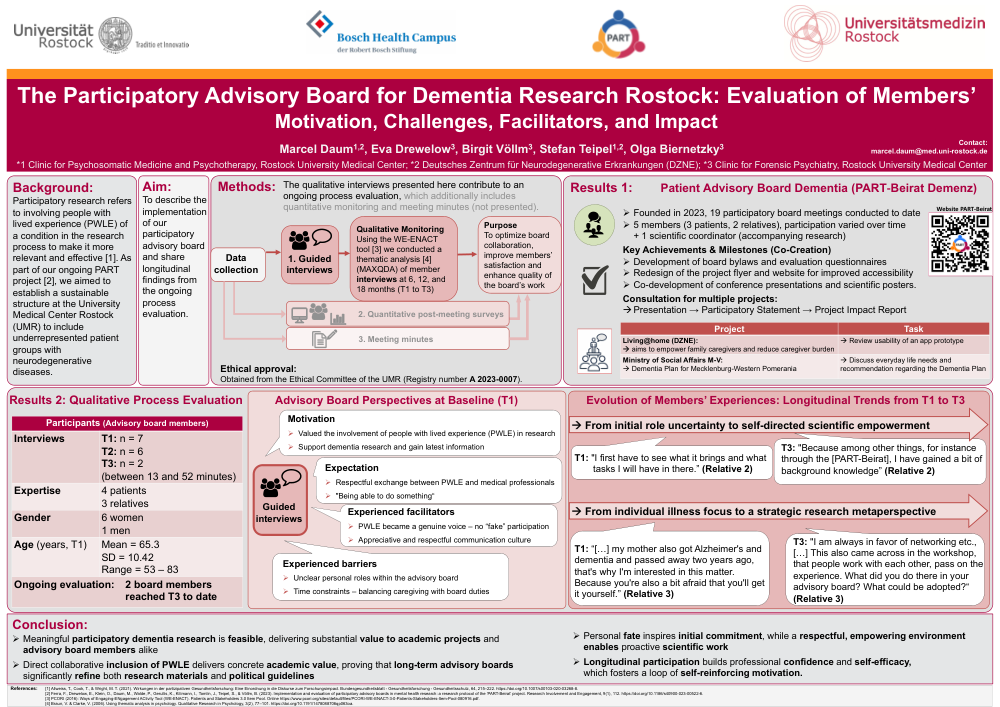
Background: Participatory research actively involves people with lived experience into the research process to improve its relevance and impact. As part of a sustainable structure to include patients with dementia and relatives, we established a participatory advisory board for dementia research (PART-Beirat Demenz) at the University Medical Center Rostock.
This study aimed to evaluate members’ experience, focussing on motivations, impact, and facilitators and challenges. Furthermore, the evaluation served to iteratively improve the advisory board experience in a participatory manner.
Methods: A longitudinal qualitative evaluation was conducted at three time points: after establishment (T1), after 6–8 months (T2), and after 12-14 months (T3). We utilized the qualitative components of an adapted German version of the WE-ENACT (Ways of Engaging – ENgagement ACtivity Tool) to capture in-depth experiences regarding the nature and extent of involvement. Data collection is ongoing until all current members reach their final evaluation point. The interviews were audio-recorded and transcribed. Data were analysed with MAXQDA using thematic analysis.
Results: To date, 14 semi-structured interviews have been completed (T1: n=7; T2: n=5; T3: n=2) with n=4 patients, n=3 relatives . Preliminary analysis indicates that initial motivations were driven by a desire to "give back" and improve research. Furthermore, participants reported an increase in self-efficacy and valued the cognitive stimulation provided by the board’s activities. Facilitators for long-term engagement included a good atmosphere, a positive communication culture, interesting topics, and flexible meeting formats. However, significant challenges were identified, including role uncertainty, the need for dementia-sensitive communication, and time constraints. The longitudinal data shows that constant adaptation of the participatory framework is necessary to address the specific cognitive and emotional needs of members.
Conclusions: The longitudinal evaluation of an active patient advisory board reveals that patient involvement into research is an individual and dynamic process. The findings underscore that establishing a dementia advisory board requires continuous, responsive quality management. Final results will provide a scalable framework for sustaining participatory structures in dementia research networks, to ensure meaningful impact for both researchers and people with lived experience.
Comments
Email is required but is not shown publicly.
Loading comments...