4,068 posters, 219 videos, 101 topics, 69 sessions, 14,365 authors, 6,128 institutions
ePostersLive by SciGen Technologies S.A. All rights reserved.
Alzheimer's Association International Conference 2026
July 12-15, 2026 | London, United Kingdom, and Online

3503
How Dementia Shapes Hospital Length-of-stay Trajectories In The Final Years Of Life
Poster Presenter
Authors
Thaís Barros Pereira da Silva, Thales Batista de Souza, Natália Cochar-Soares, Sara Souza Lima, Jassiely Priscilla de Faria Santos, Mariane Marques Luiz, Roberta de Oliveira Máximo, Andrew Steptoe, Cesar de Oliveira, Tiago da Silva Alexandre
Affiliations
Department of Gerontology, Federal University of São Carlos, São Carlos, Brazil, Department of Physiotherapy, Federal University of São Carlos, São Carlos, Brazil, Department of Behavioural Science and Health, University College London, London, United Kingdom, Department of Epidemiology and Public Health, University College London, London, United Kingdom
Part of Topic
P0938 How dementia shapes hospital length-of-stay trajectories in the final years of life
Thaís Barros Pereira da Silva1, Thales Batista de Souza2, Natália Cochar-Soares1, Sara Souza Lima2, Jassiely Priscilla de Faria Santos2, Mariane Marques Luiz2, Roberta de Oliveira Máximo1, Andrew Steptoe3, Cesar de Oliveira4, Tiago da Silva Alexandre1,4.
1Department of Gerontology, Federal University of São Carlos, São Carlos, Brazil, 2Department of Physiotherapy, Federal University of São Carlos, São Carlos, Brazil, 3Department of Behavioural Science and Health, University College London, London, United Kingdom, 4Department of Epidemiology and Public Health, University College London, London, United Kingdom.
INTRODUCTION
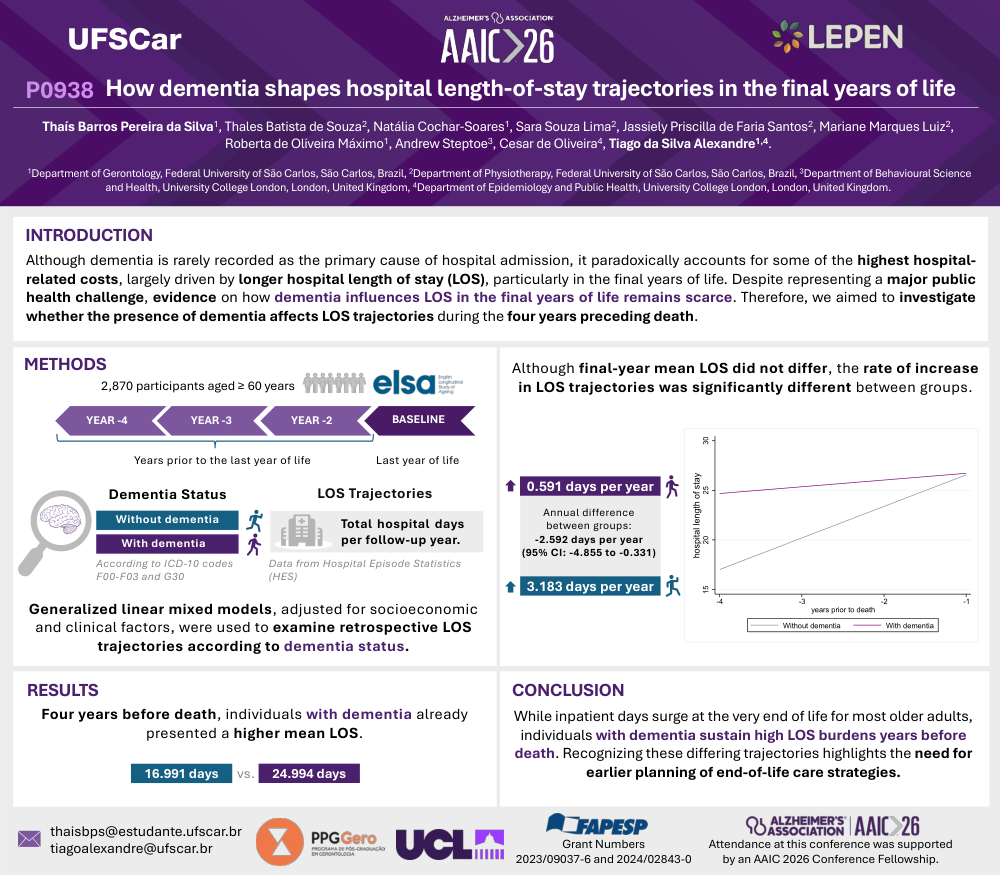
Although dementia is rarely recorded as the primary cause of hospital admission, it paradoxically accounts for some of the highest hospital-related costs, largely driven by longer hospital length of stay (LOS), particularly in the final years of life. Despite representing a major public health challenge, evidence on how dementia influences LOS in the final years of life remains scarce. Therefore, we aimed to investigate whether the presence of dementia affects LOS trajectories during the four years preceding death.
METHODS
2,870 participants aged ≥ 60 years
Years prior to the last year of life
Last year of life
Dementia Status
Without dementia
With dementia
According to ICD-10 codes F00-F03 and G30
LOS Trajectories
Total hospital days per follow-up year.
Data from Hospital Episode Statistics (HES)
Generalized linear mixed models, adjusted for socioeconomic and clinical factors, were used to examine retrospective LOS trajectories according to dementia status.
RESULTS
Four years before death, individuals with dementia already presented a higher mean LOS.
16.991 days vs. 24.994 days
Although final-year mean LOS did not differ, the rate of increase in LOS trajectories was significantly different between groups.
0.591 days per year
Annual difference between groups: -2.592 days per year (95% CI: -4.855 to -0.331)
3.183 days per year
CONCLUSION
While inpatient days surge at the very end of life for most older adults, individuals with dementia sustain high LOS burdens years before death. Recognizing these differing trajectories highlights the need for earlier planning of end-of-life care strategies.
thaisbps@estudante.ufscar.br
tiagoalexandre@ufscar.br
Grant Numbers 2023/09037-6 and 2024/02843-0
Attendance at this conference was supported by an AAIC 2026 Conference Fellowship.
Comments
Email is required but is not shown publicly.
Loading comments...