4,068 posters, 219 videos, 101 topics, 69 sessions, 14,365 authors, 6,128 institutions
ePostersLive by SciGen Technologies S.A. All rights reserved.
Alzheimer's Association International Conference 2026
July 12-15, 2026 | London, United Kingdom, and Online

8643
Transcranial Photobiomodulation In Dementia With Lewy Bodies: A Proof-of-concept Sham-controlled Trial
Poster Presenter
Authors
Sara Illick, Anne Botzung, Léa Sanna, Malvina Billères, Antoine Robinet, John Mitrofanis, Olivier Bousiges, Julien Lamy, Frédéric Blanc, Éléna Chabran
Affiliations
ICube Laboratory UMR 7357, Université de Strasbourg, CNRS, Strasbourg, France, University Hospitals of Strasbourg, CM2R (Research and Resources Memory Centre), Geriatric Day Hospital, Neurogeriatric Service, Geriatrics department, Strasbourg, France, Université Grenoble Alpes, Fonds de Dotation Clinatec, Grenoble, France
Part of Topic
Transcranial Photobiomodulation in Dementia with Lewy Bodies: A Proof-of-Concept Sham-Controlled Trial (W-0929)
Methodology for a randomized proof of concept study on the effect of transcranial PBM on clinical symptoms, quality of life, and brain connectivity in DLB.
Dementia with Lewy Bodies (DLB) is the second most common progressive neurocognitive disorder after Alzheimer’s disease1
Photobiomodulation (PBM) involves applying red to infrared light (λ=600-1000nm) to body tissues
Light absorption by photoreceptors located in the mitochondria ↑ energy production (ATP)
Can penetrate up to 30-50mm in some brain regions2
Positive results were seen in Alzheimer’s and Parkinson’s disease3,4
Early-stage DLB: cortically located pathology and characterized by synaptic dysfunction rather than cell death5, therefore PBM has a high potential for clinical and symptomatic effects.
Objectives: To explore the effect of PBM on clinical symptoms, quality of life, and brain connectivity in patients with DLB after 3 and 6 months of twice daily PBM sessions, as well as one month post intervention for any remanent effect.
Randomized, double-blind, sham-controlled, proof-of-concept trial.
Study setting: CM2R, Strasbourg University Hospital Center (Strasbourg, France)
Participants : N=30
> 50 years old, probable or prodromal DLB MMSE score ≥ 18/30
Presence of a daily caregiver Head circumference 54-62cm
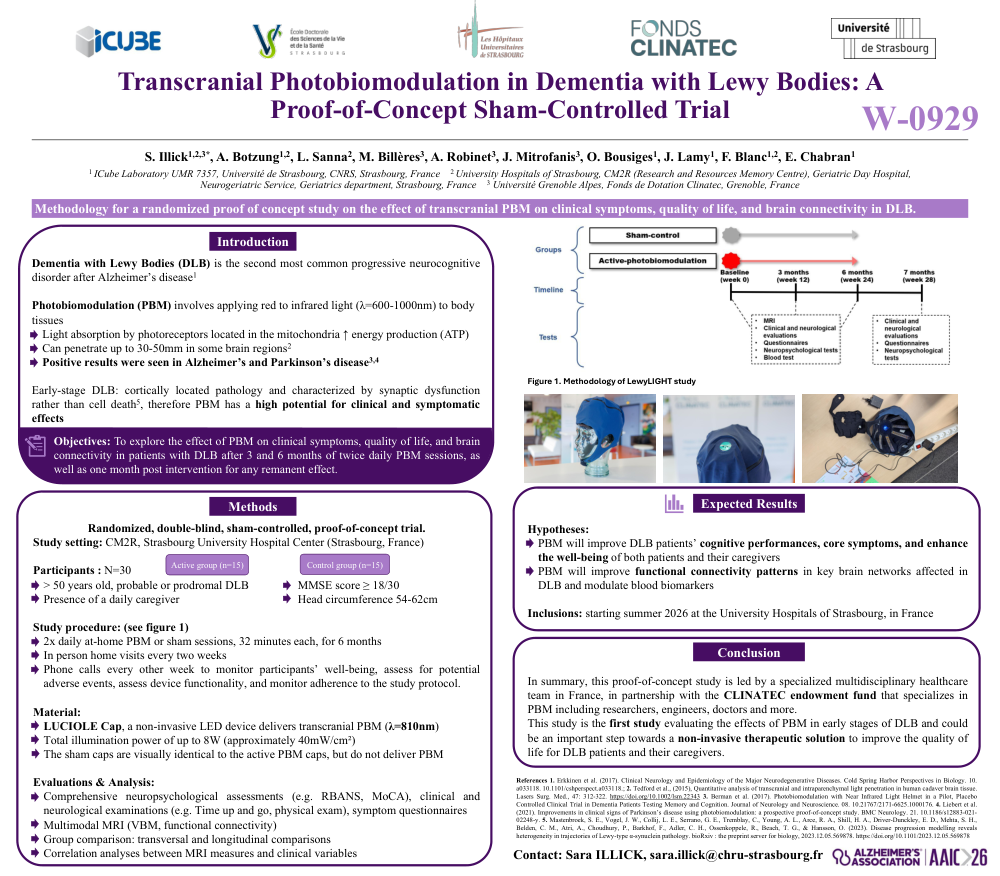
Study procedure: (see figure 1)
2x daily at-home PBM or sham sessions, 32 minutes each, for 6 months
In person home visits every two weeks
Phone calls every other week to monitor participants’ well-being, assess for potential adverse events, assess device functionality, and monitor adherence to the study protocol.
Material:
LUCIOLE Cap, a non-invasive LED device delivers transcranial PBM (λ=810nm)
Total illumination power of up to 8W (approximately 40mW/cm²)
The sham caps are visually identical to the active PBM caps, but do not deliver PBM
Evaluations & Analysis:
Comprehensive neuropsychological assessments (e.g. RBANS, MoCA), clinical and neurological examinations (e.g. Time up and go, physical exam), symptom questionnaires
Multimodal MRI (VBM, functional connectivity)
Group comparison: transversal and longitudinal comparisons
Correlation analyses between MRI measures and clinical variables
Comments
Email is required but is not shown publicly.
Loading comments...