4,068 posters, 219 videos, 101 topics, 69 sessions, 14,365 authors, 6,128 institutions
ePostersLive by SciGen Technologies S.A. All rights reserved.
Alzheimer's Association International Conference 2026
July 12-15, 2026 | London, United Kingdom, and Online

4855
Mhealth For Family Carers
Poster Presenter
Part of Topic
Expert views on co-designing an mHealth app for family carers managing behavioural and psychological symptoms of dementia: a qualitative study
Background
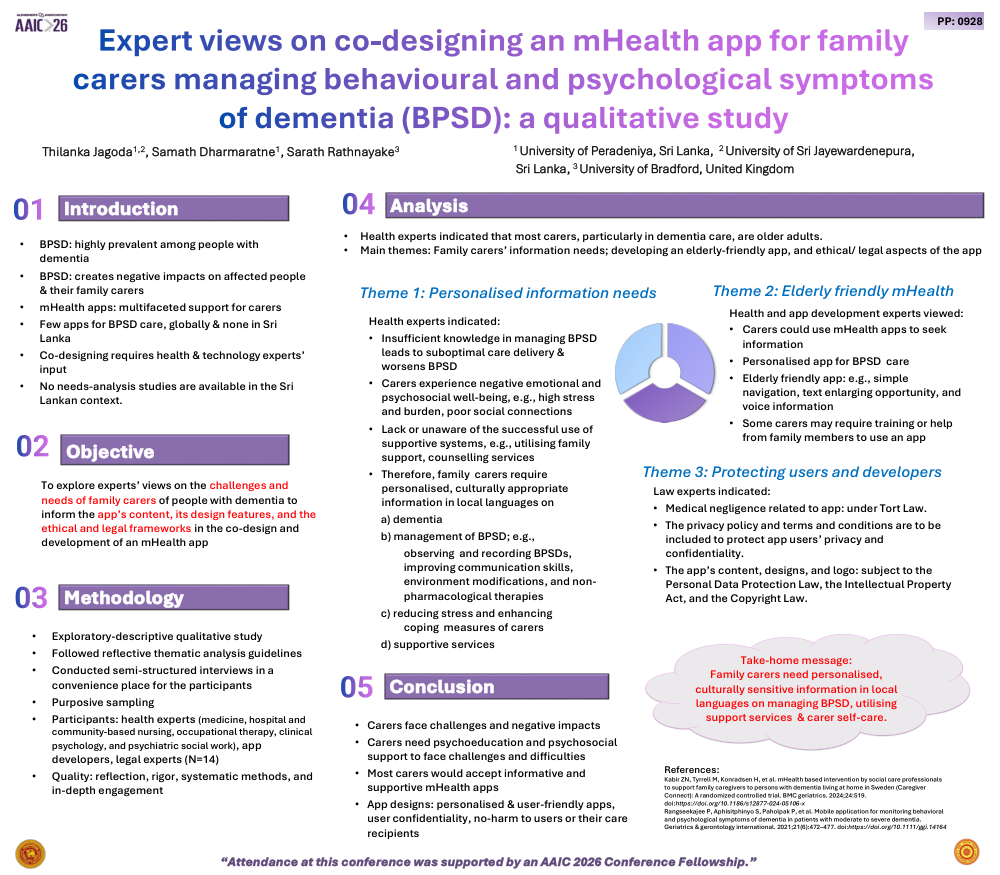
Behavioural and psychological symptoms of dementia (BPSD) are highly prevalent and mostly troublesome for family carers of people with dementia. mHealth apps provide multifaceted support for carers; however, few have been developed specifically for BPSDs. This study aimed to explore experts’ views on the challenges and needs of family carers in a resource-limited country to inform the app’s content, its design features, and the ethical and legal frameworks for app development.
Method
This qualitative study was conducted following the reflective thematic analysis guidelines. Semi-structured face-to-face interviews were conducted with purposively selected health experts (psychiatrists, psychologists, nurses, psychosocial officers, occupational therapists), mobile app developers, and legal experts (N=14). Interviews were transcribed and analysed manually.
Results
Three themes were yielded from the findings. Health experts noted that mitigating care challenges requires personalised information on care delivery, particularly regarding the management of BPSDs. Carers’ insufficient knowledge in managing BPSDs leads to suboptimal care, which worsens behavioral changes of people with dementia. This directs carers to experience negative emotional and psychosocial well-being, such as high stress and burden, and poor social connections. Health experts suggested enhancing carers’ knowledge of observing and recording BPSDs, improving communication skills, reducing stress, and developing coping strategies. Carers were unaware of the successful use of supportive systems. Health and app development experts viewed that carers could use mHealth apps to seek information. A personalised app, simple navigation, text enlargement opportunity, and voice information were suggested for an elderly-friendly app. Law experts revealed that medical negligence related to app use falls under Tort Law. The privacy policy and terms and conditions should outline how to protect app users’ privacy and confidentiality. The app’s content, designs, and logo are subject to the Personal Data Protection Law, the Intellectual Property Act, and the Copyright Law.
Conclusion
The findings indicate that carers’ lives become incredibly difficult in caring for people with dementia experiencing BPSDs. These challenges were due to a lack of knowledge, neglecting one’s own well-being, and underutilisation of supportive services, highlighting the need for education and psychosocial support. Most carers would accept a user-friendly mHealth solution for information and support.
Comments
Email is required but is not shown publicly.
Loading comments...