4,068 posters, 219 videos, 101 topics, 69 sessions, 14,365 authors, 6,128 institutions
ePostersLive by SciGen Technologies S.A. All rights reserved.
Alzheimer's Association International Conference 2026
July 12-15, 2026 | London, United Kingdom, and Online

9310
Plasma Neurofilament Light Chain To Support Delirium Diagnosis In Hospitalised Older Adults
Poster Presenter
Authors
Matthew Kang, Dhamidhu Eratne, Thomas Borchard, Christa Dang, Alexander Santillo, Henrik Zetterberg, Philip Mitchell, Malcolm Hopwood, Dennis Velakoulis
Affiliations
National Ageing Research Institute, Neuropsychiatry Centre, The Royal Melbourne Hospital; Department of Psychiatry, University of Melbourne, Ramsay Clinic Northside, Lund University, Department of Clinical Sciences,, Clinical Neurochemistry Laboratory, Sahlgrenska University Hospital; Department of Psychiatry and Neurochemistry, Institute of Neuroscience and Physiology, University of Gothenburg, School of Clinical Medicine, University of New South Wales, Professorial Psychiatry Unit, Ramsay Clinic Albert Road; Department of Psychiatry, The University of Melbourne
Part of Topic
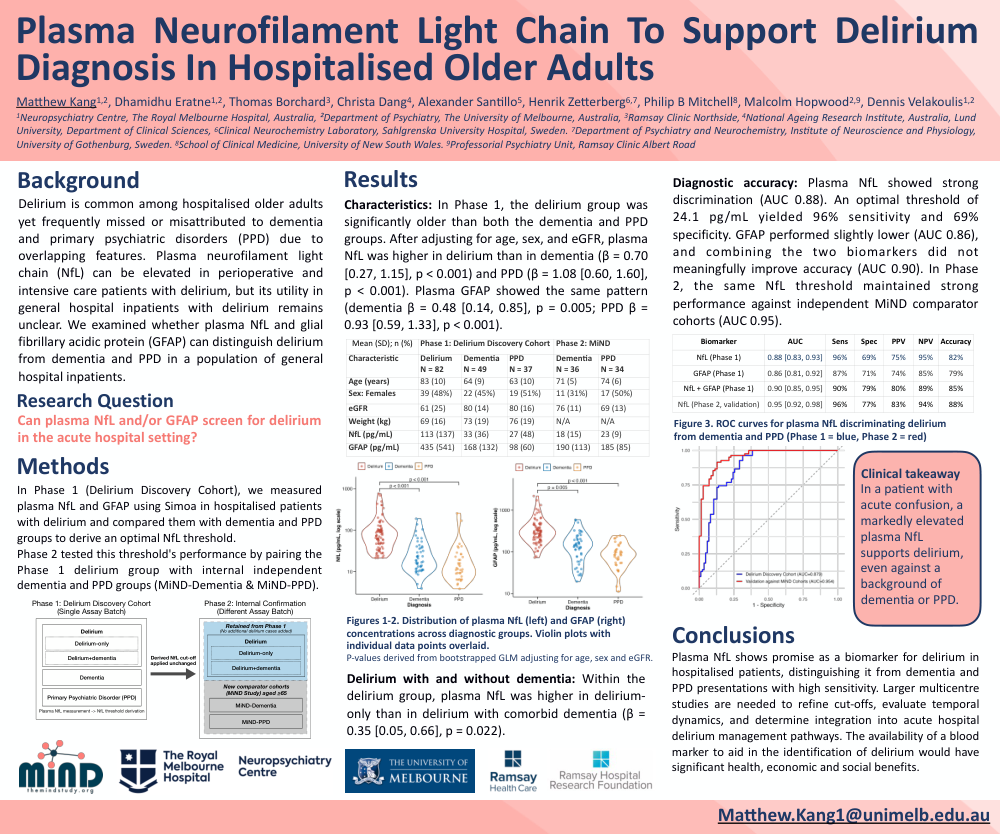
Background: Delirium is common among hospitalised older adults yet frequently missed or misattributed to dementia and primary psychiatric disorders (PPD) due to overlapping features. Plasma neurofilament light chain (NfL) can be elevated in perioperative and intensive care patients with delirium, but its utility in general hospital inpatients with delirium remains unclear. We examined whether plasma NfL and glial fibrillary acidic protein (GFAP) can distinguish delirium from dementia and PPD in a population of general hospital inpatients.
Methods: In Phase 1 (Delirium Discovery Cohort), we measured NfL and GFAP in hospitalised patients with delirium and compared them with dementia and PPD groups to derive an optimal NfL threshold. Phase 2 tested this threshold's performance by pairing the Phase 1 delirium group with internal independent dementia and PPD groups.
Results: In Phase 1 (n = 168), inpatients with delirium showed higher levels of both NfL and GFAP than dementia or PPD groups. Receiver operating characteristic (ROC) curve analysis yielded an optimal NfL threshold of 24.1 pg/mL (AUC = 0.88, 96% sensitivity, 69% specificity). GFAP showed marginally lower accuracy (AUC = 0.86), and combining NfL with GFAP (AUC = 0.90) did not significantly improve performance. In Phase 2 (n = 70), the NfL threshold of > 24 pg/ml maintained strong performance (AUC = 0.95, 96% sensitivity, and 77% specificity).
Conclusions: Plasma NfL shows promise as a biomarker for delirium in hospitalised patients, distinguishing it from dementia and PPD presentations with high sensitivity. Larger multicentre studies are needed to refine cut-offs, evaluate temporal dynamics, and determine integration into acute hospital delirium management pathways. The availability of a blood marker to aid in the identification of delirium would have significant health, economic and social benefits.
Comments
Email is required but is not shown publicly.
Loading comments...