4,068 posters, 219 videos, 101 topics, 69 sessions, 14,365 authors, 6,128 institutions
ePostersLive by SciGen Technologies S.A. All rights reserved.
Alzheimer's Association International Conference 2026
July 12-15, 2026 | London, United Kingdom, and Online

10611
Education, Social Isolation, And Homebound Status As Dimensions Of Cognitive Vulnerability In A Brazilian Primary Care Population
Poster Presenter
Part of Topic
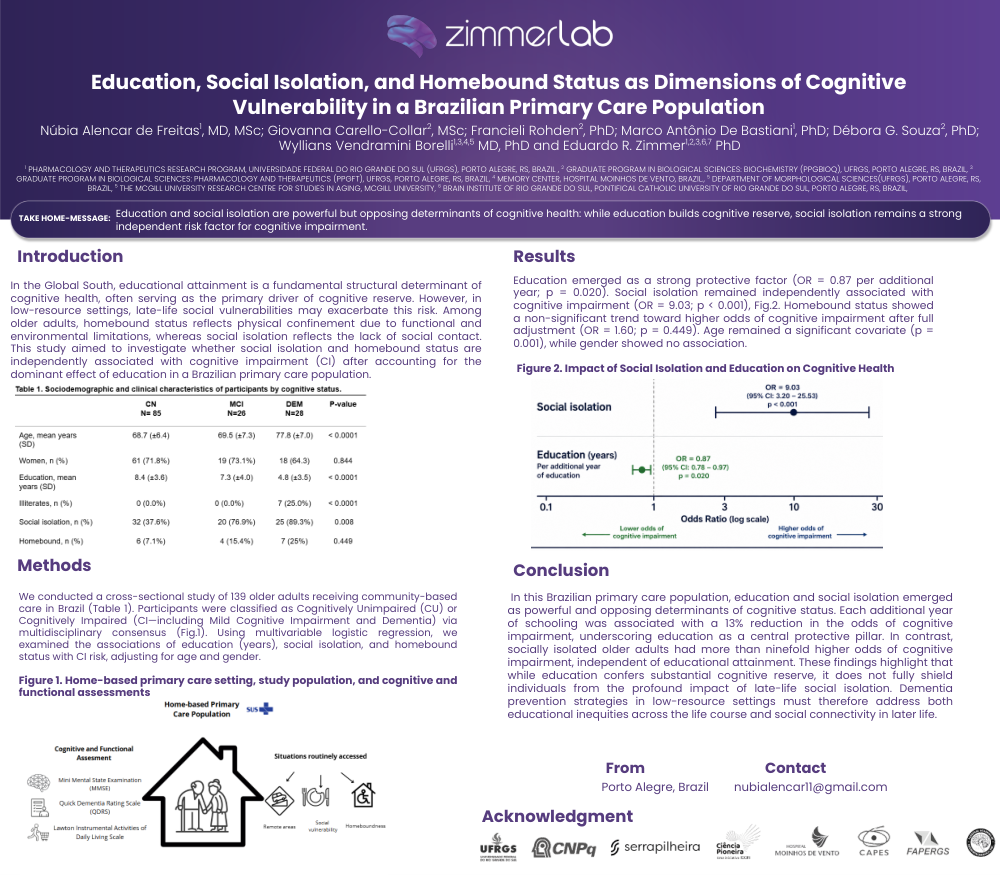
Background: In the Global South, educational attainment is a fundamental structural determinant of cognitive health, often serving as the primary driver of cognitive reserve. However, in low-resource settings, late-life social vulnerabilities may exacerbate this risk. Among older adults, homebound status reflects physical confinement due to functional and environmental limitations, whereas social isolation reflects the lack of social contact. This study aimed to investigate whether social isolation and homebound status are independently associated with cognitive impairment (CI) after accounting for the dominant effect of education in a Brazilian primary care population.
Methods: We conducted a cross-sectional study of 139 older adults receiving community-based care in Brazil (Table 1). Participants were classified as Cognitively Unimpaired (CU) or Cognitively Impaired (CI—including Mild Cognitive Impairment and Dementia) via multidisciplinary consensus (Fig.1). Using multivariable logistic regression, we examined the associations of education (years), social isolation, and homebound status with CI risk, adjusting for age and gender.
Results: Education emerged as a strong protective factor (OR = 0.87 per additional year; p = 0.020). Social isolation remained independently associated with cognitive impairment (OR = 9.03; p < 0.001), Fig.2. Homebound status showed a non-significant trend toward higher odds of cognitive impairment after full adjustment (OR = 1.60; p = 0.449). Age remained a significant covariate (p = 0.001), while gender showed no association.
Conclusions: In this Brazilian primary care population, education and social isolation emerged as powerful and opposing determinants of cognitive status. Each additional year of schooling was associated with a 13% reduction in the odds of cognitive impairment, underscoring education as a central protective pillar. In contrast, socially isolated older adults had more than ninefold higher odds of cognitive impairment, independent of educational attainment. These findings highlight that while education confers substantial cognitive reserve, it does not fully shield individuals from the profound impact of late-life social isolation. Dementia prevention strategies in low-resource settings must therefore address both educational inequities across the life course and social connectivity in later life.
Comments
Email is required but is not shown publicly.
Loading comments...