4,068 posters, 219 videos, 101 topics, 69 sessions, 14,365 authors, 6,128 institutions
ePostersLive by SciGen Technologies S.A. All rights reserved.
Alzheimer's Association International Conference 2026
July 12-15, 2026 | London, United Kingdom, and Online

3188
Feasibility of a Primary Care-embedded Brain Health Navigator to Facilitate Cognitive Assessment and Risk Stratified Clinical Pathway
Poster Presenter
Authors
Deanna Willis, Wen Xian Zhou, Nicole Fowler, Diana Summanwar, Jared Brosch, Megan Bernath, Anna Montelongo, Tobias Schamberger, Dustin Hammers
Affiliations
Indiana University School of Medicine Department of Family Medicine, Indiana University School of Medicine Department of Neurology, Indiana University School of Medicine Department of Medicine, Indiana University School of Medicine
Part of Topic
Video
Feasibility of a Primary Care-embedded Brain Health Navigator to Facilitate Cognitive Assessment and Risk Stratified Clinical Pathway
Background
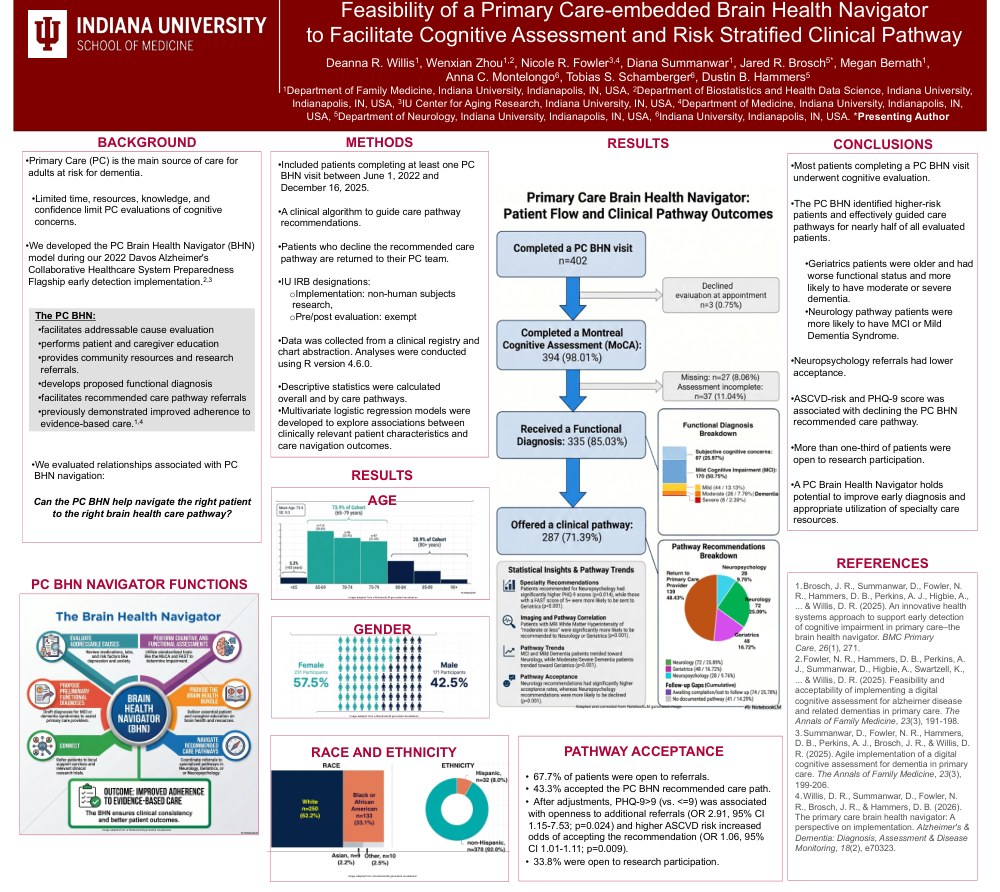
Primary Care (PC) is the main source of care for adults at risk for dementia. Scalable approachesguiding care remain limited. Wedeveloped the PC Brain Health Navigator (BHN) program during our Davos Alzheimer’s Collaborative Healthcare System Preparedness implementation andimproved adherence to evidence-based care.1We evaluated feasibility of facilitatingimpairment-risk based referrals using a PC BHN.
Methods
A PC BHN program was implemented in three health-system regions (June 2022-December 2025). PC providers referred patients for abnormal brief cognitive screening or subjective concerns. The BHN used a clinical algorithm to guide pathway recommendations.
Results
Patients:Of 2,046 eligible patients, 402(19.7%) completed a BHN visit. 98.0% (393/402) completed additional cognitive screening, 85.0% received a preliminary functional diagnosis (subjective cognitive concerns, MCI, or dementia syndrome), and 53.5% completed MRI. Addressable factors were common (elevated risk scores:depression (PHQ-9)(17.2%), anxiety(GAD-7) (11.2%), anticholinergic (22.6%), cardiovascular (ASCVD) (92.4%)).37/215 (9.2%) patientsdemonstrated more than moderate white matter.
Pathways:A pathway (neuropsychology, neurology, geriatrics, or return to PC) was recommended for 287(71.4%) patients. Pathways differed significantly across demographics and clinical features, (age, race/ethnicity, education, Medicaid, PHQ-9, GAD-7, functional status (FAST), preliminary functional diagnosis, pathway acceptance; all p≤0.05).Geriatrics:patientsmore often older and Hispanic, with worse FAST; Neurology:patients were more often Black, with higher acceptance (72.2%); Neuropsychology:higher PHQ-9 and lower acceptance; Return to PCP:more undetermined diagnoses.
Acceptance of Recommendations:272 (67.7%) patients were open to any additional referrals.Adjusted for demographics, PHQ-9 >9 (vs ≤9) associated with greater openness to additional referrals (OR 2.91, 95% CI 1.15-7.35; p=0.024).47.9% (n=173)accepted the BHN-recommended pathway. Higher ASCVD-risk increased odds of declining the recommendation (OR 1.06, 95% CI 1.01-1.11; p=0.009). 33.8% (136/402) were open to research participation.
Conclusions
Most patients completing aPC BHN visit underwent cognitive evaluation. The BHN identifiedhigher-risk patients and effectively guided care pathways for nearly half of all evaluated patients. Neuropsychology referrals had lower acceptance, and ASCVD-risk was associated with pathway decline.
-
Brosch J etal. "An innovative health systems approach to support early detection of cognitive impairment in primary care–the brain health navigator." BMC PrimaryCare 26.1(2025):271.
Comments
Email is required but is not shown publicly.
Loading comments...