4,068 posters, 219 videos, 101 topics, 69 sessions, 14,365 authors, 6,128 institutions
ePostersLive by SciGen Technologies S.A. All rights reserved.
Alzheimer's Association International Conference 2026
July 12-15, 2026 | London, United Kingdom, and Online

1651
Understanding The Meaning Of A 'good Death' For People Living With Parkinson's Disease: Qualitative Study
Poster Presenter
Authors
Leonardo Martins, Rasa Mikelyte, Ricardo Silva Carvalho, Henrique Ballalai Ferraz, Déborah Oliveira, Julia Maria Vanelli, Natália Rocha Tardelli, Fernanda Bono Fukushima, Edison Iglesias de Oliveira Vidal
Affiliations
Botucatu Medical School, São Paulo State University (UNESP), Botucatu, Brazil, Centre for Health Services Studies, University of Kent, Canterbury, UK, Federal University of São Paulo, São Paulo, Brazil, Universidad Andrés Bello, Faculty of Nursing, Viña del Mar, Chile | Millenium Institute for Care Research (MICARE), Santiago, Chile
Part of Topic
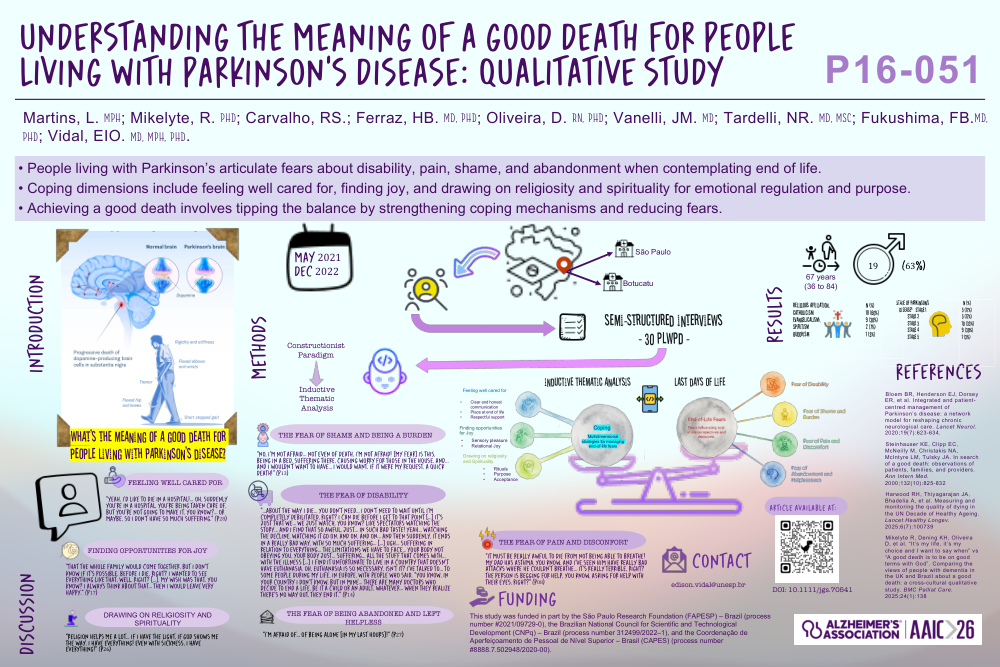
Background: Parkinson's disease is the second most common neurodegenerative disorder globally.Despite growing attention to palliative care in Parkinson’s disease, little is known about what constitutes a “good death” from the perspective of people living with Parkinson’s disease (PLwPD).
Objective: To explore the meaning of a good death for PLwPD.
Methods: In this cross-sectional multicentre qualitative study, we conducted semi-structured interviews with 30 PLwPD recruited through purposive sampling from four geriatric and neurology outpatient clinics between May 2021 and December 2022. Transcripts were analysed using inductive thematic analysis. The process involved independent coding and iterative discussions grounded in a constructionist paradigm.
Results: The sample was diverse in terms of race, gender, age, religious affiliation, educational background, and disease stage. We identified two major themes related to the participants’ last days of life:Fears and Coping. Reported fears included experiencing disability, pain and discomfort, fear of feeling shame, fear of being a burden, fear of being abandoned and left helpless. Coping was a multidimensional theme, comprising the relational experience of feeling well cared for (defined by being valued, receiving clear and honest communication, and being treated with love and kindness) alongside the active strategies of finding opportunities for joy and drawing on religiosity and spirituality. Religiosity/spirituality appeared as a key factor in emotional regulation, fostering a sense of purpose and acceptance in the face of death.
Conclusion: Our findings suggest that improving palliative care for PLwPD requires an approach that actively addresses specific fears and strengthens the multiple dimensions of coping, which includes fostering opportunities for joy, supporting spirituality, and enhancing the relational experience of feeling well cared for. This study illuminates often-overlooked aspects of care and provides a basis for the development of person-centered interventions aimed at enhancing the quality of dying—and of life—in this population.
Published article available at: https://agsjournals.onlinelibrary.wiley.com/doi/epdf/10.1111/jgs.70541
Comments
Email is required but is not shown publicly.
Loading comments...