4,068 posters, 219 videos, 101 topics, 69 sessions, 14,365 authors, 6,128 institutions
ePostersLive by SciGen Technologies S.A. All rights reserved.
Alzheimer's Association International Conference 2026
July 12-15, 2026 | London, United Kingdom, and Online

9692
Implementation And Use Of Educational Chatbots To Support Apoe Testing For Anti-amyloid Therapy
Poster Presenter
Authors
Part of Topic
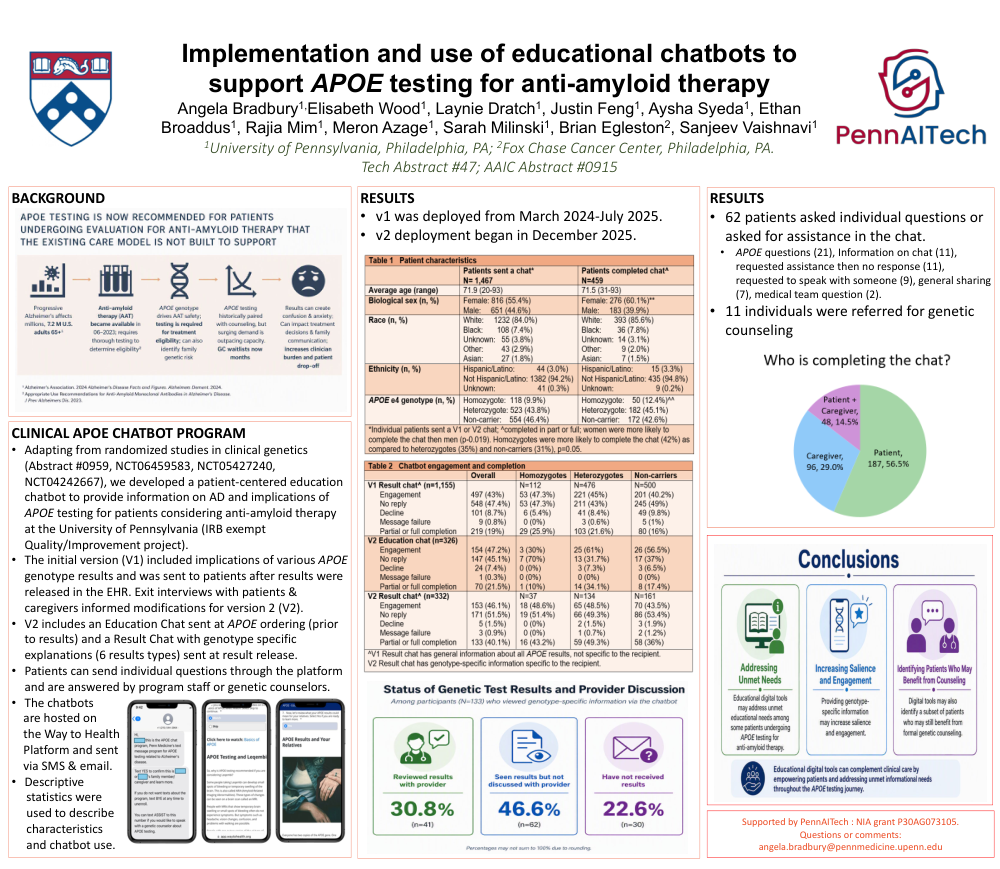
Background: Anti-amyloid therapies are available for Alzheimer’s disease (AD) and APOE genotyping is key to assessing treatment risks. Traditional genetic counseling is not feasible given patient volumes and immediate treatment implications. Digital education tools could support patients undergoing APOE testing without genetic counseling.
Methods: Adapting from randomized studies in clinical genetics, we develop a patient-centered education chatbot to provide information on AD and implications of APOE testing for patients considering anti-amyloid therapy. The initial version (v1) included general implications of various APOE genotype results. Rapid cycle testing and exit interviews with patients/caregivers informed modifications. A revised version (v2) included genotype specific information (6 result types). The chatbot was sent to patients who received APOE results by SMS text. Descriptive statistics were used to describe uptake and use of the chatbot.
Results: From March 2024 – July 2025, the v1 chatbot was sent to 633 patients, with 134 (21.2%) accessing the educational content in part or full. Accessing content varied by genotype: 32.2% of e4 homozygotes, 21.7% of e4 heterozygotes and 18.3% of non-carriers accessed the educational content (p0.056). 43 participants sent individual questions through the chat and 8 completed genetic counseling. As of December 2025, the v2 chatbot was sent to 55 patients, with 22 (40%) accessing content in part or full. Accessing content varied by genotype: 50.0% of e4 homozygotes, 55.6% of e4 heterozygotes and 31.4% of non-carriers (p=0.23). Among 16 who viewed genotype specific information via the chatbot, 4 (25%) had already reviewed results with their provider, 6 (37.5%) had seen their results but had not discussed with their provider, and 4 (29%) had not received their results. None have sent individualized questions or requested genetic counseling. With approximately 30 APOE results returned each month, we expect to have data on at least 200 patients who have received the v2 chatbot by July 2026.
Conclusions: Educational digital tools may address unmet educational needs among some patients undergoing APOE testing for anti-amyloid therapy. Providing genotype specific information may increase salience and engagement. Digital tools may also identify a subset of patients who may still benefit from formal genetic counseling.
Comments
Email is required but is not shown publicly.
Loading comments...