4,068 posters, 219 videos, 101 topics, 69 sessions, 14,365 authors, 6,128 institutions
ePostersLive by SciGen Technologies S.A. All rights reserved.
Alzheimer's Association International Conference 2026
July 12-15, 2026 | London, United Kingdom, and Online

9966
The Usefulness Of The Idea Screening Tool In The Clinics Of Mbeya Hospitals In Southern Tanzania
Poster Presenter
Authors
Part of Topic
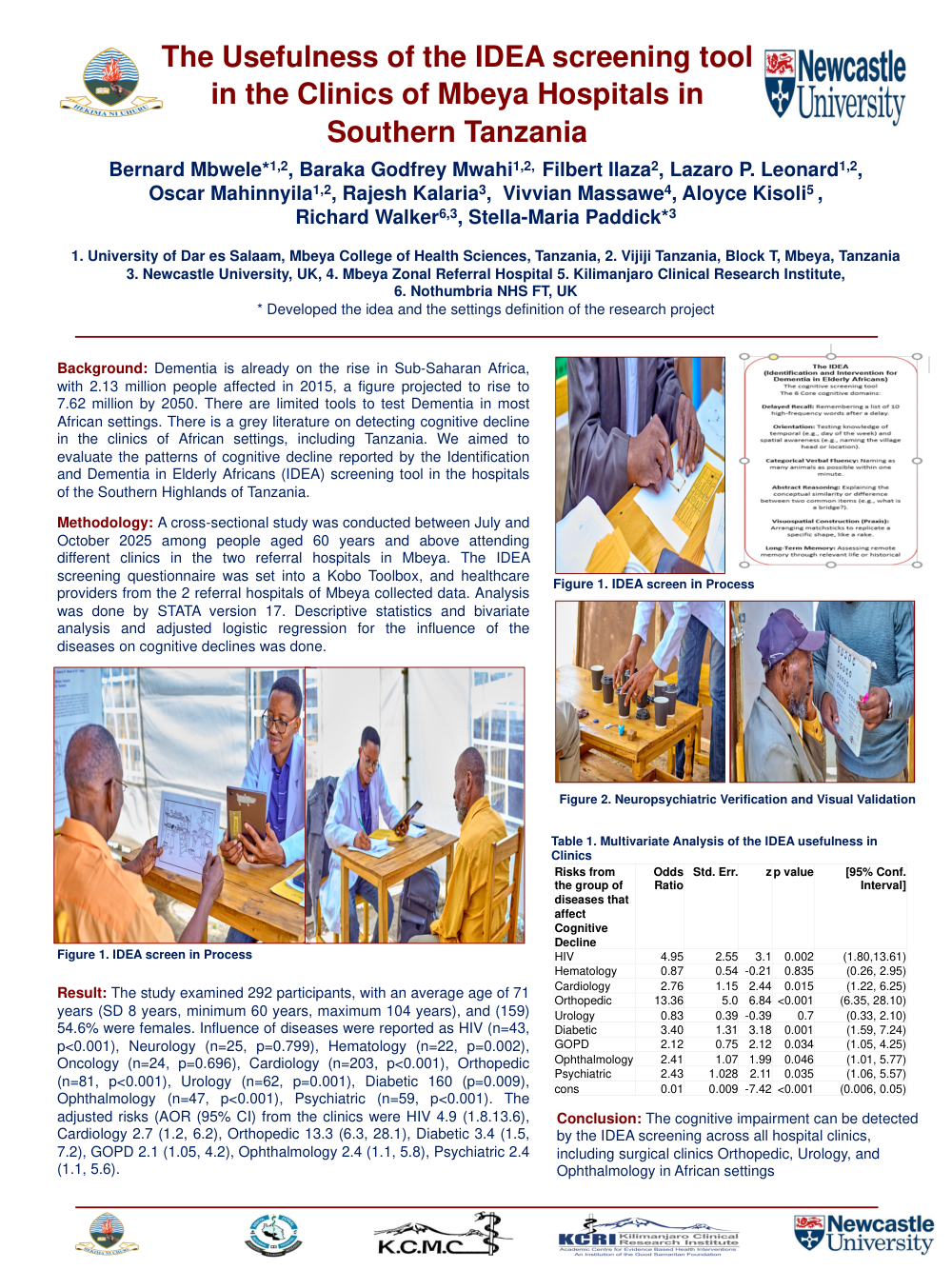
The Usefulness of the IDEA screening tool in the Clinics of Mbeya Hospitals in Southern Tanzania
Mbwele B*1,2, Massawe V1,2, Mwahi, B.G1,2, Kisoli. A4. Filbert Ilaza2, Leonard L. P. 1,2, Mahinnyila, O 1,2, Kalaria, R. 3, Walker R. W3, Paddick, S-M*3
1. University of Dar es Salaam, Mbeya College of Health Sciences, Tanzania
2. Vijiji Tanzania, Block T, Mbeya, Tanzania
3. Newcastle University, UK
4. Kilimanjaro Clinical Research Institute
5. Nothumbria NHS FT, UK
* Developed the idea and the settings definition of the research project
Background
Dementia is already on the rise in Sub-Saharan Africa, with 2.13 million people affected in 2015, a figure projected to rise to 7.62 million by 2050. There are limited tools to test Dementia in most African settings. There is a grey literature on detecting cognitive decline in the clinics of African settings, including Tanzania. We aimed to evaluate the patterns of cognitive decline reported by the Identification and Dementia in Elderly Africans (IDEA) screening tool in the hospitals of the Southern Highlands of Tanzania.
Methodology
A cross-sectional study was conducted between July and October 2025 among people aged 60 years and above attending different clinics in the two referral hospitals in Mbeya. The IDEA screening questionnaire was set into a Kobo Toolbox, and healthcare providers from the 2 referral hospitals of Mbeya collected data. Analysis was done by STATA version 17. Descriptive statistics were done for continuous variables and categorical variables, and bivariate analysis of diseases in clinics that influence cognitive decline by the Chi-square test and adjusted logistic regression for the influence of the diseases on cognitive declines.
Results
The study examined 292 participants, with an average age of 71 years (SD 8 years, minimum 60 years, maximum 104 years), and (159) 54.6% were females. Demographically, 127 were farmers (43.5%), 93 had secondary education (31.9%), and 158 were married or living with a spouse (54%). From the IDEA screening tool, 69 participants had score of <7 (23.7%), 25 mild cognitive impairments (8.6%), and 197 presumably normal scores (67.7%). Influence of diseases were reported as HIV (n=43, p<0.001), Neurology (n=25, p=0.799), Hematology (n=22, p=0.002), Oncology (n=24, p=0.696), Cardiology (n=203, p<0.001), Orthopedic (n=81, p<0.001), Urology (n=62, p=0.001), Diabetic 160 (p=0.009), Ophthalmology (n=47, p<0.001), Psychiatric (n=59, p<0.001). The adjusted risks (AOR (95% CI) from the clinics were HIV 4.9 (1.8.13.6), Cardiology 2.7 (1.2, 6.2), Orthopedic 13.3 (6.3, 28.1), Diabetic 3.4 (1.5, 7.2), GOPD 2.1 (1.05, 4.2), Ophthalmology 2.4 (1.1, 5.8), Psychiatric 2.4 (1.1, 5.6).
Conclusion
The cognitive impairment can be detected by the IDEA screening across all hospital clinics, including surgical clinics Orthopedic, Urology, and Ophthalmology in African settings.
Comments
Email is required but is not shown publicly.
Loading comments...