4,068 posters, 219 videos, 101 topics, 69 sessions, 14,365 authors, 6,128 institutions
ePostersLive by SciGen Technologies S.A. All rights reserved.
Alzheimer's Association International Conference 2026
July 12-15, 2026 | London, United Kingdom, and Online

529
Intelligent Support Systems For Individuals At Risk Of Neurodegenerative Diseases
Poster Presenter
Authors
Affiliations
DiLab, Management Information Systems Department, San Diego State University, Neuroinformatics Lab, Department of Neurology, Center for Design, Discovery, and Data Analytics in Neurological Disorders, Department of Epidemiology and Biostatistics at University of California, Irvine
Part of Topic
Video
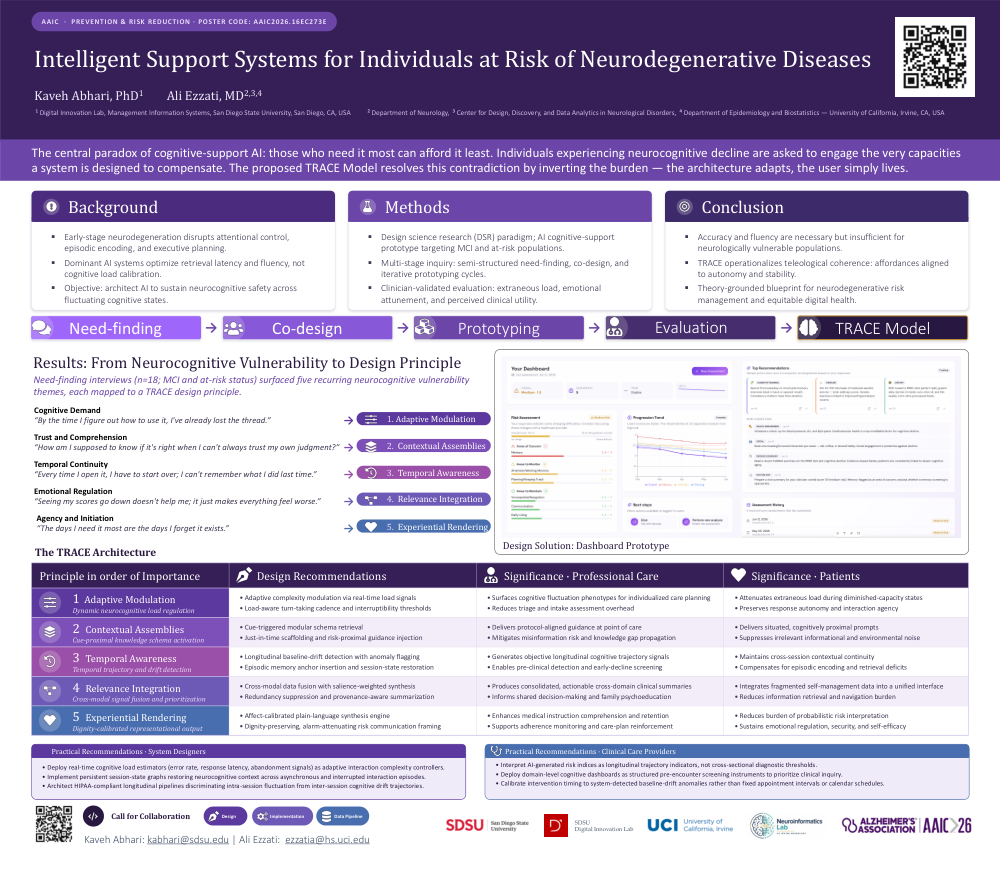
Background: Individuals at risk of neurodegenerative diseases experience emerging challenges in attention, memory, planning, and meaning-making that can erode confidence long before formal diagnosis. Although artificial intelligence tools promise greater access to information and assistance, most systems prioritize speed, retrieval, and linguistic fluency rather than cognitive preservation. These assumptions conflate availability with accessibility, reducing support to a delivery problem rather than a design imperative. For people experiencing early cognitive vulnerability, comprehension, emotional security, and continuity of daily functioning are paramount. This study investigates how AI-enabled support systems can be architected to reinforce understanding, reduce cognitive strain, and sustain autonomy for individuals navigating the early stages of neurodegenerative risk.
Methods: We employed design science research to prototype and evaluate an AI-based cognitive support agent for individuals with early or suspected neurodegenerative decline. We analyzed how specific architectural design choices affect usability, cognitive load, emotional attunement, and perceived support. Data were examined to identify the structural features that enable the system to stabilize comprehension, enhance task follow-through, and adapt to fluctuating cognitive capacity.
Results: Five architectural principles (TRACE) emerged as foundational to meaningful cognitive support. (1) Adaptive Modulation enables the system to adjust interactions to the user's shifting cognitive energy, attentional bandwidth, and moment-to-moment intent. (2) Contextual Assemblies activate relevant knowledge structures — including risk-specific, behavioral, and clinical information — based on situational cues. (3) Temporal Awareness monitors patterns over time, recognizing changes in routines, memory failures, or decision-making difficulties. (4) Relevance Integration synthesizes multimodal data such as reminders, symptom logs, environmental context, and personal history. (5) Experiential Rendering conveys complex medical or behavioral insights through accessible, emotionally attuned representations that reduce cognitive burden.
Conclusion: TRACE challenges dominant AI paradigms that view accuracy, scale, or conversational fluency as sufficient for cognitive assistance. It advances the concept of teleological coherence, in which computational architecture aligns with the lived purpose of maintaining autonomy, dignity, and stability for individuals at risk of dementia.TRACE offers a rigorous, theory-driven blueprint for designing AI systems that strengthen early-stage cognitive support, complement clinical care, and advance equitable digital health.
Comments
Email is required but is not shown publicly.
Loading comments...