4,068 posters, 219 videos, 101 topics, 69 sessions, 14,365 authors, 6,128 institutions
ePostersLive by SciGen Technologies S.A. All rights reserved.
Alzheimer's Association International Conference 2026
July 12-15, 2026 | London, United Kingdom, and Online

5617
Health Care Providers’ Perspectives On Use Of Amyloid-targeting Therapies For Alzheimer’s Disease In A High Poverty Us State.
Poster Presenter
Part of Topic
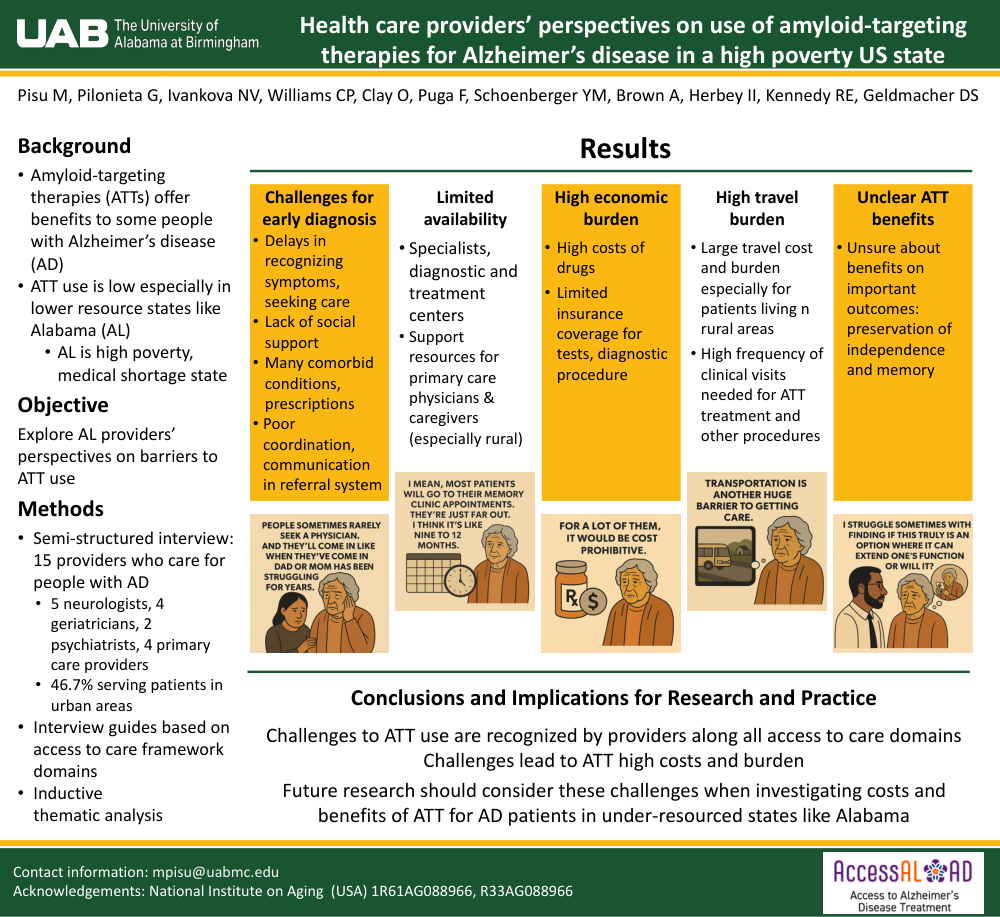
Background: New amyloid targeting therapies (ATT) show promising improvements in Alzheimer's disease (AD) outcomes, but their clinical use remains low. A better understanding of barriers to ATT utilization is needed, especially for patients in regions of widespread poverty and limited access to care. We address this knowledge gap by exploring the perspective of AD providers in Alabama, a state ranking among the 10 poorest US states and with high AD prevalence.
Methods: We conducted semi-structured interviews with 15 providers who cared for people with AD. Informed by an Access to Care framework, the interview questions focused on six domains: awareness, availability, accessibility, affordability, accommodation, and acceptability. Interviews were recorded, transcribed verbatim, verified, coded using inductive thematic analysis.
Results: Participants (N=15) included 5 neurologists, 4 geriatricians, 2 psychiatrists, and 4 primary care providers serving patients in urban (46.7%), suburban/rural (26.7%), and both urban/rural (26.7%) areas of Alabama. Emerging themes highlighted: (1) challenges in early AD diagnosis, including delays in recognizing symptoms and seeking medical care because of cultural attitudes toward care of older family members, lack of social support, many comorbid conditions and prescriptions, or poor coordination and communication in the referral system; (2) limited availability of specialists and diagnostic and treatment centers across the state, resulting in long waiting times and long travel burdens for patients and caregivers, as well as scarce support resources for primary care physicians and caregivers, especially in rural areas; (3) high costs of drugs and limited insurance coverage for tests and diagnostic procedures; (4) large travel cost and burden related to the frequency of clinical visits needed for ATT treatment and other procedures, especially for patients living in rural areas needing to travel to urban centers; and (5) unclear benefits of ATT on important outcomes such as preservation of independence and memory.
Conclusions: Alabama-based AD providers recognized many challenges to ATT utilization along several access to care domains that lead to high costs and burden. Future research should consider these challenges when investigating costs and benefits of ATT for AD patients in under-resourced states like Alabama.
Comments
Email is required but is not shown publicly.
Loading comments...