4,068 posters, 219 videos, 101 topics, 69 sessions, 14,365 authors, 6,128 institutions
ePostersLive by SciGen Technologies S.A. All rights reserved.
Alzheimer's Association International Conference 2026
July 12-15, 2026 | London, United Kingdom, and Online

6622
Participant Feedback On A Longitudinal Discrete Choice Experiment (DCE) For Older Adults With Dementia And Their Care Partners
Poster Presenter
Authors
Part of Topic
Participant Feedback On A Longitudinal Discrete Choice Experiment (DCE) For Older Adults WithDementia And Their Care Partners
Author Block:
Anne M. Turner, Astoria Ho, Jean O. Taylor.
Department of Health System and Population Health, University of Washington, Seattle, WA, USA.
Abstract:
Background:
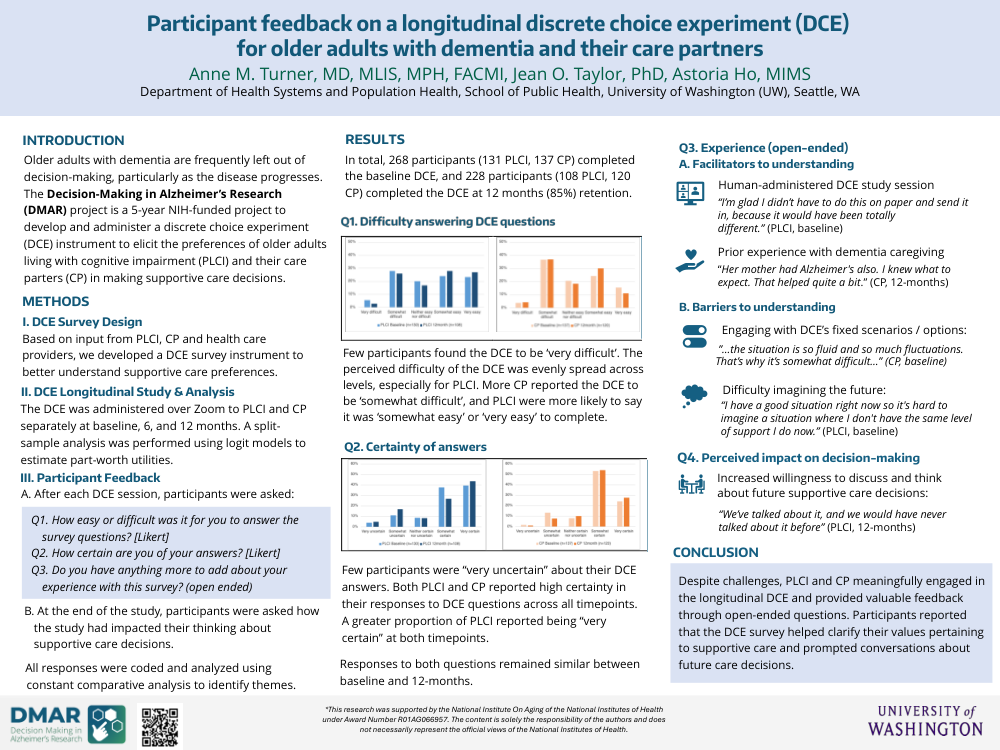
Older adults with dementia are frequently left out of decision-making, particularly as thedisease progresses. The Decision-Making in Alzheimer’s Research (DMAR) project is a 5-year NationalInstitutes of Health funded project to develop and administer a discrete choice experiment (DCE)instrument to elicit the preferences of older adults living with dementia (PLWD) and their care partners (CP)in making supportive care decisions.
Methods:
The DCE was administered over Zoom separately to PLWD and CP at baseline, 6, and 12 months[baseline: 131 dyads (PLWD/CP); 12-months: 108 dyads]. Feedback regarding the DCE instrument waselicited after each DCE survey session. At the end of the study participants were also asked whether andhow the study had impacted their thinking or discussion about supportive care decisions. All responseswere coded and analyzed using constant comparative analysis to identify themes.
Results:
Participants provided brief but valuable responses after each DCE session regarding facilitators,barriers, and areas for improvement. Analysis of responses at baseline (94 PLWD, 113 CP) and at 12-months (61 PLWD, 89 CP) revealed facilitators to understanding and engagement with the DCE. Facilitatorsincluded having a human explain and administer the DCE, prior experience with individuals with dementia,and repeated exposure to the instrument over time. Challenges with the DCE included difficulty withweighing trade-offs, issues with the presented fixed choices, and problems with imagining a future state inwhich dementia had worsened. CP provided more specific suggestions for improving the instrument thanPLWD. When asked if their involvement in the study impacted their thinking or discussions aboutsupportive care decision-making, 129 participants responded with “yes” or “I don’t know.” Many (43 PLWD,72 CG) expanded further, primarily describing increased willingness to consider a future involving theprogression of dementia, and greater dialogue within dyads regarding future choices.
Conclusion:
Despite challenges, participants meaningfully participated in the longitudinal DCE studies andprovided valuable feedback through open-ended questions. Participants reported that the DCE instrumenthelped them to clarify their values pertaining to supportive care and prompted conversations aboutpossible future care.
Comments
Email is required but is not shown publicly.
Loading comments...