4,068 posters, 219 videos, 101 topics, 69 sessions, 14,365 authors, 6,128 institutions
ePostersLive by SciGen Technologies S.A. All rights reserved.
Alzheimer's Association International Conference 2026
July 12-15, 2026 | London, United Kingdom, and Online

9766
Olfactory Dysfunction And Cognitive Impairment In Chinese Older Adults With Sensory Impairments
Poster Presenter
Authors
Affiliations
Department of Neurology and Neurological Rehabilitation, Shanghai Disabled Persons’Federation Key Laboratory of Intelligent Rehabilitation Assistive Devices and Technologies, Shanghai Yangzhi Rehabilitation Hospital (Shanghai Sunshine Rehabilitation Center), School of Medicine, Tongji University, School of Nursing, Wannan Medical University
Part of Topic
Olfactory Dysfunction And Cognitive Impairment In Chinese Older Adults With Sensory Impairments
INTRODUCTION
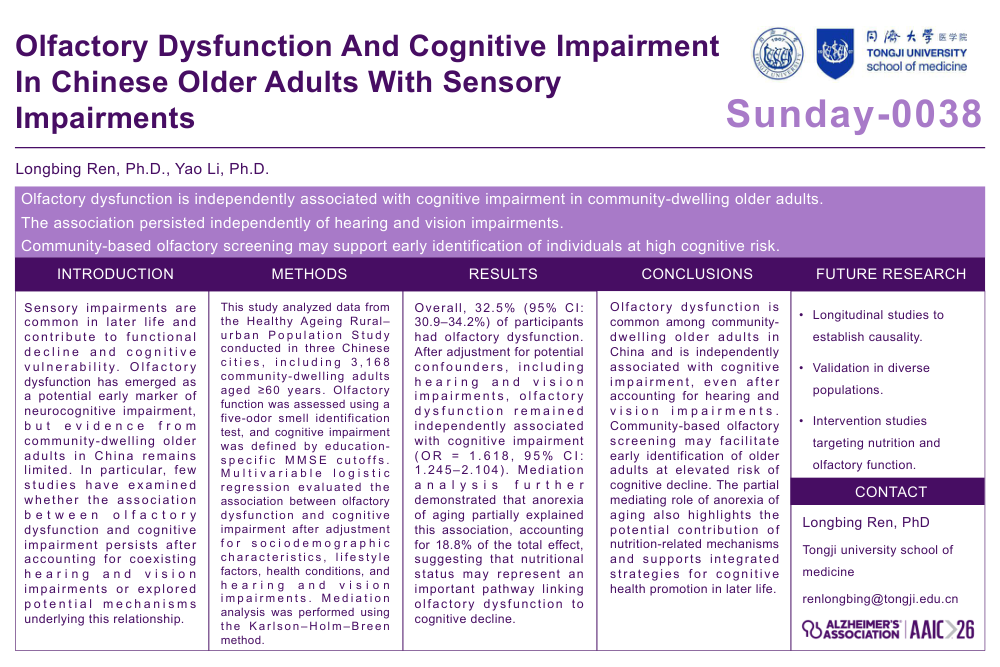
Sensory impairments are common in later life and contribute to functional decline and cognitive vulnerability. Olfactory dysfunction has emerged as a potential early marker of neurocognitive impairment, but evidence from community-dwelling older adults in China remains limited. In particular, few studies have examined whether the association between olfactory dysfunction and cognitive impairment persists after accounting for coexisting hearing and vision impairments or explored potential mechanisms underlying this relationship.
METHODS
This study analyzed data from the Healthy Ageing Rural–urban Population Study conducted in three Chinese cities, including 3,168 community-dwelling adults aged ≥60 years. Olfactory function was assessed using a five-odor smell identification test, and cognitive impairment was defined by education-specific MMSE cutoffs. Multivariable logistic regression evaluated the association between olfactory dysfunction and cognitive impairment after adjustment for sociodemographic characteristics, lifestyle factors, health conditions, and hearing and vision impairments. Mediation analysis was performed using the Karlson–Holm–Breen method.
RESULTS
Overall, 32.5% (95% CI: 30.9–34.2%) of participants had olfactory dysfunction. After adjustment for potential confounders, including hearing and vision impairments, olfactory dysfunction remained independently associated with cognitive impairment (OR = 1.618, 95% CI: 1.245–2.104). Mediation analysis further demonstrated that anorexia of aging partially explained this association, accounting for 18.8% of the total effect, suggesting that nutritional status may represent an important pathway linking olfactory dysfunction to cognitive decline.
CONCLUSIONS
Olfactory dysfunction is common among community-dwelling older adults in China and is independently associated with cognitive impairment, even after accounting for hearing and vision impairments. Community-based olfactory screening may facilitate early identification of older adults at elevated risk of cognitive decline. The partial mediating role of anorexia of aging also highlights the potential contribution of nutrition-related mechanisms and supports integrated strategies for cognitive health promotion in later life.
Comments
Email is required but is not shown publicly.
Loading comments...