4,068 posters, 219 videos, 101 topics, 69 sessions, 14,365 authors, 6,128 institutions
ePostersLive by SciGen Technologies S.A. All rights reserved.
Alzheimer's Association International Conference 2026
July 12-15, 2026 | London, United Kingdom, and Online

10241
Barriers To Accessing Dementia Pharmacotherapy In Cearα, Brazil
Poster Presenter
Authors
Affiliations
Part of Topic
Introduction
Dementia is a major public health challenge in Brazil and remains widely underdiagnosed, particularly in low- and middle-income settings. Data from the Brazilian National Dementia Research Network (ReNADe) show that many individuals with cognitive impairment never receive a formal diagnosis or disease-specific treatment, delaying management and increasing the burden on families and caregivers. Evaluating real-world access to dementia pharmacotherapy is crucial for guiding policies aimed at reducing regional disparities in healthcare.
Methods
A population-based analysis used dispensing data for acetylcholinesterase inhibitors—donepezil, rivastigmine, and galantamine—provided by SUS across all municipalities of Ceará, compared with municipality-level dementia prevalence from the 2025 Brazilian Delphi Consensus (Northeast region). Approximately 70% of individuals with dementia were assumed eligible for treatment. Exploratory analysis: private-market purchase-derived utilization proxies (Aliberti et al., 2024 sex- and age-specific prevalence applied to IBGE census data) were added to estimate combined (SUS + private) coverage scenarios and to test associations with socioeconomic/structural indicators (OLS regression).
Results
Main analysis (SUS)
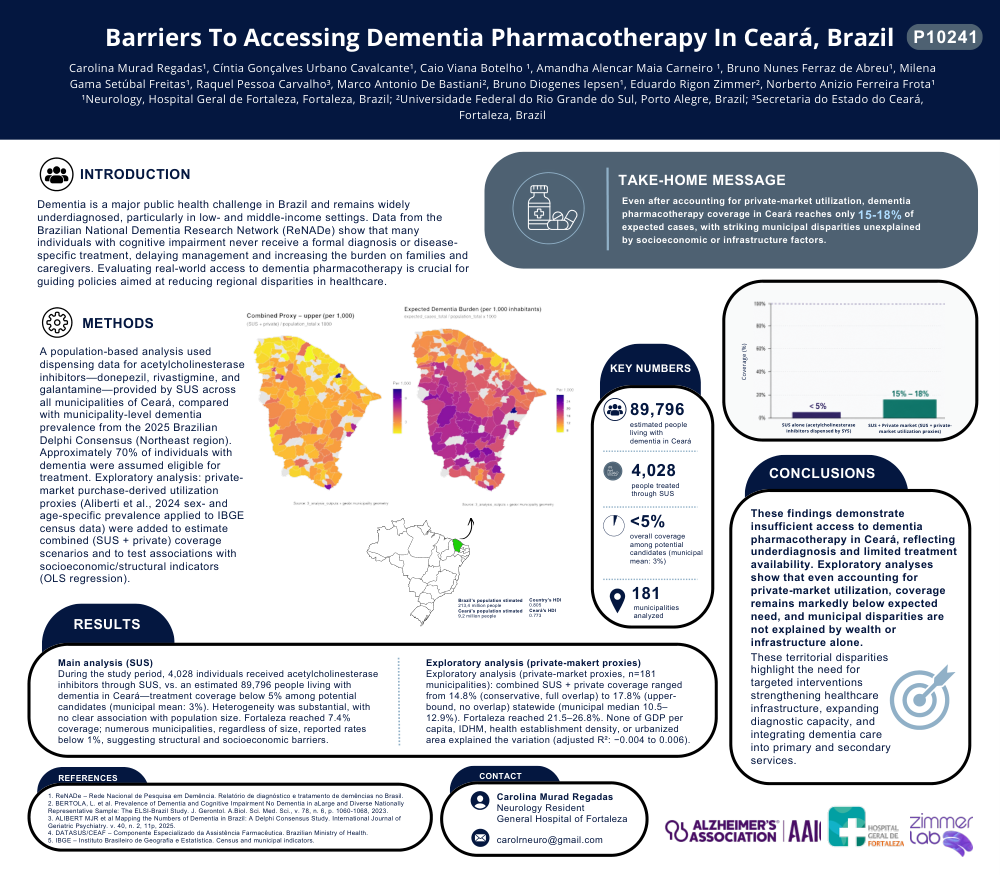
During the study period, 4,028 individuals received acetylcholinesterase inhibitors through SUS, vs. an estimated 89,796 people living with dementia in Ceará—treatment coverage below 5% among potential candidates (municipal mean: 3%). Heterogeneity was substantial, with no clear association with population size. Fortaleza reached 7.4% coverage; numerous municipalities, regardless of size, reported rates below 1%, suggesting structural and socioeconomic barriers.
Exploratory analysis (private-makert proxies)
Exploratory analysis (private-market proxies, n=181 municipalities): combined SUS + private coverage ranged from 14.8% (conservative, full overlap) to 17.8% (upper-bound, no overlap) statewide (municipal median 10.5–12.9%). Fortaleza reached 21.5–26.8%. None of GDP per capita, IDHM, health establishment density, or urbanized area explained the variation (adjusted R²: −0.004 to 0.006).
Conclusions
These findings demonstrate insufficient access to dementia pharmacotherapy in Ceará, reflecting underdiagnosis and limited treatment availability. Exploratory analyses show that even accounting for private-market utilization, coverage remains markedly below expected need, and municipal disparities are not explained by wealth or infrastructure alone.
These territorial disparities highlight the need for targeted interventions strengthening healthcare infrastructure, expanding diagnostic capacity, and integrating dementia care into primary and secondary services.
Take-home message
Even after accounting for private-market utilization, dementia pharmacotherapy coverage in Ceará reaches onlyof expected cases, with striking municipal disparities unexplained by socioeconomic or infrastructure factors.
Comments
Email is required but is not shown publicly.
Loading comments...